
A Continuation
I was sent the above items from Music Interface Technologies (hereafter MIT) with the request of our editor to evaluate their effectiveness in my system. No problem, as I love audio gear as much as the audio listening experience! I have already written a thorough review of the MIT cable technology, which can be found here on Dagogo.com, so I will focus on the “worthiness” aspect of the power cords and power conditioning components before me.
I have several simple philosophies I apply to this hobby which I call “Audiophile Laws”. I observe that there are physical and moral laws which govern our universe. To run afoul of one of them is to invite a less than beneficial outcome. From my experiences in audiophilia, I have concluded that there are also simple “laws” (although not written in stone) regarding audio which is better served to obey rather than break.
‘… a potential upgrade component is only worthy of consideration if it produces an immediate discernable effect.’
One in particular is the “Worthiness” principle, whereby a potential upgrade component is only worthy of consideration if it produces an immediate discernable effect. The change in sound the component (in some cases the word tweak would apply, however I do not consider cables and power conditioning tweaks, I consider them proper components) produces should be immediately noticeable. Certainly it should be clearly heard in less than 30 seconds. If it takes several minutes, or even hours of listening to determine if there is a change, then why are you wasting your time with the change?
One practical outcome of the Law of Worthiness is that if one does not like the sound of a component initially, it is highly unlikely that opinion will change drastically after break-in. What’s more likely to happen is that hopefulness regarding a change will set in, allowing one to put up with the less than expected performance. In the long run, the anticipated results never appear and dissatisfaction reappears. Some audiophiles have been through this cycle many times. If they would adhere to the Law of Worthiness, it would save them much angst.
‘… just because a sound strikes one as distinct doesn’t mean it will be the most pleasing alternative long term.’
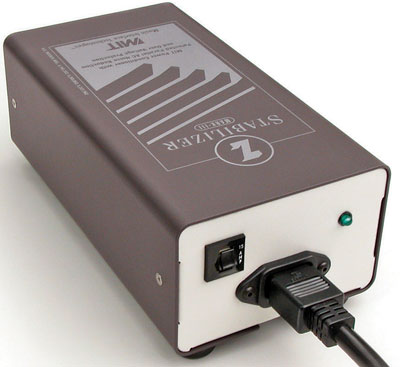
Z Stabilizer III HG
I applied that principle here in the review of the MIT power products. I found every one of them produced an instantly discernable change to the sound. I also found the degree of distinction to roughly correlate to the product gradation that MIT has set. The “HG” (hospital grade) version of the Z Stabilizer III was clearly more thorough in it’s capabilities than the standard version, the Oracle power cords patently superior to the Z Cords, etc. However, just because a sound strikes one as distinct doesn’t mean it will be the most pleasing alternative long term. That’s where living with the change for a while allows the audiophile to judge its efficacy.
In this assessment, I had a distinct advantage in having lived with MIT products for years. I used them prior to reviewing (in fact, I wanted to secretly put MIT’s claims to the test in my first review of their cables; see my prior review of their products) and continue to use them in reviewing. It was relatively easy to mentally put the improvement of each piece into perspective.
My goal was less to see how well the basic Z Cord did and instead more to focus on the conditioning product, the Z Stabilizer, and the higher-end cords of the Oracle line. I stepped the introduction of these products into my system to see what the result would be. I started with the big momma, the Oracle AC 2, direct from wall to my Rega Saturn cdp. My Pathos Classic One MkII tube hybrid integrated’s were fed direct from the wall by two MIT Shotgun AC power cords. A rig doesn’t get much simpler than this – source into attenuated monoblocks. I have yet to find a superior scheme for economical, powerful class A tube performance.
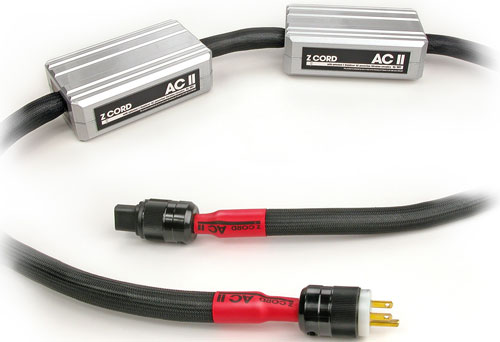
A word about the Oracle power cords: Fabulous. I think that’s the term to summarize them. Why are they so fabulous? I certainly wouldn’t think myself to call any power cord fabulous had I not been convinced of its worthiness. I placed several different branded power cords on my Saturn previously in an attempt to juice its performance. Not that the performance was shoddy; it’s one of the finest players I’ve heard in its price range. But there is always room for improvement, so on went the Oracle.

Auditioning
What can be said about the mental health of an individual who places a power cable worth $3,500.00 on a cdp worth $2,400? I’m sure you could find some clever phrases. I’ll stick with the term innovative, as I don’t prefer the word delusional! I did, however, sit back and listen to what the Oracle AC 2 has done to the sound and shake my head. I never would have thought that so much more finesse, delicacy, and emotion could be drawn out of the Saturn!
In my previous review I presented the MIT cables with their Terminator boxes as being similar to equalizers from yesteryear. Boosting the signal, yet streaming fully the magnified signal, they really do seem to swell the presentation far more than almost any other cable I’ve used, not only enlarging or expanding the soundstage, but innocuously cleaning it. An even higher expression of my mental instability was the utilization of the Oracle 2 power cord ($3,500) into a Z Stabilizer III HG ($699), from there outbound via the Oracle 1 ($1,695) to the Rega Saturn ($2,400). Right, that means I had $5,894 worth of cables on a $2,400 player! Consider that this power scheme was slightly over 60% more costly than the source.
Of course, such things don’t happen in real life. But should they? Just the other day as I perused the audiophile forums, this very question was posed in different words to the effect, “Should I spend more on cdp and less on power cord for it, or about 50/50?” Distilled down to its essence, the question asked the justification for upgraded power cords. Very few would second guess whether moving up the line in a player would yield improvement. But many secretly wonder if moving up the line in power cabling and conditioning can yield worthwhile improvement.
‘The primary lesson I learned was that in the case of MIT cables and conditioners the sky seems to be the limit.’
Should a person go to the point of spending as much on power cabling and conditioning as they have for their cdp? Or even more? While this is a question designed to stimulate thought and without a defined answer, my experience was eye opening. The primary lesson I learned was that in the case of MIT cables and conditioners the sky seems to be the limit. I found none of the MIT additions to detract from the detail or add superfluously to the experience. Every one of the additions moved me closer to the heart of whatever piece I was hearing. On vocals, I could visualize the microphone’s placement advancing toward the mouth of the singer with each piece added.
- (Page 1 of 2)
- Next page →