
To cut to the chase, inclusion of the modified Divinitive in the system significantly improved the sonics, especially with music that was recorded at louder levels. My working hypothesis is that the improvement is due to both better impedance matching, and to not throwing away any bits.
Because my switch from the old system to the new one entailed so many changes, it was not possible for me to perform any direct comparisons to the Channel D Seta phono preamplifer. As this unit has received very positive reviews elsewhere, I will provide just a brief description and some listening impressions. (Interested readers are encouraged to visit Channel D website to learn more about the Seta, and for Pure Vinyl and other Channel D products.) The Seta is a relatively small unit, measuring only 12” in width, 7” in depth, and a mere 2” in height. It is available in black or red; I chose black. It is unassuming in appearance, its cost being devoted to R&D and parts, not to bling. It has very high bandwidth — up to 5 MHz in the Model L (for Low output cartridges). It uses an internal AGM battery, which automatically recharges. On the rear of the unit are both balanced (XLR) and single-ended (RCA) inputs, as well as balanced outputs. (As mentioned above, I connected the output of the Seta to the inputs on the Lynx Hilo, to allow digitization of the audio signal, which was passed on to the Mac Mini via USB). Also on the rear is an adjustment for channel balance Trim. Resistive cartridge loading on the Seta Model L is adjusted with externally accessible rotary switches located on the back panel, and can be set to 25, 50, 100, 150, 200, 500, 1000 or 2000 ohms. Other values can be achieved by plugging in resistors to sockets provided on the circuit board. The front panel contains a number of small indicator lights, for Charge Lock, Battery Status indicator, Power indicator, Signal Present Indicator, and Gain. Gain is adjusted via a small button, which also changes the color of the indicator light. The gain settings are 43, 46, 49, and 53 dB.
Vinyl playback using the Seta and Pure Vinyl was “more analogue” sounding than were ripped CDs, though the two were not terribly dissimilar. In fact, pretty much everything I described above for the sound of the new system, is applicable to vinyl playback. The similarity is perhaps not surprising, given that both signals pass through the Lynx Hilo. However, the low noise and lack of distortion suggest that the SETA phono preamp and Pure Vinyl RIAA filters are doing what they are supposed to do. That may sound like damning with faint praise, but that is not at all my intent. Audio components are supposed to “get out of the way,” allowing the music to come through with a minimal coloration. The Channel D hardware and software do precisely that. As Martha Stewart used to say, “it’s a good thing.” It is worth pointing out that while there is a considerable variety of programs (both PC- and Mac-based) for playing back ripped CDs or downloaded music, there are very few for digitizing vinyl. Channel D Pure Vinyl was not only one of the first but to my knowledge, is the most advanced and powerful by a considerable margin. Truth be told, it has many features that I have not yet even begun to explore.
What’s Good for the One, is Good for the Many
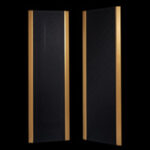
Though the impetus for my switch to the new system was the requirement for a digital crossover to use with the Sanders Sound speakers , I learned some important lessons that are applicable to all speakers. The most important lesson has to do with bass. I have a large, dedicated, well-treated listening room, with numerous bass traps. My room is capable of considerable bass but like all rooms, it suffers from room-induced bass nodes. I had previously purchased a Behringer Eq which I used in conjunction with the Behringer crossover. The Behringer Eq has the ability to generate test tones, and perform auto-correction. This clearly improved the bass in my room but as I recently learned, there was yet more benefit to be obtained. As I mentioned above in my description of the Fab Filter, it is easy to create multiple filters. We initially created a filter to correct the bass, using the setting from the Behringer Eq. During one of Rob’s visits he was kind enough to bring another of his products, Mac the Scope, with which we measured my room’s bass response. (Mac the Scope has is a very powerful program, with capabilities that extend far beyond this.) We used the measurements so obtained to create a new filter which was similar but not identical to the one based on the Behringer.
Many listeners spend small fortunes on interconnects, power cords and conditioners, etc., but ignore the largest problem: the room. This is especially true for bass, in which case the room is often the largest determinant of the sound. I am aware that for reasons of domesticity, not everyone has the luxury of using large bass traps. However, virtually everyone can use digital bass correction, provided they can get past their pre-conceived notions. I confess that until recently I too was a skeptic, believing that any sort of processing would do more harm than good. While that used to be the case, it no longer is due to the advent of computers with enormous processing power. Allow me to share a recent experience. A few weeks ago, I received for review the Sadurni Acoustics Staccato horn speaker system. http://sadurniacoustics.com/technology.html; review in progress). Jorge Sadurni flew to New Jersey to help with assembly and set-up. I had told him about my use of digital bass correction and while he was polite, he was clearly not pleased. Once the system had been set up and the subwoofer modules adjusted, he remarked that he didn’t like what the bass correction was doing. I explained that in fact I had turned off the bass correction prior to his arrival, as I wanted us to hear his speakers in an “unadulterated” fashion. I asked if he would like to hear the system with the correction turned on, and he responded in the affirmative. (As I have now learned, he is extremely open-minded.) I opened up the appropriate window in Channel D Pure Vinyl, checked the box so as turn on the bass filter, then hit “play.” Before I could say “so what do you think,” his jaw hit the floor (figuratively, not literally), and he told me that he was convinced. I insisted that we go back and forth a few times (with the filter on, it was necessary to turn up the volume of the subwoofers slightly), and this solidified his initial impression. I should add that the bass could probably be even better than we heard, as the correction filter was not optimized for these particular speakers, in their position in the room, etc.
Though I was unable to directly compare analogue vs. digital RIAA correction, one thing of which I am sure is the benefit of digitizing the signal (be it before or after the RIAA) so as to correct the bass. I now consider this not a luxury but rather, a critical part of the system. In fact, I would go so far as to say that the sonic benefits are equivalent to what one would obtain by adding many thousands of dollars to one’s equipment budget.
The ability to Eq the system is not limited to bass frequencies. Until recently I would have resisted this tooth and nail, but with the user-friendly interaction between Fab Filter and Channel D Pure Vinyl, it is both easy and fun to experiment, especially given that one can do so in real time. One can alter an existing filter or simply create a new filter; the advantage of the latter is that it can turned off when not needed, or even deleted. Being new to Eq’ing, I was surprised by how dramatic a change could be realized by simply adding as little as 1 dB boost in the 500 Hz range, or by making similar sized cut in the treble, both of which can be quite advantageous with recordings that are on the harsh side. Although I used this judiciously, it did prove to be a powerful tool. It should be emphasized that unlike swapping components, Eq’ing in this manner costs nothing (once the software has been purchased, or course), is implemented by simply clicking a few buttons or dragging a mouse, and can be turned on and off at a whim.
Final Thoughts
What began as an endeavor to replace the Behringer digital crossover for the Sanders Sound Model 10C speakers, turned into an incredible learning experience. First, I learned about some extraordinary products — Channel D Pure Vinyl, Lynx Hilo, and Fab Filer plug-in. Second, I gained some appreciation (though perhaps just the tip of the iceberg) of the incredible benefits that computers can bring to high-end audio. Modern technology has brought and continues to bring advances in many aspects of audio; some examples include non-resonant speaker cabinets; novel materials for drivers; and refinement of Class D amplifier technology (as evidenced by widely praised Merrill Audio Veritas amplifiers). Arguably however, the area that has benefitted most has been computer audio. For most of my years in the-end audio, I was a “purist.” I believed that systems had to be as simple as possible, that only SET amps could provide musical satisfaction, and that CDs were at best, a poor substitute for vinyl. As time has gone by, and as I’ve experienced new things, I’ve had to shed many pre-conceived notions, and spit out quite a bit of Kool-Aid. The use of digital processing, not just for room correction but also — heaven forbid-! — for RIAA processing, has been the latest and perhaps most significant step. Importantly, I’ve come to realize that fantastic results can be obtained by combining old and new technologies. A notable example is the incredible synergy between the Veritas amps and Sadurni Acoustics Staccatos. The greatest impediment to growth is a closed mind; enormous benefits can be gained by listening to new ideas, and by having an honest willingness to give new things a try.
I will end by expressing my extreme gratitude to Merrill Wettasinghe and Rob Robinson for their guidance, assistance, and most of all, their patience.
- ← Previous page
- (Page 4 of 4)





Hi Larry,
Steve from Los Angeles here. Like you, I own the Sanders System. Also, I setup and perform the Sanders demo in Newport Beach and Chicago. I had dinner with you and Roger in Denver a couple of years ago… Anyway, here is my point…Like most audio enthusiasts, including Roger, I am interested in having the best audio experience possible at home… That is not to say that it cannot be improved upon…However, that said, have you subjected your new crossover setup to tightly controlled, double-blind testing at the Sanders facility? Assuming the new crossover setup meets the Sander’s BQC’s, you could put this matter to rest by bringing it with you to RMAF this year and going to the Sanders facility! I will be helping at the RMAF this year and look forward to this evaluation. Since Roger only uses a PC, you may need to bring along your Mac Mini.
Best,
Stephen