There will be plenty of reviews of the Billie Amp Mk3, but none like this. In addition to using the Mk3 in a standard system configuration, I will report on using it in my Faux Mono Integrated Amp configuration, in which two stereo integrated amps are used together in a horizontally bi-amped system. Why do so? Because it makes a commendable product like the Billie Amp perform well beyond its expected parameters to reach the level of sets of components many times the price of two Mk3.
Let’s climb the stairway to Heaven, not the one sung about by the Rolling Stones, or the one dreamed about by Jacob, the son of Abraham, who slept in the desert and used a rock for a pillow (see Genesis 28:10-22). This stairway to Heaven is comprised of performance steps reaching an ethereal state of listening using the Heaven 11 Billie Amp Mk3! Should you choose to follow my lead to the end, I will lead you to a level of system performance that few others will reach, even those who have reviewed the Billie Mk3. I hope your curiosity is aroused, because this review will be atypical.
I am picking up where I left off in my first review regarding the Heaven 11 Billie Amp Mk2. This review will compare the Mk2 and Mk3, especially in my favored system configuration utilizing two integrated amps for a more powerful and involving experience.
Differences between the Mk2 and the Mk3
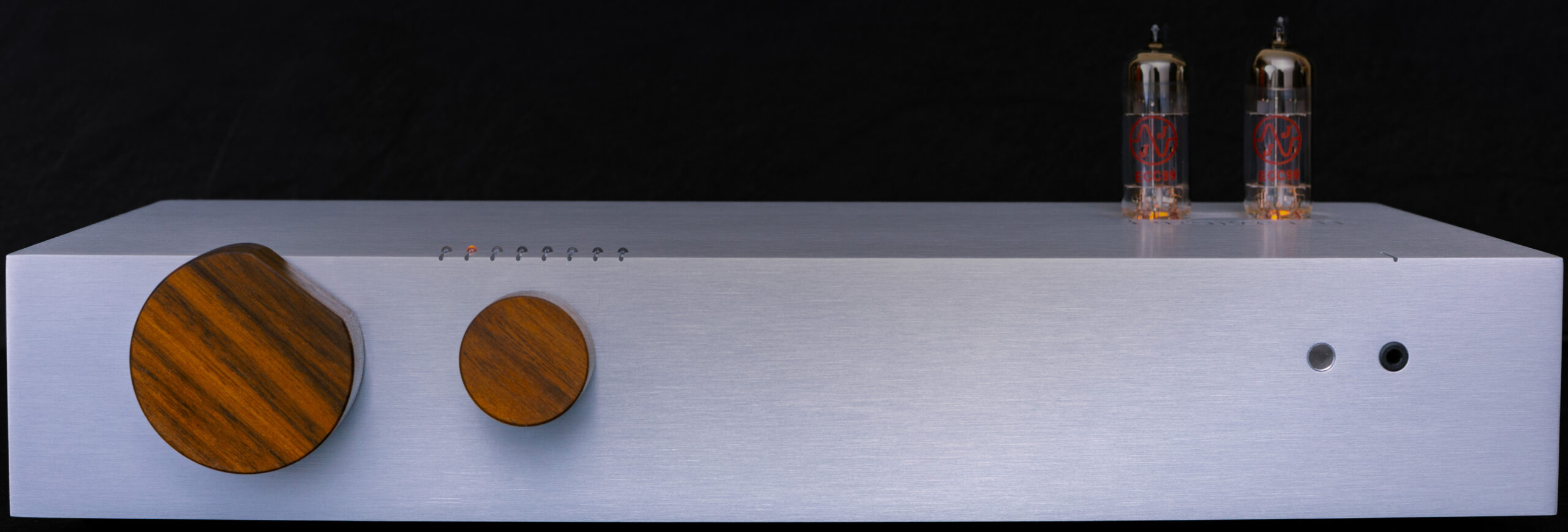
The size and weight of the Billie Mk3 have grown furtively, taking the integrated from the earlier 12 pounds and dimensions of 14.25” x 8” x 3” to a one-inch increase in length. The unit retains the smart blend of retro-modern design aesthetic with its stark black casework, LED illuminated pair of tubes, and warmly appointed front control knobs made of natural materials such as wood or stone. The price of the base Mk3 has increased by roughly 33% to $2,995. This product is one of the few unquestionably worthwhile purchases across the global HiFi landscape and I consider it a value on a par with Magnepan or Vandersteen entry level speakers.
The few visible updates are seen on the rear panel, where a USB C and a second Toslink input has been added and some of the inputs have been rearranged. I appreciate that the Pre/Sub Output jacks are highlighted. The Billie Mk3 is an especially smart choice for space constrained or budget-limited listeners. One could do a lot worse in pursuit of sound than to hook up their phone to the Mk3. The most profound changes are unseen, optional user-installed upgrades, which I will detail below.
In my review of the Mk2, I suggested that Heaven 11 upgrade the RCA input jacks, but it appears for the sake of affordability they are unchanged. The company might have to retool the chassis for such a change, so I can see why they have not done so. Still, I hope that in the future with new designs such an improvement is employed. Does that issue put me off from using the Mk2 or Mk3? Absolutely not! I have had other components with similar RCA jacks. The firmness of the connection is not confidence inspiring, but it never seems to affect the operation. Thankfully, the company is putting the money into serious speaker posts, and the ones used in the Mk2 and Mk3 are exemplary! The heavy posts inspire confidence when heavier cords with spades are cinched down. Far better the speaker posts are strong than the other way around.
As it appears a similar chassis was used for the Mk3, there is still quite close spacing of the output posts, and larger spades are closely anchored. Thus, I continue my precautionary practice of slipping a piece of leather (any non-conducting material will do) between the posts and spades to ensure that if one is loosened it does not contact the other. We know what would happen then, and I take no chances with a class D amp’s output channels shorting. The spades have never come loose previously; the posts are very good. But I am not about to chance it. It may seem odd, then, that I go about system building by splitting digital signals out from sources and horizontally wiring pairs of integrated amplifiers to speakers! While these are odd methods, I have not found them to pose serious risk to components. If they did, I wouldn’t use such methods. As usual, such activities are “do at your own risk”.

Baseline system
Pertaining to all comparisons of the Mk2 and Mk3 versions of the Billie Amp and all optional upgrades for the Mk3, the front end of the system remained as follows:
PS Audio AirLens streamer; 1m Audioquest Coffee Coax Digital Cable with DBS; TEAC CG-10M-X Master Clock Generator; 1m Silent Source RCA Interconnect acting as digital cable; TEAC VRDS-701 Dual Monaural USB/DAC CD Player/Pre-Amp/Headphone Amplifier; Amazon cheap Optical (Toslink) Y-cable; 1.5m Audioquest Vodka Optical (Toslink) Cable x 2; two Billie Amp Mk3; two pair of Iconoclast Cables Generation 2 TPC and two pair of SPTPC Speaker Cables; 3m Iconoclast Generation 2 RCA Interconnects to Perlisten D212s Subwoofers. All power cables were 2m (Iconoclast) Belden BAV Power Cables.
Comparisons of the optional Performance Headphone Module, Performance DAC Module, the ICEpower class D module of the Mk2 versus the Hypex class D module of the Mk3, and steel versus gold pin tubes were all conducted by comparison of a single unit, not the Faux Mono Integrated amp system configuration discussed below. Both Qobuz and Tidal’s upper tier music services were used, and the user interface was PS Audio’s proprietary Connect app, which worked splendidly with both music services.
Performance headphone module upgrade
I am blessed to play with 6’ tall speakers, so normally I do not get excited about headphones. When I am older and crustier, I will cease maneuvering 200+ pound speakers in favor of toting 2-pound headphones. Nevertheless, as Itai Azerod, the founder and product designer of Heaven 11, sent the optional headphone upgrade board, I felt compelled to try it. I don’t own the latest audiophile headphones, but I do have a pair of Sony MDR-NC7 noise cancelling headphones from 2018, a decidedly non-audiophile-approved set of cans, that have been stowed away in a box of ancillary equipment. They have a frequency response of “30-20,000 Hz”, no worse than many small tower speakers, so they are the ideal zero-cost product for this review. After all, is the typical Heaven 11 customer going to lay down a couple thousand dollars for a headphone? More likely, a headphone user with this integrated amp will have reasonably priced ones. Thus, the Sony headset represents two things, budget audiophiles’ high aspirations and limited budgets, and proof that one does not need all elements of an audio system optimized to hear upgrades.
It is a distinct advantage in reviewing to have two configurable devices side by side. It only took a few minutes to unscrew the footers, lift the lid, swap the board, and close the unit. Kudos for Heaven 11 trusting in the basic competence of the audiophile community and not charging for return (or round trip) shipping and bench time for upgrades. A set of identical components, one with upgrades, offers close to real-time comparisons and chases away any uncertainty whether the upgrades are efficacious; operationally switching between the two units during playback took me about 15 seconds.
As the two Mk3 units were connected identically, the headphone comparison was the quickest I have done. Starting with the music playing through both units, I kept the volume down on them both to silence the mains and subwoofers, plugged the headset into one of the units, and brought up the volume. To switch, I lowered the volume, plugged the headphones into the other unit with the upgrade Performance Headphone Module ($150), and brought up its volume.
Impressions of the Performance Headphone Module while listening to Kirk Whalum’s “In This Life” and Nothing but Thieves’ “Welcome to the DCC (Dead Club City)”.
- You’ve got to be kidding me! THAT MUCH difference?
- Makes my fit for airplane travel headphones sound like they were upgraded to
$1K cans!
- The obvious improvement is a sizable increase in output, which results in better
sound across the board. The output is so much higher that I must turn down
the volume substantially, yet lyrics are clearer and the music more impactful.
- Verily, the entire suite of parameters of sound quality were improved, which
means the Performance Headphone Module is a most efficacious mod.
- For budget headphone listeners, this is the one upgrade you must make.
- The best part is that if you failed by not purchasing the Performance Headphone module, you can still do so.
- (Page 1 of 3)
- Next page →