Billie Spartan
How does the Billie Amp Mk3 sound?
How does the Billie Mk3 sound? In a word, luscious! Think of a piece of fruit that you had eaten, one that you still recall because it was so sweet and juicy with just the right amount of tartness and sugary taste. Through the years, my enjoyment of eating pears has soared, and sometimes when I bite into them there is so much juice in the pulp that a trickle of it runs down my face before I have fully closed my mouth! That is a treat literally bursting with succulence!
The Mk3 is a treat for the ears and is bursting with sweet, juicy performance. Listening impressions of the same five tracks which were used in the headphone module comparison were highly favorable to the Mk3 and the Hypex class D module. I rather enjoyed every aspect of the switch to the Hypex module. I have been listening to Dave Koz’s saxophone on his recordings for over 30 years, and never have I felt so moved, so emotionally close to his music as when using the Mk3. I especially enjoyed “Faces of the Heart” as heard through the Kingsound King III electrostatic speakers. The music is slow, meant to have a grandeur, and with this pairing of integrated amplifier and speakers Koz’s instrument reminded me of the powerful, warm voice of Gregory Porter.
Another vocal performance that stood out was “Let It Die” by The Amalgamates on Voices Only 2010 College A Capella (Disc 2). Some songs are meant to showcase a vocalist’s ability to transform their voice from supple to prickly, such as Paula Cole’s “Where Have All the Cowboys Gone?” Throughout the song, as she sings about a relationship that has gone bitter, her intonation and diction become harsher until she is mocking her husband who has become a bum. Similarly, the song “Let It Die” is about a man who is angry over his lover’s letting the relationship die. As he repeats the question, “Why’d you have to let it die,” in reference to the relationship, he transforms from choir boy to rock singer. The piece ends with the rest of the group dropping out for his solo last phrase, “… let it die.” He is shouting it with a raspy, caustic edge. The Hypex Mk3 Billie Amp was better at capturing the vocal transition than the Mk2.
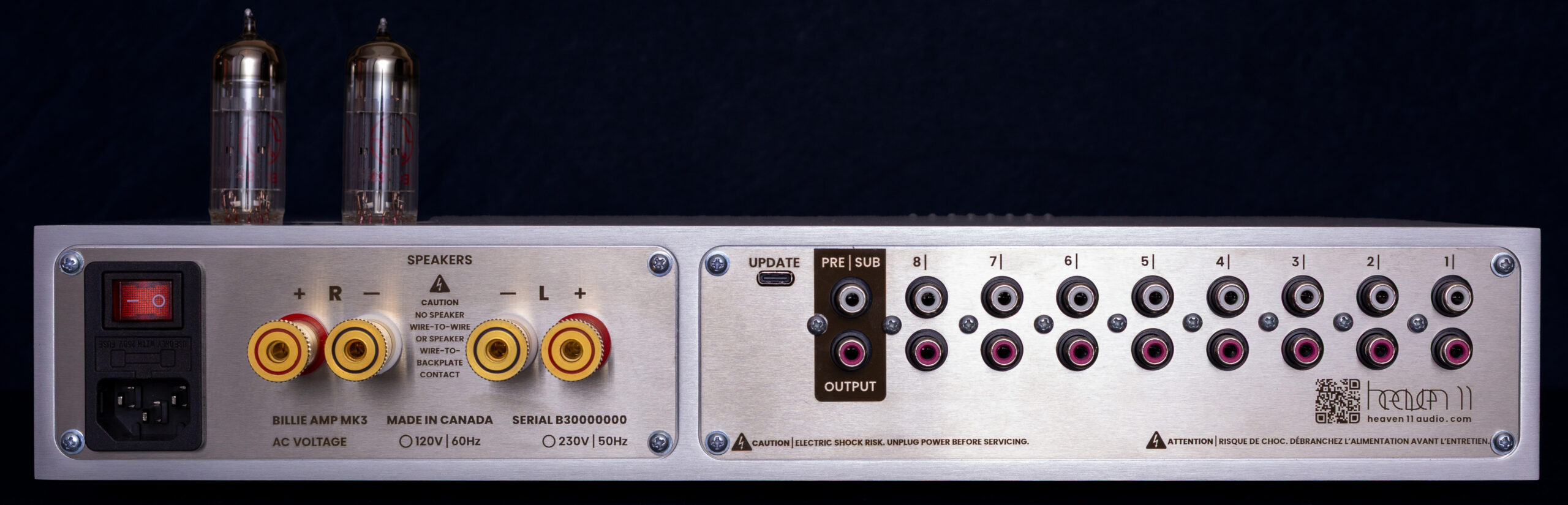
The Preamp/Sub Out of the Mk3 is set high and I had to turn down the Perlisten D212s Subwoofers from -2dB to -11dB to mesh with various main speakers. The quality of the bass was excellent and had as much texture and fullness as the rest of the frequency spectrum. The song “Dead Club City” by Nothing but Thieves is about a sterile future where people are zombified by technology. After several measures of introductory vocal and instrumental lead in, the drums and synths hit hard. There are two versions of this piece on Tidal, and the one with the black album cover is muted and less clean. The one with the red album cover is tighter, cleaner. The difference in these recordings was clear as night and day. It’s thrilling to hear LF and bass with impact and precision. The Mk3 was exemplary in driving big speakers like the Legacy Audio Whisper DSW Clarity Edition to epic performance. Imagine the experience of hearing eight 15” woofers and four powered 12” subwoofers slamming out such a song with laser-like precision. It’s tremendous fun!
The advantage of swappable parts
I have done a fair bit of work with products that allow the user to swap parts. I wrote a few articles pertaining to components which allow rolling upgraded opamps, and I have written several reviews of PureAudioProject speakers, which have user-friendly crossover boards that allow for swapping capacitors and resistors. I have done both and recommend them both as efficacious.
Heaven 11 has taken the idea one step further by allowing the entire component to be reconfigured by swapping, or upgrading, the amplifier module, the DAC, and headphone amp! The listener who craves variety will immediately see the benefit in a product that allows chameleon-like changes to accommodate a wider palate of performances. The benefit is compounded when the owner has more than one pair of speakers. I have found precious few affordable products that mate superbly with all speakers while not requiring reconfiguration of the system with component and cable changes to achieve optimum sound quality. With an integrated amp like the Mk3, the owner has several chances to hit the jackpot in terms of achieving their ideal performance.
If the Hypex version of the M3 is a bit off for one’s taste in terms of color or resolution (after months of use, I cannot fathom someone reaching that conclusion, but audiophilia involves a wide spectrum of listeners), it can be addressed with substitute parts of comparable quality. Kudos to Heaven 11 for such foresight in design. Also, the JJ ECC99 tubes can be swapped for Electro Harmonix’s 12BH7, said to confer a darker sonic signature with more roll-off, which, according to Heaven 11, “may be favorable in brighter systems and environments.” I did not compare those tubes; however, I have used both the steel pin ECC99 and the gold pin version of the ECC99, and I strongly prefer the gold pin tube for a more erudite performance. Though one might not realize it unless the tubes were compared directly, the gold pin tubes warm and soften the presentation a smidgen in a Goldilocks fashion. This is yet another example of a fortuitous upgrade offered by Heaven 11. The three upgrades, headphone, DAC, and tubes, bring the total cost of the Mk3 to $3,785, about 25% more than the stock unit. Buy them all. When you have an opportunity to supersize an affordable performance outlier, it’s a no brainer. It will give phenomenal flexibility in system building such that nearly any combination of genres of sources and speakers can be accommodated to the great satisfaction of the owner.
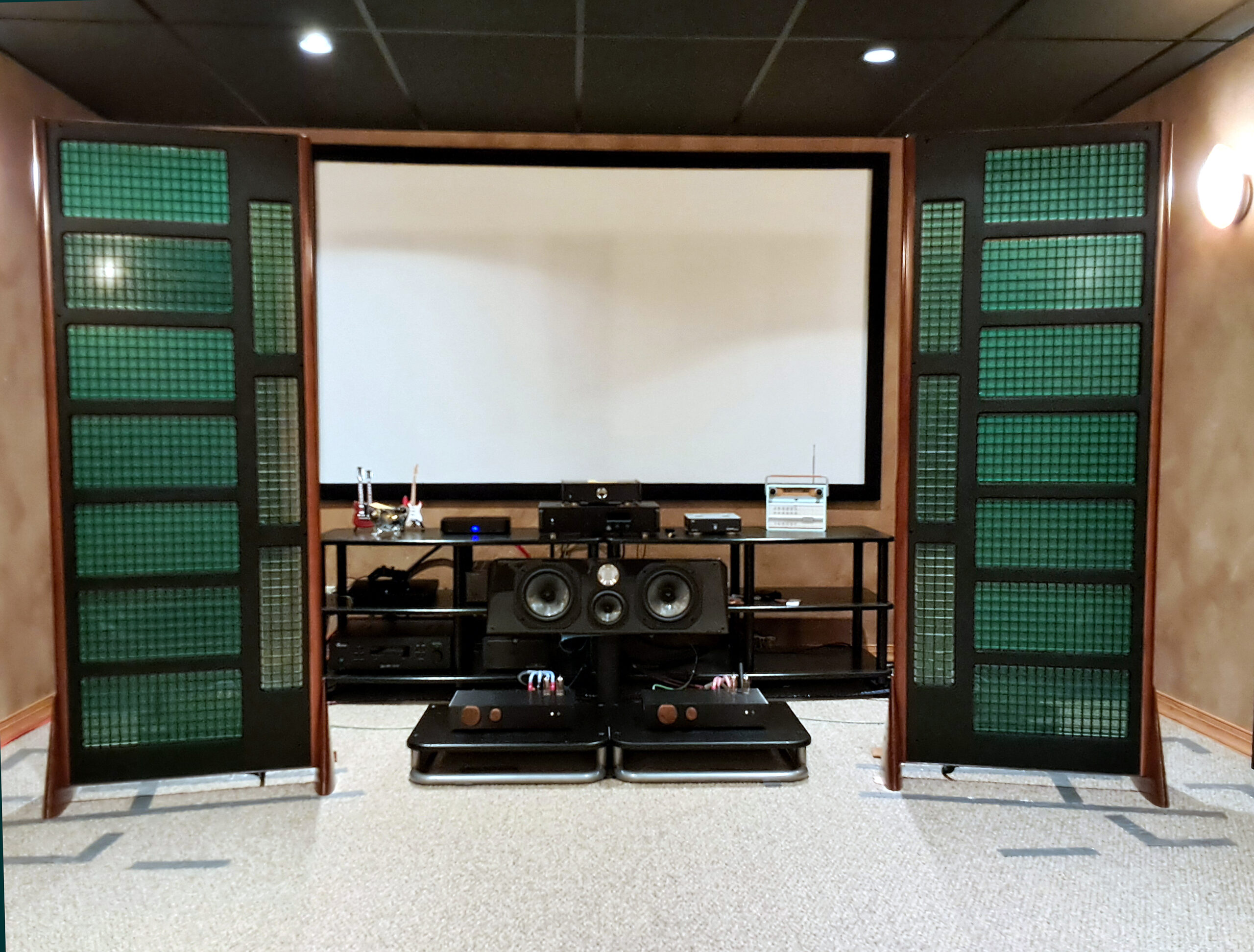
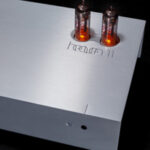
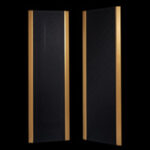
Heaven 11 Billie Amp Mk3 in Faux Mono Integrated Configuration with Kingsound King III electrostatic panels
The steps we have taken
I have been leading you to see that from the Mk2, there are clear steps of highly efficacious performance improvements for a reasonable amount of money when one considers the spectrum of performance-to-cost in high end audio. Step one is the decision to upgrade from the Mk2 or initiating ownership of a Mk3. Step two is buying the Classic versus the Spartan. Step three is buying the gold pin tubes. Step four is buying the Performance Headphone Module. Step five is buying the Performance DAC Module.
What about cables? I have no comment on the Crescendo Cables offered by Heaven 11 because I have not used them. The cables I am currently using are Iconoclast Cables, a full loom of them. The Iconoclast products have been superb with the single and twinned Billie Mk2 and Billie Mk3 across a variety of speakers. I have heard the Mk2 and the Mk3 with the following speakers in my possession:
+ Kingsound King III electrostatic speakers
+ Legacy Audio Whisper DSW Clarity Edition (hybrid array)
+ Colibri C2 Loudspeaker (horn hybrid)
+ PureAudioProject Trio15 10” Coaxial (hybrid coaxial)
+ Wharfedale Opus 2-M2 Bookshelf Speakers (dynamic)
Heaven 11’s integrated amps have performed in exemplary fashion across a wide variety of speaker genres. Few products do so with such aplomb. It is testimony to the excellent parts selection, topology, and build of the Mk2, and now, the Mk3.
Faux mono integrated amplifier configuration elevated
Ready for the big step? At the time of the review of the Mk2, I was conducting my first experiments with using two integrated amplifiers with the topology preamp/DAC/class D output wired in a horizontal bi-amp configuration, which I call Faux Mono Integrated configuration. There are several wonderful advancements to the sound as a result, and the coup de grace feature of this arrangement is thorough tonal control over the speakers’ performance by slight adjustments of one unit’s volume control! It is a benefit that eludes nearly all HiFi systems, even those breaching the $100K mark!
I first wrote about it in the PS Audio Stellar Strata Mk2 review, however the first product to get the treatment was the Billie Mk2. That review was completed and the exploration was ongoing, so I elected to not mention it in that review. This article has allowed me to revisit that splendid moment when I was transported to the 11th Heaven when the two diminutive integrated amps from the get-go outperformed all the quite expensive, quite involved systems of separates that I had built over the years. Yes, two little integrated amps with a total MSRP of $4K outperformed all the systems configured traditionally with dedicated components costing anywhere from $5K to 25K apiece! Perhaps that will get your attention as I discuss this system configuration!
How is the Faux Mono Integrated Amplifier system accomplished? Using a digital source, I split the output using an appropriate Y-cable, either RCA or XLR (in this instance, the Mk3 can only accommodate an RCA input). That allows for twinning the signal to be sent to two units. For this review, Audioquest Cable graciously supplied me with two pair of Optical cables to compare the Mk3’s Optical inputs to the RCA (single ended) inputs. I was sent a 1m pair of Cinnamon Optical (Toslink) and a pair of Vodka Optical (Toslink) cables. My uber high-end Y-cable was a cheap no name Toslink product from Amazon. The introduction of the optical cable versus RCA dropped a great deal of previously unrecognized background noise. The signal tightened, even with the affordable Cinnamon Optical. Copious amounts of minute details in the music presented themselves. Vocals and instruments bloomed, not only in terms of resolution but in timbral color, too.
I do not understand how different materials of optical cables and different strand counts affects the light and consequently the sound but noticed on Audioquest’s site that the Cinnamon Optical is made with “1.25% Silver Conductors”, while the upper end Vodka Optical cable is made with “10% Silver Conductors”. How they put silver into a fiber optic cable, I do not know. Why silver in the cable influences the light such that it makes the sound better, I do not know. It had been a few years since I tried an optical connection, and things have changed! Years ago, I tried optical connections with the SONORE Micro Rendu and the Small Green Computer, which were tethered together with a much fancier optical cable that separated L/R channels. The performance of the Faux Mono Integrated amplifier system with the Audioquest Optical (Toslink) cables, though not a direct comparison, I consider notably superior.
The tricky part in accomplishing the Faux Mono Integrated configuration is the speaker cable wiring. One unit is dedicated solely to bass, and the other solely to mid/treble. Thus, one Mk3 is wired to the L/R bass speakers’ posts only and the other to the L/R mid/treble speakers’ posts only. That is by necessity, because they are stereo integrated amps, and if you wire them up vertically, one for each speaker, the channels are confounded. By dedicating the speaker cables for one unit to bass only and the other unit to mid/treble only, proper channel separation is preserved.
I could write a lot more about this, and I have done so in my upcoming book The Audiophile Laws. Finishing with the cables, if an active subwoofer is used, the respective RCA line level output from the Billie Mk3 is sent to the subwoofer, i.e., Left Pre/Sub Out from the left Mk3 unit is sent to the left subwoofer, and the Right Pre/Sub Out from the right Mk3 unit is sent to the right subwoofer.
This setup is apparently superior. The simplicity of the Faux Mono Integrated Amplifier setup and the optical cables yielded the best sound I achieved with the Heaven 11 Mk3. I strongly suggest those who have a Heaven 11 Billie Amp Mk3 to check into the Audioquest Optical cables. As with the other upgrades that Heaven 11 offers, the price difference between the Cinnamon and Vodka versions of Optical cables is not great, so go for the Vodka Optical. It is nearly as efficacious an upgrade as the Performance DAC Module!
The big deal with the twin integrated amplifiers is the capacity to control tonality of the system without penalty (and I have not mentioned the option of loading one unit with the steel pin tubes and the other with the gold pin tubes to explore outcomes). If at any moment the tonal palate is not to my liking, with a quick flick of a finger, I adjust one unit and the music snaps into proper tonal order. I have become so accustomed to this nearly omnipotent musical power that I struggle to find reason to build traditional systems wherein one is trapped tonally. Finally, don’t think for a second that resolution and dynamics are sacrificed. They are superior to not only a single Mk3, but to the bulk of big gun systems comprised of separates I have built over my 18 years of reviewing. Perhaps I have made my point clearly?
Six steps to perfection
I nearly lost count of all the steps required to reach audio bliss! Ah, but they are such easy steps! Even the hardest step, that of pulling out the credit card, is relatively painless compared to the broad-shouldered components that chew through a budget for what? Not any better performance. Does anyone dare to take the largest step, the leap of faith, and use a pair of Billie Amps in the Faux Mono Integrated configuration? It would be nice to have some company up here in Audiophile Heaven. But even if you do not take that last step, the 5th step is a pretty nice place to be.
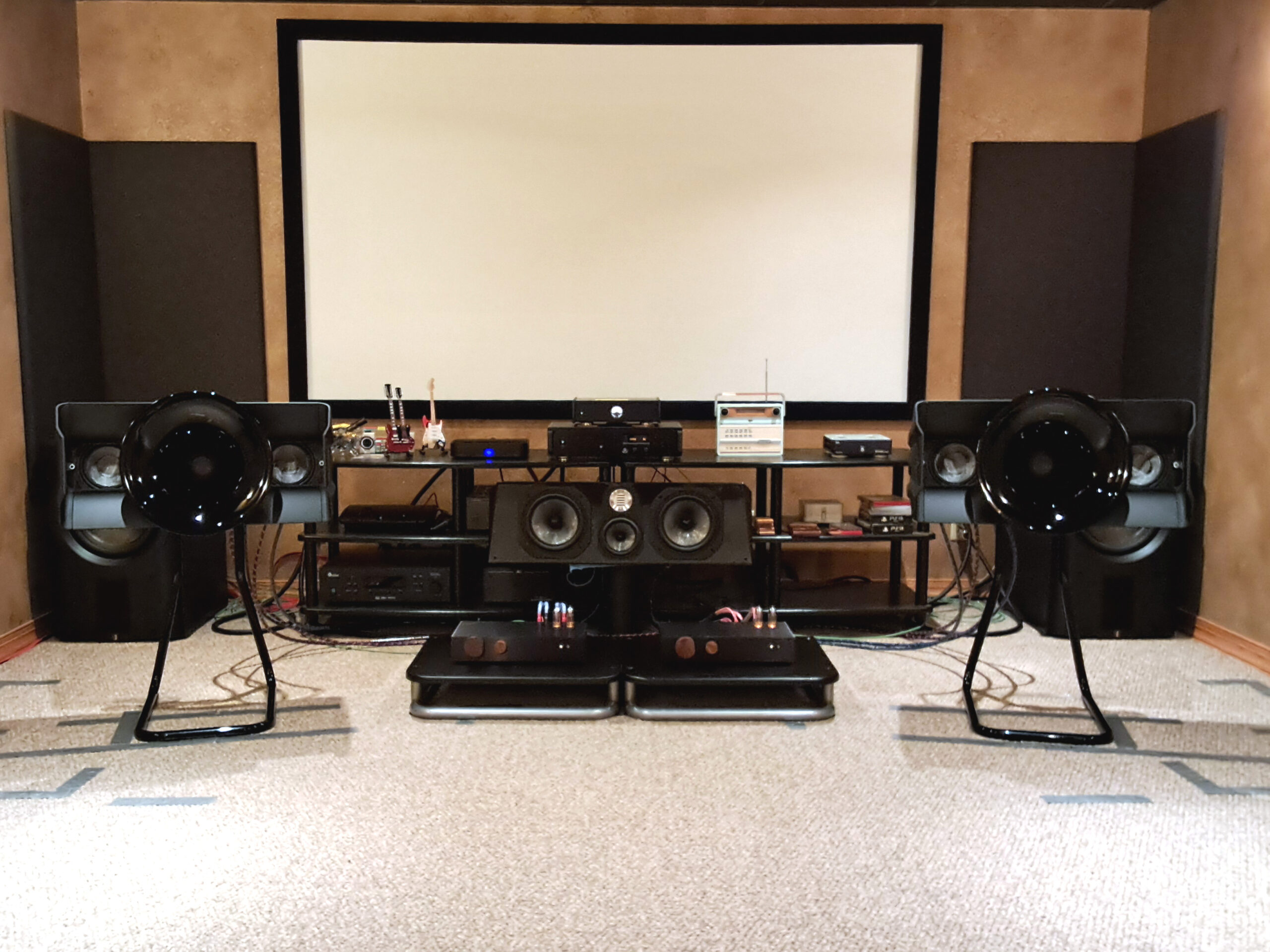
Heaven 11 Billie Amp Mk3 in the Faux Mono Integrated Configuration with Colibri C2 Loudspeakers with Perlisten D212s Subwoofers
Associated Components:
Digital Sources: Bricasti M5 Network Player, PS Audio AirLens, TEAC VRDS-701 Dual Monaural USB/DAC CD Player/Pre-Amp/Headphone Amplifier and TEAC CG-10M-X Master Clock Generator
Streaming Music Service: Tidal premium; Qobuz
Interface: ROON; Audrivana
DAC: (Placeholder) Eastern Electric Minimax with discrete opamps rolled in
Preamp: (Placeholder) Cambrige Audio Azur 840E
Amps: Legacy Audio i.V4 Ultra
Integrated: Heaven 11 Billie Amp Mk2 (two units used in horizontal bi-amp configuration); PS Audio Stellar Strata Mk2 (two units used in horizontal bi-amp configuration)
Speakers: Legacy Audio DSW Clarity Edition; Kings Audio King III electrostatic speakers; Pure Audio Project Trio15 10” Coaxial version; Kings Audio King Tower omnidirectional; Aspen Acoustics Grand Aspen; Wharfedale Opus 2-M2 Monitors
Subwoofers: Perlisten D212s Subwoofers
IC’s: Iconoclast RCA and XLR Generation 2 with Ultra-Pure Ohno Continuous Cast Copper conductors
Speaker Cables: Iconoclast Series 2 TPC Speaker Cable; Iconoclast Series 2 SPTPC Speaker Cable
Digital Cables: AudioQuest Digital Coaxial Carbon 1.5m; AudioQuest Digital Coaxial Coffee 1.5m; Iconoclast RCA or XLR 2m Interconnect used as digital link; Audioquest
USB: AudioQuest Cinnamon USB 1.5m; Audioquest Coffee USB 1.5m; Clarity Cable Supernatural 1m
Power Cables: Iconoclast BAV Power Cord; Clarity Cable Vortex; Snake River Audio Signature Series
Power Conditioning: Wireworld Matrix Power Cord Extender; Tice Audio Solo
- ← Previous page
- (Page 3 of 3)