
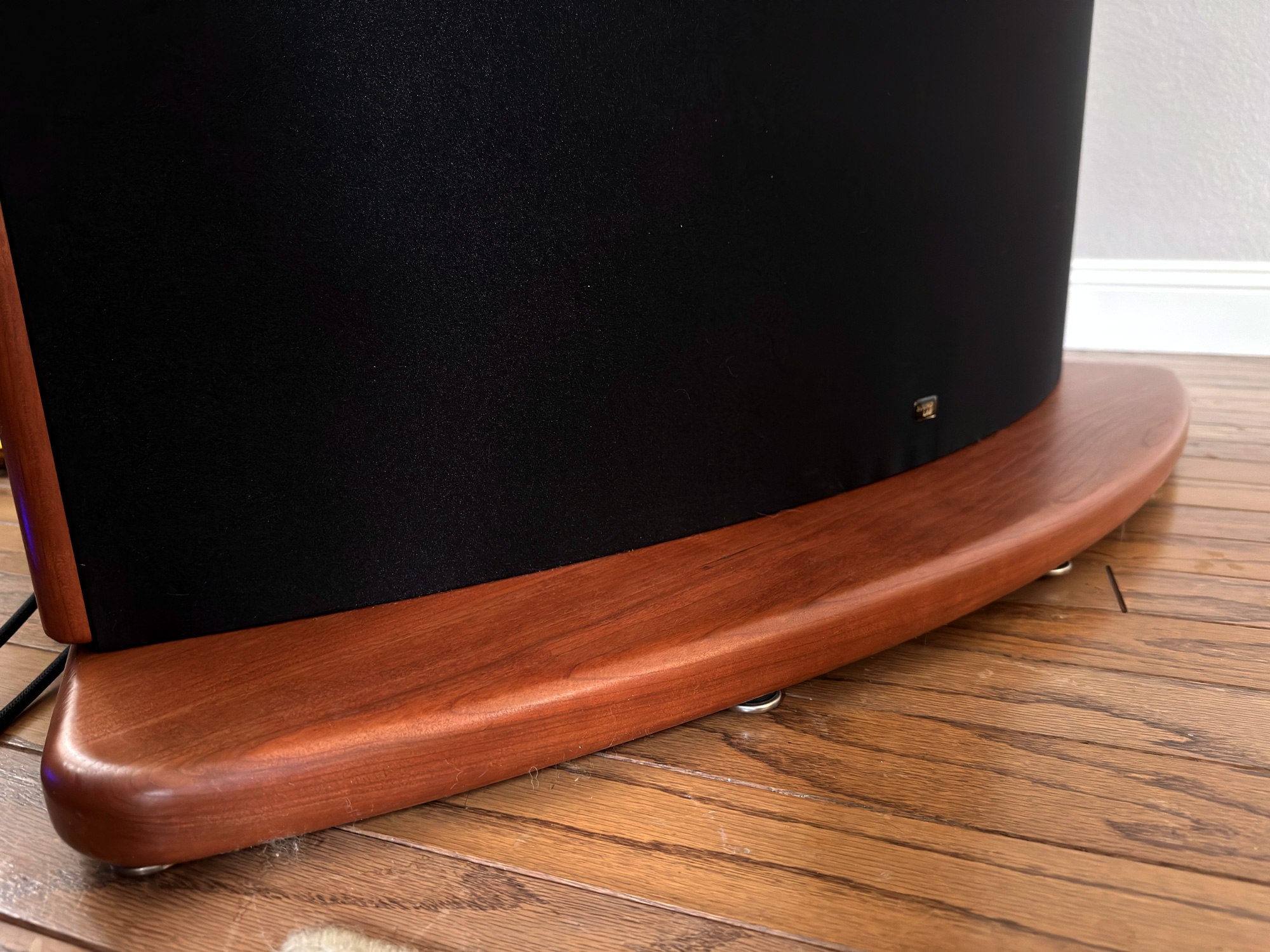
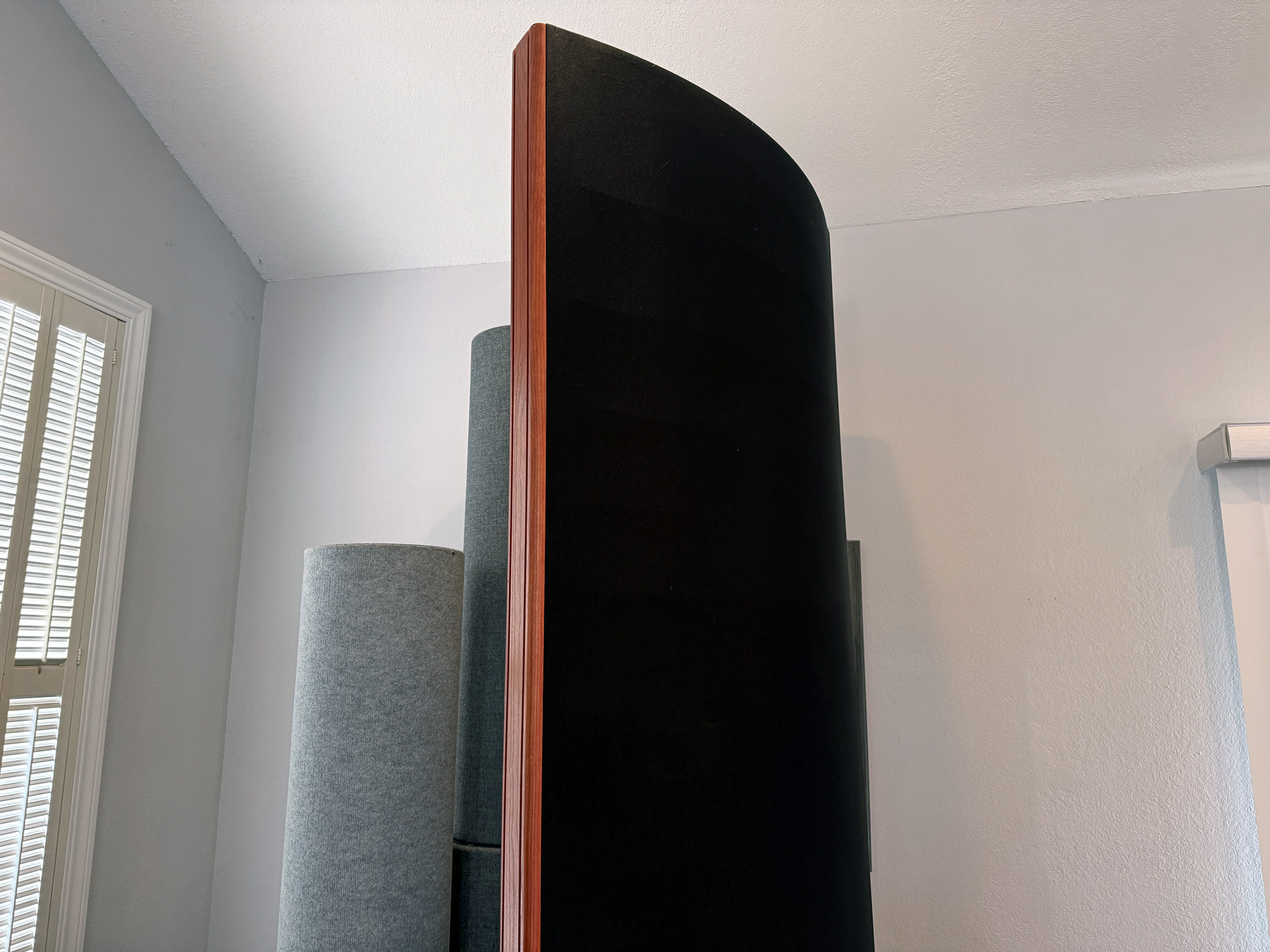
The primary characteristic of Sound Lab technology is its unique horizontal and vertical dispersions, ensuring that the listener is always on-axis whether standing or sitting. The curved panels perform optimally when toed-in completely rather than directed straight ahead. In contrast, the inherent horizontal and vertical dispersion characteristics of dynamic speakers restricts one’s listening position to be at the same height as the tweeter, if one were to experience the reproduced sound accurately and completely; that is, on-axis. Final positioning of the panels placed them 11 feet and 8 inches apart measured at the center of each panel, and 13 feet away from the listening position.
The formation of dynamics and scale by the 945 was of such immensity that it was no idle talk of Dr. West when he described the capabilities of the panels on his website that, “it can capture sounds as delicate as a rain drop in life-like clarity…”
In playing the 1986 Deutsche Grammophon digital recording LP of the Karajan Beethoven Missa Solemnis, the separation of instrument groups, the massive chorus and the lead vocalists are supremely portrayed. The earlier, seventies analog recording of this work by the same musicians would prevail with the less definitive dynamics and extensions of dynamic speakers, but the Sound Lab is where the more demanding recordings prosper, and when the digital recording enters into the ending of the “Credo” and proceeds to the ”Sanctus”, the melding of the four vocalists under the Karajan musicianship is sheer magic, complimented sequentially by some of the most serene violin solo amidst the entire orchestra and chorus. The Sound Lab panels are colossal doorways within which a powerful and surrealistic sonic presence emerges.
The CD edition attained a lesser degree of liquidity of the field-coil cartridge and uber sensibilities of the Pass Labs phono preamp, but the level of ambience and scale projection, detail rendition and timbre cohesion through the sheer 3,125 square inches of radiating surface of Sound Lab rivaled the real thing, a feat of the most dynamically expeditious and nimble.
It literally takes the largest Sound Lab to create and sustain the most delicate balance, realizing the meticulous work of the recording engineering team. But the M945PX is also a tonality god. Accompanying the articulate recreation of performance venues of concert halls and jazz clubs is a deluge of reverberating musical notes from instruments large and small. Modern jazz recordings such as the 2017 Venus SACD reissue of the Eddie Higgins Trio 2001 album Bewitched, caresses the listener’s face in an intimate and immersive performance of pulsating ripples of tones and textures via the nine feet tall colossus duo. The panels’ handling of tonality is the most exquisite and nuanced. No horns or dynamic drivers behave like the vast electrostatic panels, and jazz sounds its most dynamic and tonal through the charged membrane.
Many audiophiles imagine the sound of a large Sound Lab, like the 945, in terms of the point-source dispersion patterns of one-inch tweeters, and excursion capabilities of eighteen-inch woofers. The Sound Lab M945PX panel reveals a point of coalescence at half height where upper bass to top-end seem to originate concentrically, acutely resembling a concert stage, whether it is of a symphony hall or rock concert. It conjures up a Tannoy 15-inch dual-concentric at work but with even superior definitions, transients and scale, and is especially impressive when a wide range of instruments are played through it. There is no experience of any other speaker type that will prepare you for the Sound Lab sound. But the most impressive feat of the vast canvas arguably is when a solo instrument is funneled through the panel. This is the moment when the recording process is often at its most minimalistic and all the prowess of a recording studio powerhouse is focused on capturing one instrument, and the colossal M945PX stands tall and becomes the ultimate conduit. Of particular merit is the reproduction of a solo flute through the panels, when volume is set to match the instrument scale discreetly, at which point the panels become virtual reality projectors and you promise you will pay attention to the instrument next time you’re in concert because you never knew the true beauty of a flute until you heard it through the Sound Lab in your own home.
The M945PX is the very antithesis of the conventional colossal speakers, as it maintains finer grains of instrumental texturing and dynamic contrasting even at gentler listening volumes, a presentation otherwise obscured by inefficient dynamic speakers with multiple drivers. The 90 dB sensitivity of the panels at 8 ohms means the entire membrane of a panel is at once producing sound more discernible and defined than any dynamic speaker. In addition, the panel’s efficiency facilitates use of amplifications of lower power, a prime example being the $599, 85 wpc Onkyo A-9555 class D integrated amplifier circa 2017 that induced the panels to producing delicate and sweet instrument textures. The M945PX is not the Sound Lab of old from the eighties in which impedance varied wildly, testing the limits of amplifiers.
Back when I was reviewing the M645PX, I had tremendous fun with it. For not only does it fit better in more compact living spaces, and it can still inundate a sizeable listening area such as mine when called for, it costs half of the 945. Most importantly, the same amplifier power that drives the 645 to fruition is perfectly sufficient to drive the 945, the larger panel sounding fuller and louder because of the increased radiating surface. Speaking for myself, remembering how much power I employed in driving inefficient bookshelf speakers such as the Celestion SL700 in the nineties, I keep the Pass Labs XA200.8 and Bricasti Design M28 behemoths nearby, the Pass Labs for their pure class A muscle and the Bricasti Design for their class A/AB finesse. The 645 sounded progressively finer and more realistic which every upgrade in amplification power delivery.
Thus, the re-emerging theme of the 645 was always the extent to which I could push the panels; but the narrative changed with the 945 when the gargantuan panels literally billowed out every conceivable recreated sound with ease even with just 100 watts. The sheer radiating surface area operating at 8 ohms rendered the point of ultra powerful amplifications moot in my listening space; a space twice larger might be able to take fuller advantage of the total volume capacity of the panels.
Again, per Dr. West, “The spatial volume of a huge room tends to reduce bass intensity since bass fills the volume of the room but the mids and highs remain concentrated. A smaller room volume confines the bass energy to essentially the same space as the mids and highs and thereby the balance is more optimum.”
In this regard, a pair of the 645 already surpasses any cone speakers that I’ve heard in the bottom-end transient, timbre accuracy, and a superbly high-resolution bottom-end, not the larger-than-life bottom-end force of others. Retrospectively, the overtones of bass notes produced by cone woofers are accurately experienced only if the drivers are aligned on-axis with the listening position. Dynamic speakers, except those with bass columns or dual-concentric designs with centers three feet off the floor, cannot achieve this alignment. Herein lies the distinction of whether a speaker is designed to produce a bottom-end for the senses or sensibilities.
My auditioning of the Sound Lab signifies an end of a long search for the transducer of the most natural and superlative order.
My lifelong dream of encountering the smallest transducer capable of the most lifelike reproduction of sound notwithstanding, it still takes a single membrane as vast as that of the 945 to satiate my quest. The M945 is the M645 effect times two, its tonal density expanded to such degree as to require the cleanest- and clearest-sounding amplifications for the most delicate and sweeping reproduction of the classical solo piano and acoustic instruments alike with the attendant acoustics. And the smaller panel is already superior to multitude of cones.
I enjoy auditioning new products, although the novelty of them fades more and more quickly. The Sound Lab is among the few products that amazes me consistently, even after owning the pair for two years come this April.
The M945 exposes performance weaknesses in otherwise constantly worshipped source materials and amplification components via the sheer, unprecedented level of information and all its complexities as produced by its ultra sized canvas. Where even enormous conventional box speakers with their more limited presentation physiques had to live with their fundamental limitations, the M945 reveals all parameters and the way lesser components upstream are suppressing them. The audio hobby can often be very unrewarding if just one element of the system is out of place; the Sound Lab is the most rewarding and consistently engaging element in the entirety of my sound system.
The reviews have largely accorded me the experience I need to make a more informed opinion on the virtues and fallacies of each speaker type except for the Acapella Audio Arts Triolon Excalibur horn system due to its rather prohibitive cost, making the availability of it on the U.S. importer’s part for me to audition it, as well as my owning it outright equally difficult. Woe. Especially considering the Acapella horn and plasma tweeter technology, along with the Destination Vista horn design, the Tannoy 15-inch dual-concentric and the large Sound Lab electrostatic panels constitute the four speaker types superior to most everything else to my ears.
At $60,000 the pair, the Majestic 945PX, therefore, sets the highest bar in value-to-performance ratio of all loudspeakers I’ve come across. It is the definitive speaker I ever need to own. The fact that it costs a comparative mere pittance among its peers sealed the deal for me. There is no loudspeaker system under $200,000 that can touch it save for its own kin, the Ultimate 945PX, or the industrial PRO-STAT 990. Or the $1M custom panels Dr. West and his team produced for one Asian customer a few years back.
Review system:
Acoustic Sciences Corporation TubeTraps
Audience AV frontROW RCA cables
Audio Reference Technology Sensor Haute Couture spade speaker cables
Audio Reference Technology Analysts EVO RCA
Audio Reference Technology Analysts SE interconnects, power cables
Audio Reference Technology Super SE interconnects, power cables
Stage III Concepts Ckahron XLR interconnects
Audio Note IO Ltd field-coil cartridge system
Audio Note UK AN-1S six-wire tonearm for IO Ltd
Audio Note UK AN-9L stepped-up transformer
Pass Labs Xs Phono
Technics SP-10 MK2A turntable
Audio Desk Systeme Ultrasonic Vinyl Cleaner
Aurender N200 high-performance digital output network transport
Aurender AP20 DAC/integrated amplifier
Bricasti Design M21 DSD dual-mono DAC
Atma-Sphere MP-1 3.3 tube balanced preamplification system
Bricasti Design M20 Preamplifier
Pass Laboratories XA200.8 pure class A monoblocks
Bricasti Design M28 class A/AB monoblocks
Atma-Sphere Class D GaNFET monoblocks
Orchard Audio Starkrimson Mono Ultra Premium GaNFET monolocks
- ← Previous page
- (Page 2 of 2)





Constantine,
Which tube amp did you use? You list MP-1 but this is only for preamp. Do you have an MA-1 or 2?
Hello, Chris,
Thank you for your question. The tube amplifier mentioned is not from Atma-Sphere; it is one from a different make that I auditioned and rejected for review. I mentioned it in the review generically to press a point on using the tone controls of the panels. Since the tube amplifier didn’t make it past the auditioning stage, the name of the manufacturer will not be mentioned.