
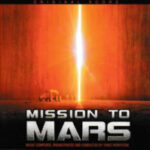
Art, in its highest form, empowers us to reach deep into our psyche and re-experience that part of us that is innocent, peaceful and without trepidation. There exist some film soundtracks that are a joy to listen to for its own sake; occasionally also comes one that stands above most. Composer Ennio Morricone’s (1928-2020) soundtrack to the Brian De Palma 2000 science fiction epic Mission To Mars is a prime example.
Evolution of the state of performance of symphonic music from the days of sixteenth century concerts in chambers to the modern era on the silver screen has been no less epical.
For instance, Vivaldi, being a Baroque figure, is an outlier in his time with a full deployment of cadenzas in his Four Seasons, evoking dramatic variations in emotion to depict seasonal changes, when his peers continued to compose light, relaxing orchestral works. Even Mozart himself being the vanguard in the ensuing Classical period composed largely lighthearted short symphonies, all forty-one of them, with a handful among them vastly more popular than the rest.
So it seems times and trends matter differently for the individuals. For while being part of the Classical movement, Beethoven, junior to Mozart, harboring immense drive and ambition from a harsh upbringing, projected unrelenting belief in the goodness of life and his fellow men in his music, not resentment, and the infusion of intense emotions prevails throughout his compositions, symphonies and all. The sheer impact of emotions in the symphonic form is further enhanced by using increasingly larger ensemble sizes to satisfy an ever-increasing number of audiences.
Still, it will always be a beckoning to the world of yore whether one plays the symphonies of Shostakovich, Stravinsky, Bach or Beethoven; classical music takes the listener into a world when the pace of life was slower and calmer, evoking a state of mind serene and contemplative. Welcome to the twenty-first century where the orchestral music denotes far more complex and intense emotions than conveyed in eighteenth and nineteenth century classical music. Hollywood changed the narrative by popularizing the motion picture art, casting heavy focus on the visual; it was so successful that it forever shifted the psyche of global populace from concertgoing to moviegoing, relegating music secondary. Modern composers can but only make a living composing for the silver screen, thus rendering the art heavily subject matter driven, and emotionally striking, such as a romance amidst the American Civil War, encounters of a lone extraterrestrial stranded on Earth, the charged missions of a British spy, the tragedy of an intergalactic youth, the American exploration of space, etc.
Which brings us to Mission To Mars.
If you never saw the science fiction epic or don’t remember much of it anyway, then an experience of the soundtrack before watching is the place to start. For while the film is a most riveting work to watch both for the special effects and character development, and the sheer ambition and scale of the storytelling is rare and breathtaking even by today’s standard, the soundtrack beckons to be experienced on its own, before the wonders onscreen become permanently etched into your memory.
It is a 62-minute symphonic score performed by the New York Philharmonic. The NYP’s music making is not often associated with film music, that accolade goes to the London Symphony Orchestra, but the dynamism and lyricism of the NYP is unmistakable and always an occasion to behold. There is curiously no download of it available, and a few used CDs still linger on eBay; the other choice is to audition the music through YouTube.
Featuring Gary Sinise in the lead role and arguably Tim Robbins in his most memorable, Don Cheadle and Connie Nielsen give some of the most empathetic cinematic performances as well. We now have more advanced understanding of obstacles for human colonization of Mars, such as the insurmountable finance needed for the human sustaining environmental infrastructure, as well as the havoc that low gravity of Mars and extended space flight wreak on human anatomy, in addition to the toxicity of Martian dust, but back at the turn of the millennium our lack of knowledge infused the subject matter with heavy and willful romanticization. So is the film fantastical, and at times fantastically blissful, but there is also plentiful supply of top tier drama and suspense. Best of all, filmmaker Brian De Palma makes it utterly scientific and hence believable.
Even at its level of understanding of the subject matter back in 2000, Hollywood manages to depict Mars exploration as hazardous and challenging. What makes the film unique is the sense of optimism and adventure it imparts into the audience, showcasing the best in human spirit. The Morricone score is at once uplifting and wondrous complimentarily, with a track or two highlighting essential misfortunes, nonetheless. It is the sweetest music the composer concocted since “Gabriel’s Oboe” from the 1986 religious adventure The Mission, only this time the maestro presents us with such sweeping melodies, sounds and dynamic scales that raise a euphoria from deep within our own psyche each of us has seemingly been nurturing since birth.
And then there is the quality of the recording. Two of the composer’s other soundtrack recordings, namely The Mission and The Untouchables are of similar demonstration quality, the dynamics uncompressed, the extensions well formed and timbral separations distinctive. Mission To Mars carries the torch most notably. Crank up the volume and you will wish some other popular soundtracks would sound this good.
But perhaps most notably, the Morricone score evokes a rare, awakening sense of awe and wonder. Exploration of unknown worlds and locales has its own challenges and awards, but we mere regular folk get to feel that human connection to something predates our existence and otherworldly, through this music. NASA will do well to use the music in its publicities.
It is also noteworthy that at 72 years old in the year 2000, the composer crafted such a score that the immense innovation and relevance of the music compliment the pioneering spirit of the storytelling beautifully. Few scores compare in the sense of innocence, exhilaration and wonderment of space exploration in equal parts. Leave it to Morricone to evoke positive emotions via solo woodwinds. Even to this day, this composition surpasses many other works of the theater by its liberating melodies and masterly sonorities.
The musicality of this score will never get old. It remains my wish that a high resolution download of the original score will emerge in the not-too-distant future.
Review system
Audience AV frontROW cable system
Cardas Clear Beyond cable system
Aurender AP20 reference all-in-one cache player/DAC/integrated class D amplifier
Aurender N200 cache player
Aurender AP20 (DAC/Preamp Out mode)
Orchard Audio Starkrimson Mono Ultra Premium GaN-FET monoblocks
Pass Laboratories XA200.8 class A monoblocks
Aurender N200 cache player
Bricasti Design M21 DSD DAC
Atma-Sphere MP-1 3.3 tube preamplification system
Pass Laboratories XA200.8 class A monoblocks
Sound Lab M945 electrostatic panels
Acoustic Science Corp. Tubetraps
- (Page 1 of 1)





Constantine,
God’s Peace,
I can imagine the soundtrack is impressive when heard on the big Sound Lab speakers!
On another note, I discovered (not the band, but the album) Styx’s “The Mission” about a year or two ago though the album is from 2017. It’s not remotely like the soundtrack to the movie, but I thought the lyrics were thoughtful and with the classic panache of a veteran rock band. It takes me back to the heyday of theme albums. It also is clean in its lyrics, for which it passes both of my filters for good music, performance and lyrics.
Blessings,
Douglas Schroeder