
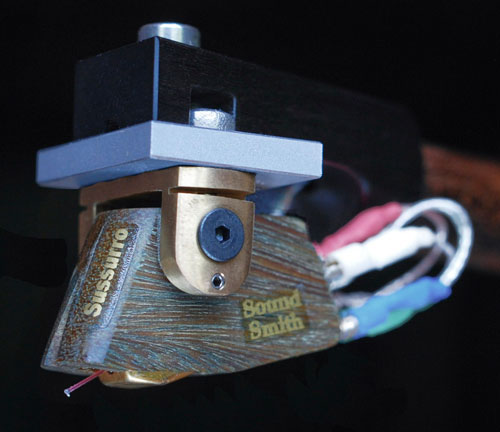
Sussurro (Italian)
Noun: whisper, rustle, murmur
When I met Peter Ledermann at T.H.E. Show and spent some time listening to his cartridge named, “The Voice”, I was quite taken with what I thought was one of the most listenable cartridges I had heard. Not in some euphonic way, or anything that I could put my finger on, but The Voice was just so unobtrusive. I didn’t get the impression of a mechanical device with a rock being scraped through a tiny vinyl groove. It was one of my favorite rooms at T.H.E. Show 2009.
I felt (and still feel) that The Voice realized the promise of the moving-iron cartridge design. The Grados, even at their best, always fell short of the best moving-coils. Sometimes it was tracking. Sometimes it was detail retrieval. At the end of the day, I think it came down to the stylus and cantilevers employed by Grado not matching up to the best exotic materials of the competition. The Voice was a design that didn’t sound like a moving-iron, moving-magnet, or moving-coil. It had some magic all its own. It employed the moving-iron principal, but was built with exacting perfection.
I guess I made a decent impression on Peter since he offered me a chance at reviewing the Sussurro when he was finished with the design. In the few times I’ve had with Peter over the phone (and at T.H.E. Show), he’s struck me as a man of honor, integrity, intelligence and humanity. For more on the story behind Peter, please read Gary Lea’s interview with Peter.
An E-Type with Lead in the Boot
There are a lot of misconceptions about cartridges, one being that moving-coils have less mass. Well, sometimes yes, but not always. One thing not figured into the equation is the wires leading off the coils, which act like springs. Many medium- and high-output moving-coils have substantial windings. It would be like a supermodel with junk in her trunk, or a sports car with bricks in it.
With a moving-magnet or moving-iron, you can make the magnet/iron very small, attach a low-mass cantilever, and employ a line contact stylus. This gives you less mass, higher compliance, better trackability, and less record wear than many moving-coil cartridges. Not that it’s a new idea. Shure spent the better part of 40 years designing, making, improving, and then discontinuing the V15. At its best, the V15 series could track circles around cartridges costing 20 times as much. I know because I heard it in my house. At its worst, it was merely a great tracking cartridge that made you turn on the TV in search of a good movie. I know because it happened to me. Whether it was the inductance, the not-very-rigid user replaceable stylus, or just so-so materials, the best moving-magnets and moving-irons have always come up short when compared to the best moving-coil competition.
Peter, with the Sussurro, has attempted to address every possible aspect of design and execution that has heretofore limited the performance of the moving-iron phonograph cartridge. He has fewer wire windings in the cartridge’s magnetic circuit, reducing impedance and dramatically reducing inductance. Lower inductance means better high frequency extension and better resolution. He has employed a ruby cantilever, which is low mass, low resonance and highly rigid. He has affixed a complicated, multifaceted, highly polished stylus for excellent high frequency resolution, low distortion, and minimal “groove pinch”. Opposite the stylus, the tiny block of iron is of very high purity (better magnetic properties than “any old iron”) and very low mass (better tracking, lower distortion). Holding it all together is a nicely crafted wood body, shaped in a way to afford some protection for the stylus and cantilever, and keeping detritus from the all-important “guts”. To allow for ultra precise adjustment of VTA/SRA, Peter has introduced a nifty swiveling mounting block that lets you adjust VTA at the cartridge end of the arm (as opposed to the more conventional method of lowering/raising the back of the arm). This will be handy for users of arms that lack VTA adjustment. This last feature is something that I think should be an option, not standard, but that’s because I can adjust VTA rather easily. Taken in whole, this is an attempt to build THE state-of-the-art moving-iron, using materials and methods usually reserved for the best moving-coils.
For those of you comparing the Sussurro to The Voice, there are major differences. The Voice is a lower cost, higher compliance, higher output cartridge. This will make it a better choice for some of you who are on a budget and don’t have a closely matched phono stage and/or tonearm.
The Sussurro was mounted on my trusty SME V. It’s not a necessarily optimal match, by the way. I tried to get a different, heavier tonearm that would better suit the low (-ish) compliance of the Sussurro. I had tried to arrange a 12” VPI unipivot, but that didn’t work out. The turntable was my redoubtable Denon DP80 direct drive in ancient VPI plinth, driving Peter’s phono stage through Wireworld phono cable. Speakers were my modded Maggies or the Sanders 10B electrostatics. Amp, for the most part, was Sanders’ ESL amp (a great amp for any hard-to-drive speaker). The preamp was either the Allnic L1500 linestage or StereoKnight’s Magnetic Silverstone B&R (fully balanced, remote controlled, transformer volume control). Associated wiring ranged from XLO Reference, StereoKnight (balanced interconnect), Furutech, and Aural Symphonics.
Mounting the Sussurro was easy, except that my sample lacked a stylus guard. That made me a little nervous, but at least it had tapped screws. One complication is that you are limited on the length of screws that you can use. Peter sent a good selection, plus I have quite a few hanging around the place. Just under the tapped holes is the wooden body of the cartridge. The width of the cartridge is somewhat greater than many cartridges, and the user-adjustable mounting bracket allows you to mount to most tonearms. It might present some problems on those flimsy old SME headshells that have the sides that point down and run parallel to the sides of the cartridge. I would hope you’d use something better than one of those, but in case you do, you might have space constraints.
Setting VTA and overhang was no more difficult than the ZYX Airy 3 or the Haniwa cartridge (under review). No surprises. The mounting bracket does allow for adjustment at the end of the tonearm. This could help two groups: if you use a tonearm that does not have adjustable VTA; if you run out of adjustment because you either have an abnormally short or tall (in relation to the platter) tonearm setup. My SME V had sufficient adjustment, so I did not mess with the Sussurro’s value-added features.
Loading was something of a challenge for me. Most phono stages I’ve had are geared towards either the stereotypical MM or the low-output moving-coils. The Haniwa phono stage (also under review) had 3 ohms and 47K settings. The Allnic phono stage was similarly designed for low-output or high-output, with a low impedance transformer setup for moving-coils. The Haniwa was too far outside the range of adjustment for the Sussurro. The Allnic, on the lowest gain setting (hence the highest impedance tap on the transformer), sounded magical. For a brief period, I ran this combo, and it made some of the finest music I’ve ever heard. However, Peter designed the cartridge to work best with a 1-2K load. This is something his new phono stage can do, so I decided to use the Soundsmith MCP2. By the way, the MCP2 deserves its own article, although it is featured at the end of this review.
Listening to Real Music, Really!
If you want to know what the Sussurro is really about, pull out some marginal sounding historic recordings. In this instance, I listened to Louis Armstrong’s “Hot Fives and Hot Sevens” from The Smithsonian Collection of Classic Jazz. This stuff, originally recorded to 78 lacquers, and later remastered from good condition 78s, can be tedious, even tortuous, on some systems. With the Sussurro, I was emotionally engaged by these old treasures. There was a good degree of dimension, even though it was mono. Musicians had a sense of space and size.
Armstrong’s trumpet playing was recreated with puffs of air at the beginning of notes. There was a beautiful hooty-ness to the clarinet sound, lots of wood and body with just enough high overtones. The sound of muted instruments was amazingly good. I didn’t even notice the muting until now.
The famously difficult solo at the beginning of “West End Blues” was reproduced with such clarity that I could start to understand some of Armstrong’s baroque-like figures (triplets, grace notes, or whatever is jammed into this little gem of trumpet playing). The Sussurro helped to transcend the mechanical limitations of such an archaic recording.
Sarah Vaughan’s “Ain’t No Use” showed that the Sussurro could be as spacious as a great moving-coil, and with a more natural musical flow. This cartridge brought out all the tonal nuance of Sassy’s incomparable instrument. The midrange was slightly luscious, something that served all the music I played. It didn’t add to, or distort the human voice. It was more like Sarah switched microphones, from a ribbon to a Neumann/Telefunken condenser. This is somewhat subtle. It isn’t as dramatic a difference as differences in speakers.
When drama was called for, the Sussurro delivered. The British Columbia (EMI) pressing of Poulenc’s Concerto for Organ, Strings and Timpani is a real devil to track. Near the beginning of the piece, there is a massive sustained chord held by the organ, while the violins fiddle away at the top of their range. Most cartridges fail this test, displaying gobs of intermodulation distortion. The Sussurro was one of two cartridges that have sailed through without sounding strained. Bass was huge, while the string overtones floated over the orchestra.
Moving on to something totally different, I found myself listening to Eminem and Tupac. On heavily modulated bass tracks, the Sussurro didn’t break a sweat. It could pump out as much bass as any moving-magnet or moving-iron I’ve used, and much more than my ZYX and Lyra cartridges, which comparatively can be somewhat reticent to kick out the jams. As the Beastie Boys are known to say, this cartridge can “get some action from the back section.”
This might be THE cartridge for people with eclectic tastes in music. I never felt “oh, such-and-such kind of music won’t sound good on this combo”. From historic jazz, to AC/DC, to Waylon Jennings, to 45 RPM jazz reissues, to classical, it always satisfied like my grandmother’s cooking.
On “Box Of Rain” from American Beauty, the Sussurro put an exclamation point on my listening notes. There is something disjointed about a “hyper-fi” system playing back The Grateful Dead. The in-your-face detail assault is counter to this music’s feel and emotion. American Beauty is warm and harmonically rich, with real acoustic instruments and multi-part vocal harmonies. The Sussurro made this and other naturally voiced records sound authentic. Just the right proportions of sound, and nothing that says “hey look at how awesome a cartridge I am; I’m so awesome you can hear someone in row K pass gas”.
Peter’s Magnum Opus?
So is the Sussurro as-promised? Is it as impressive in operation as its specs and materials would suggest? It sure looks fantastic on paper. It sounds even better. I’ve never had a component with this combination of strengths. It tracks as well as any moving-coil I’ve used, and is very close to the über-tracking Shure V15vxmr. Its dimensionality is the opposite of the classic high compliance moving-magnets, which tend to be two-dimensional, jittery and washed out. Compared to the best Grados I’ve heard, the Sussurro is more refined, with better tracking, three-dimensionality and lower distortion. The Sussurro is slightly warm, with an overall tonal balance similar to a wood-bodied Koetsu (not the Platinum series), but with better bass, better tracking, and less harmonic distortion (compared to the non-Platinum series).
So, the Sussurro isn’t completely neutral, but I don’t give a damn about that. It’s ever-so-slightly warm. Not amber. Not golden. Not syrupy. Not chocolaty. Just a wee bit warmer than some of the competition (ZYX and Clearaudio are the Sussurro’s opposite). The building of a system takes a synergistic combination of components, and the Sussurro is just the cartridge for one of those “an-acrylic-factory-explodedturntables”. Quite honestly, it was a perfect match for the ribbons on my Maggies, which can be a little hot. On the other hand, it sounded marvelous with the Sanders 10Bs, which are definitely not bright. Much like the Sanders 10Bs, the Sussurro has the highs, but it doesn’t poke your ears out the way other cartridges can. This might simply be the absence of ringing in the highs, which is still a problem with moving-coils. I can say that it has better high frequency resolution than any moving-magnet or moving-iron cartridge I’ve used, with the added benefit of more dramatic dynamics, better resolution, and much better dimensionality.
Usually, warmly voiced cartridges sound sluggish. Not the Sussurro. It had fast attacks, and no overhang. Piano runs, trills, guitar riffs, complicated interplay between sections, drum solos, etc… All are very clean, allowing you to pick out notes, musical lines, sections and even individual players.
The reproduction of cymbals was one of the best I’ve heard. Unperturbed by coil resonance and high mass, different cymbals in a drum set have individual flavors. Some are shimmering, some splashy, and some sound like miniature gongs – lots of “doingggggg” in the sound. (What animated descriptive. Pure Ingenuity! –Ed.) This is so much better than red-book CD that it’s laughable to compare. Most digital just homogenizes cymbals. This is a strength of analog that digital is only now starting to get right (with 24/196).
Similarly muted trumpets and trombones, which are hell on lesser trumpets, sounded so much more natural. This is where I found the Denon DL103 unlistenable. Miles Davis’ harmon mute sounded ghastly with the DL103. Even good hyper-elliptical profiles have trouble with closely recorded mutes. Not until I had my first line contact did I not feel like I had to clean lacquer flakes from my hair. The Sussurro goes further to alleviate the intermodulation distortion with its low mass, low inductance and radical stylus profile.
Let’s keep in mind that I had this mounted on a tonearm designed for high compliance cartridges and it was driving a $700 phono stage. With a higher resolution phono stage (no insult intended to the MCP2, which is the best phono stage I’ve heard in the $700 price range) and more massive tonearm, things will be different–kind of an obvious statement. Break-in took some time, so don’t make decisions based on a brand new cartridge. At least 20 hours would be recommended, and don’t forget to let the cartridge warm up a bit when first playing records. I’ve found that most cartridges are like tube electronics, needing a little run time to stabilize.
It’s something of a unique product, this Sussurro. Had I not recently spent money on the system, I would’ve kept it. I imagine that I will come back to Peter in the future and buy a Sussurro or Voice, which are both amazingly good cartridges. When I heard The Voice, it was love at first sound. Now that I’ve had quality time with the Sussurro, it’s been something more than simple infatuation. If the Sussurro were a lady, she’d be a supermodel and a Nobel laureate.
I’ve heard many expensive cartridges over the years, and none can embarrass the Sussurro. In a few cases, the Sussurro will actually embarrass the stratospherically priced competition. In an embarrassment of riches, I’ve had the Sussurro, the new Haniwa cartridge, and the ZYX Airy 3. All three have certain reference quality characteristics, and the Soundsmith is up there with the very best. The Sussurro is in the same league as the Koetsu Platinum and Mysonic/AirTight/Haniwa cartridges. While all these sound quite different, they present music organically, letting you forget about the mechanics of playback. Your choice of cartridge will be system dependent and based on your tastes, naturally. An audition is a must before you shell out this much money. People typically build a system from the speakers up. This is a cartridge good enough to be the starting point for a system. If you pass on the Sussurro because it’s not as expensive as the other cartridges, or it’s not a moving-coil, or it doesn’t have Japanese mysticism attached, you are making an error. This cartridge is the real deal, and is very enthusiastically recommended. Oh, and Peter makes a great sounding strain gauge too….
Soundsmith MCP2: This little phono stage competes!
The MCP2 moving-coil phono stage, at only $700, is a fine example of function over form. Peter doesn’t waste your money on fancy clothes. The production case is black anodized aluminum, with a 24vdc “wall wart”. I was shocked to find it had input transformers. Many MC cartridges don’t sound good without input transformers—in my opinion. Most moving-coils have high frequency ringing and the right transformer load will almost completely eliminate the issue. An added benefit is that transformers kill RFI, and help eliminate ground loops. The Soundsmith is the only phono stage at this price point with step-up transformers (that I know of), and that’s not the only thing making it unique.
Peter has fixed an issue that has always bothered me, something that cried out for a sensible solution. Instead of being stuck with a handful of loading options, he’s made the load infinitely variable from 10R to 5K, which will match most good quality moving-coils (actually, all the good ones I’ve heard). Channel-to-channel balance seemed fine to me. I’m assuming this is a high quality (both channels tracking very close) potentiometer in a shunt circuit after the step-up transformers, but I did not ask. This is an assumption.
The wonderful thing about continuously variable loading is hearing the frequency response and dynamics change with load. It’s a rather complex relationship, and when you get it just right, the image pops into focus and tonal balance is just a little warm, but with plenty of extension. In a way, it makes for a unique front-end tuning-knob. As you know, there are cartridges that absolutely need to be loaded down—way down—to control coil ringing. A low impedance loading could be considered as electrical damping, just as the little rubber damper inside the cartridge is mechanical in nature. Back in the “good old days”, being able to tweak the loading to “just right” was a nightmare scenario of turning off the phono stage, swapping load resistors, powering back up, waiting for it to stabilize, then repeating the process. All the while, your aural memory starts to fail you, and by the time you’re done, you’re left questioning which setting actually sounded best. Peter’s method takes seconds, gives you way more options, and you won’t run the risk of lifting circuit board traces, stripping screws, or getting electrocuted. Big thumbs up on this.
So, how does it sound? It’s amazingly good and stands the comparison to any transistor phono stage I’ve heard. Where it blows away a lot of competition is the meaty, beaty, big and bouncy character it imparts on music; music that gets “audiophiled-to-death” by overly etched, detail-freak ‘stages, some of which cost a ton of money. The detail is mostly present with the MCP2, though not to the degree I’ve heard with some other stages. Thing is, the MCP2, like the Sussurro cartridge, does a wonderful job of delivering a balanced performance. Being able to dial in the load on tweaky moving-coil cartridges to your taste (not someone else’s taste) means that a weakness in one area will be offset by getting the frequency response, and electrical damping, correct.
The MCP2 also fairs well when judging rhythm and slam. It’s better than the stock version of the Jasmine phono stage I reviewed, and better than most of the classic tube based stages I’ve used over the years, including the 6DJ8-based examples, such as Counterpoint, Audible Illusions, etc. I did hear a rolling off in the very low bass. It’s not something I would hear with panels like the Maggies, but with the hybrid Sanders 10B. The bass is still better than most tubed phono stages, and compares well with similarly priced transistor units, some of which do bass and only bass.
So, where does it come up short? Chiefly, in terms of dimensionality, it can’t compete with the more expensive (like 8X as much, and up) tube units with killer power supplies, cost-no-object parts, and chassis made of gold sourced from another galaxy, all hand assembled by small gnomes in an enchanted forest. No, Peter’s unassuming phono stage is good, but a little 2D when compared to the Allnic 1500 LCR, Aesthetix Io super-duper version, Ypsilon, etc.. I did briefly listen to the Sussurro with the Allnic phono stage. It was magnificent, and one of the two best sounding combos I’ve heard in my system. Switching to the MCP2 wasn’t night-and-day, or a huge let-down. Yes, it wasn’t as good as the Allnic, but it did share one thing with the H1500: great tonal balance and good rhythmic drive.
The MCP2 is a bargain at the price, and is a better match to many moving-coil cartridges than the more common FET-based units. It really deserves to have its own, full-fledged review, but take for granted that it’s a bargain, sounds very musical, and doesn’t let the Sussurro down. Matter-of-fact, the Sussurro/MCP2 combo is a must-hear if you had figured on spending $5-6K on a cartridge/preamp combination. It might be anathema to many in the high-end, but this moving-iron cartridge and diminutive little phono stage can wipe the floor with many moving-coil/tubed phono stage combinations. Bravo Peter, and keep up the great work!
- (Page 1 of 1)








Dear Philip, i’ve been readung a couple of your reviews in which you both mention listening to the combination SME V and Allnic 1500. I own exactly the same and was wondering what your favourite cartridge with this specific combination is? Thanks a lot in advance for helping out, patrick – belgium
Thanks for the question.
The Sussurro was the best, overall, but is very expensive. Some people will laugh, but the Shure V15-iii sounded really good. Cartridges that are a little darker or thicker sounding blended well with the combination. Analytical cartridges, not so good.
Dear Phillip, noticed you are using an SME V. And an Allnic 1500 as well.
What is your favourite cartridge to listen with this combination?
Have a great weekend, Patrick – Belgium
Hello, at which loading / step up setting did you use the allnic phono stage with the sussurro? thanks Markus
Hy Phillip, have a wonderful day. Could you please tell me if the MCP2 has something similar to a step-up transformer inside? Can you tell me if such phono stage could work well in combination with a Koetsu Rosewood Standard and my system consisting of a Linn Sondek LP-12/Lingo/Ekos turntable plus electronics from Classé (Six preamp and 25 Power Amp) and bookshelf speakers Volent Paragon. Thank you in advance for your kindness and assistance. Decio Lopes.-
Dear Phillip,
It is a good report, because it compares the best MI H-output cartridge, against the best MI L-output cartridge.
There remains a doubt, when you say: “When I heard The Voice, it was love at first sound. Now that I’ve had quality time with the Sussurro, it’s been something more than simple infatuation. If the Sussurro were a lady, she’ d be a supermodel and a Nobel laureate.”
So what class would The Voice be?
I think it’s important to know if you have The Voice, with a higher value phono preamplifier, do you run out and look for The Sussurro cartridge?
Thank you in advance for your point of view.
Kind regards,