Staff |  Window Shopper |  Press Releases |  Reader Response |  Advertise |  Front Covers |  Contact
RSS Feed
 
  
Advertisements
Equipment Reviews more reviews »
April 2009
Bookmark and Share

Jack Roberts and the $3,495 cartridge to live with: EMT Jubilee Series JSD5


Jack Roberts

 
Specifications:

Stylus and cantilever: Diamond on Boron
Stylus Tip JSD5: Gyger S
Tracking force: 2.35g (should not exceed 2.5g)
Impedance: 2 x 20 Ω approx.
Output level at 1kHz (for 5cm/s rms recorded velocity): 2 x 1 mV, +/- 2dB
Frequency response: 20 to 30kHz
Compliance: 15 m/mN
Connection: gold plated pins
Weight: 11g approx.
Recommended load: =/> 100Ω


Manufacturer:

EMT Studiotechnik GmbH
Industriestrasse 25
77972 Mahlberg

Tel. +49 (0) 7825 877 18 11

URL: http://www.emt-studiotechnik.de/default.htm
Email: info@emt-studiotechnik.de


U.S. Importer:

Tone Imports

Tel. (646) 425-7800

URL: www.toneimports.com
Email: shindo.usa@mac.com


There were a few pieces of equipment I had long wanted to hear in my own home. First, on the list was to hear some good Lowther-based speakers in my own system. Second, was to spend some time with the new version of the phono cartridge that had been this young man's first audiophile love: the Decca cartridge. Well, thank you dear editor, for both have happened. After listening to several different Lowther-based speakers, I found that I loved just a couple and couldn't tolerate the others, but the Teresonic Ingenium Silvers have become my speakers of choice.


The Decca didn't turn out quite the same. Yes, I got to review the new London Reference and it may still be the best phono cartridge ever made, depending on how you define “best”, of course. For unless you have just the right tonearm, it struggles with tracking; and even in the right arm, it will never be considered a great tracker. Still, there is that clarity, the immediacy, the dynamics, and that incredible bass impact.


Why do I mention all this at the start of the review of an EMT phonograph cartridge? The answer is simple, the EMT JSD 5 gives me almost everything I had hoped for in a modern Decca. In my review of the London Reference I said, "The Decca cartridges of my youth were amazing. They were immediate sounding, and had the deepest, tightest, and most powerful bass I have ever heard."  This is the kind of sound you get with the EMT JSD 5, plus a more organic sound and all the good things we have come to expect from modern cartridges without the bad things.  Well, more about all this in a little bit.


EMT Phonograph Cartridges  
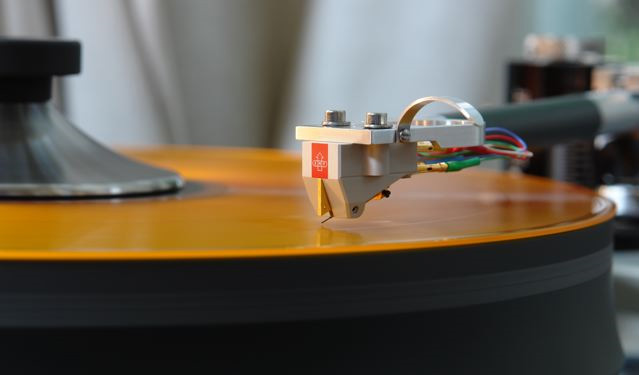
Photo © Matthew Rotunda


As I mentioned in my review of the EMT TMD25N mono cartridge, EMT may not be as well known in America as Garrard, SME, or Thorens, but there are few companies in professional and broadcast vinyl replay as highly regarded as EMT. Wilhelm Franz founded the company in the year 1940 in Berlin; the JSD 5 and JSD 6 cartridges were made to celebrate the company’s 66th anniversary. After WW II EMT became a leader in this field.


In 1989, EMT was sold to the Belgium BARCO group and became BARCO-EMT.  Under this arrangement all that seemed to be left of EMT was that they still serviced customers’ cartridges and tonearms as well as manufacturing a few cartridges. Late in 2003, EMT was sold by BARCO and thankfully begin to create new products again under the name EMT-Studiotechnik. EMT says the JSD 5 and 6 are the best cartridges they have ever made and there is no doubt that they have the EMT house sound: Big, substantial, full of color, and with a midrange that just won't quit. They also are more extended in the frequency extremes and have a flatter frequency response than previous EMT cartridges.


Description 

The EMT JSD 5 and 6 cartridges look very different from any other EMT cartridges I have ever seen.  Most EMT cartridges are built into dedicated headshells that mount directly on EMT or SME type tonearms. The cartridges they make for other tonearms are of the naked variety with their big blank billboard in front and totally open sides, with all the coils and wire open for us to see. The mounting pins just hang on very delicate wires.


This EMT JSD 5 cartridge is kind of a half-naked design. The half-open case is milled out of what EMT describes as a "massive block of purest special aluminum." They use gold-plated system components and unlike other EMT cartridges it uses normal ½- inch standard mounting and standard hard mounted pins for connecting to your phono cartridge. The JSD 5 reviewed here uses a Gyger S stylus, where the JSD 6 uses a super fine line stylus.


Setup

Since the JSD 5 was built from the start to be mounted in other tonearms, its mounting and hook-up went quite easily. After getting it mounted in the Clearaudio Carbon Fiber Satisfy tonearm, I used it with an Auditorium 23 standard step-up transformer. The tonearm wire was Clearaudio's and the interconnect from the step-up to Shindo Masseto was Shindo Silver. The amp was my Wavac EC300B and the speakers were the Teresonic Ingenium Silvers with Lowther DX4 Silver drivers. I used this setup for the entirety of the review.


While mounting the cartridge was quite easy, I did find the setup itself to take a lot attention to detail to get the JSD 5 to sound up to its potential. Maybe it wasn't all that fussy and just took a little more time to break in, but let me talk about the setup just a minute anyway. Matt at Pitch Perfect Audio in San Francisco said to set the VTF at 2.5g and check it every couple of days as it breaks in. I too found a VTF of 2.5g to be where the cartridge sounded its best. It tracked just fine and sounded good at anywhere from 2.0 to 2.75, and was just a tad sweeter, and the music flowed just a little better with a VTF of 2.5 than any other weight I tried. Another thing that is very important with any cartridge, but I found especially so for the JSD 5 is to recheck overhang every time you change the VTF or VTA. You will hear a nice difference when it is spot on.


Use and Tracking


Most modern cartridges are very good trackers, especially when their suspension is new. The EMT JSD is actually a step above most as a tracker and the stylus does not seem to pick up too much dirt from the record and it plays quiet in the groove. All in all, a very easy cartridge to use.


Let's Listen


Photo © Matthew Rotunda


First Impressions: As for how music sounded, let me start by giving some first impressions. The thing that jumped out at me is that the EMT JSD 5 reaches out and just “man handles” music in a way that I'm not sure I had heard before. I found this sound very intoxicating. There is nothing wimpy about this cartridge. Yet, as I listened to Eva Cassidy's Songbird album I was amazed at the delicacies I could hear in her voice. This is especially amazing when combined with the power of the music itself. The organ on SIDE TWO had more substance and color through the EMT than I had heard on this album before.


Lasting Impressions: Nearly thirty years ago, Harry Pearson wrote in The Absolute Sound about the difference in equipment that could allow recorded music to sound like music, and the equipment that sounded musical. What I’ve learned is that most high-end equipment is neither, but most is very good at letting you hear all the different parts of the performance. You can hear the bass, the midrange, how extended the treble is, the soundstage width, depth, and, well, you get my point. Often, these systems also make it hard to listen to less-than-perfect software. Then, there are the system we call musical or sometimes a “music lover’s” system. These systems are more forgiving of different quality and different types of music software.


Then, there are the very few systems that can occasionally produce sound in your home that sounds like music. EMT tables, arms and cartridges are often in the few systems I have heard that can occasionally sound like music and are always enjoyable to listen to. The JSD 5 definitely falls into this category of equipment. I think part of what creates this sound is the way the JSD 5 allows the flow and movement of music to come through. It is as if the music actually builds a sense of momentum.


Another part of this sound is a lack of distortion. This lack of distortion, combined with the EMT's flow and momentum, helps create an illusion that there is music being performed more than reproduced in your room. While it is my opinion that the audiophile soundstage isn't important to this illusion of music being performed instead of reproduced, scale is. Even mono recordings have scale and all musical performances have scale, whether it is large or small. The fact is that scale is one of the EMT JSD 5's real strengths.


Let's Listen: I'm going to do something now I seldom do in a review, but I think it would be helpful for those looking into cartridges in this price range. I've chosen several of my favorite songs on vinyl and I'm going to talk about them and then give a quick comparison of the EMT JSD 5 at $3400, the Benz Ebony TR at $3500, and the London Decca Reference at $5300. These are three cartridges I love and I would love to own all three of them. Let's get started.


“Swing Low Sweet Chariot” and "Amazing Grace" from Joan Baez’s album From Every Stage are two songs I always listen to with new equipment. The EMT JSD 5 was very similar to the Decca London on both of these cuts, there seemed to be more people in the crowd, more nuances in Baez's voice, the sound was incredibly immediate, and alive sounding. It did all this plus having a very coherent soundstage. The JSD 5 also had the ability to let you hear the organic layering of her voice, the music and the crowd. Add to all this is the fact that it's a great tracker. These cuts are inner grove cuts that often give cartridges a hard time. The JSD 5 sailed through them without me even noticing it was an inner grove cut.


Comparison Summary

Decca:


Ebony TR:


JSD 5:

Powerful, transparent, trouble tracking "Amazing Grace"


More beautiful sounding than either of the other two, transparent, but not quite as powerful sounding, good tracker


Nearly, maybe the equal to the Decca at being bold, powerful, and transparent. It is more organic sounding than the Decca and was also a good tracker


Listening to Ry Cooder's great album Jazz, I found it to be a very involving experience. This is the kind of album that highlights the differences between the JSD 5 and my own Benz Ebony TR. The Benz is more delicate, sweeter, it just plain sounds prettier on the top-end on many of the cuts on this album. The JSD 5, on the other hand, is more alive sounding, the music flows more like a musical performance, it has more impact, and the sound just has more substance. 


Comparison Summary

Decca:


Ebony TR:


JSD 5:

Transparent, alive, with great impact


More beautiful sounding than either of the other two, sweeter, delicate, flow is very good, incredible inner detail


Bold, powerful, and as transparent as the Decca, more beautiful and delicate than the Decca, but not quite up to the TR here, again the most organic of the bunch


The musical Evita is a wonderfully musical experience on vinyl that never quite worked for me on redbook CDs. On the opening of side four, there is a children’s choir. These delicate voices need to be reproduced with clarity, and with beautiful harmonics. The Benz Ebon TR gets the delicacies of these voices so real they'll make you want to cry, the London Reference gets the harmonics right, it also seems to remove one last, very thin veil. With the Decca, you also feel like the phrasing of the singing actors is so precise that it comes across like they are just a few feet from you. It is on this number that you really get the most of best of both worlds with the JSD 5. Still, I will understand those who prefer the ever so slightly more refined sound of the Ebony TR. Heck, I may be among your number. I'm finding it hard to make up my mind, because I like them both so much.


Comparison Summary

Decca:


Ebony TR:


JSD 5:           

Harmonics very right, extremely clear, lots of presence


Gets the delicacies of the voice just right, a little more organic sounding and not quite as forward sounding


Comes close to getting the strengths of the other two on this cut


I find listening to Bob Dylan and Johnny Cash sing “Girl from the North County” from Dylan's Nashville Skyline always useful in evaluating equipment. These two men are both great folk singers, yet so different in voice and technique. This is why the song is so great for evaluation. You should be able to hear the power in Cash's voice, the gravel in Dylan's and the emotion in both of their voices. First, let me say that the JSD 5 conveys the great power and emotion of the song with flying colors. It also conveys the flow of the music well. The delicacies of the voices and differences of technique of the two men is not quite up to the TR's ability in these areas.


Comparison Summary:

Decca:


Ebony TR:


JSD 5:

Powerful, transparent, great bass, incredible emotion, tracking below par


Conveys the delicacies and differences of the two men's voices better than either of the other, but not quite the drive of the other two, tracked well


Great power, emotion, very organic, and tracked well


Conclusion 

What else is there to say? Well, I should have said it earlier; this is one great cartridge for listening to classic rock.  If you’re looking for a cartridge that just reaches out and makes music come alive from those magic vinyl records, the EMT JSD 5 is a cartridge you should hear. If you can afford it, I highly suggest living with it.


Manufacturer's Comment:


Thank you Jack Roberts for a nice and thorough review of the EMT JSD5 cartridge. I'm really glad you're enjoying it so much. It might be interesting to hear Jack's impressions of the JSD6 or JSD5 or JSD6 Gold in the future. I think he'd find a bit more ease of set up with a more relaxed, delicate and beautiful presentation without sacrificing the dynamics, body and intoxicating sound that Jack loved. The JSD5 was the right choice for this review as it seems to bring a nice balance to Jack's arsenal of cartridges.


Best regards,

Jonathan Halpern

Tone Imports LLC


Home  |  Event Reports  |  Equipment Reviews  |  Spotlight  |  Music  |  The Columns  |  Dagogo Classics
Staff  |  Window Shopper  |  Press Releases  |  Reader Response  |  Advertise  |  Contact  |  Sitemap  |  RSS Feed
© Dagogo 2009  |  created by dca/dcpr