Introduction to Ypsilon
Ypsilon Electronics was founded in 1995 by two sound engineers. They each had experience in the field of the reproduction of live music. Maybe it’s their experience in live concerts along with their technical background that contributes to the truly high-end sound they have been able to build into their products.
It was the $90,000 Ypsilon SET 100 hybrid monoblock amplifiers that recently made our dear editor wax on philosophically about marriage, women, and musical ecstasy. So you may wonder if this beautiful $54,000 digital source could move me so. Well, I’ll have to admit from the start only one digital source has ever really moved me to feel involved emotionally in music in anyway like the analogue source does, but the engineers at Ypsilon do welcome that exact comparison in their design goals.
Design Goals
According to the Ypsilon web site, analogue filters color the sound and affect dynamics in a negative way, in fact in such a negative way that the digital industry developed the technology of upsampling. The result is that the sampling frequency of 44kHz is increased to 96kHz or 192kHz, and more effective analogue filters can be used to reject the out-of-band noise. Even when this process is performed by powerful digital signal processing devices, the end result is never like the originally retrieved data. Of course, by not using analogue filters, the DAC’s measurements would include the out-of-band noise; but, it sounds more open, with bigger scale and a more analogue-like presentation.
Remember that the basic idea behind DSD technology was to get rid of the digital filters used in PCM. Unfortunately the industry did not embrace it but instead, kept interpolation in one way or another. With the Ypsilon CDT-100 and DAC-100, neither oversampling nor upsampling is used, and a very linear and accurate chipset is implemented. The conversion is accomplished by a specially designed transformer, designed and built in-house. The analogue stage of the DAC 100 is a single-ended class triode transformer coupled at the output. The power supply uses a valve rectifier and choke regulation. All signal and power supply transformers are designed and manufactured by Ypsilon.
They go on to say that by using only the best materials available in the DAC-100 and combining it with CDT-100 the sound can only be compared with the best analogue sources. In fact, the engineers at Ypsilon say it was their love for music that lead them to see if they could build high-end products that would be able to reproduce music in such a way that you would not be able to tell the difference from true live music. A goal they have not reached yet, of course; no one else has either. I’ll tell you this: the exciting thing is that they have spared no expense in trying.
Description
The packing, the shipping containers, the connectors, and the chassis of the Ypsilon transport and DAC scream quality and expensive; and so they are. It’s obvious from the minute you get them that someone cared about the impression these products make. No joke, the Ypsilon equipment looks as exclusive as some of the top high-end equipment on the market. That care also comes through loud and clear when you listen to their products.
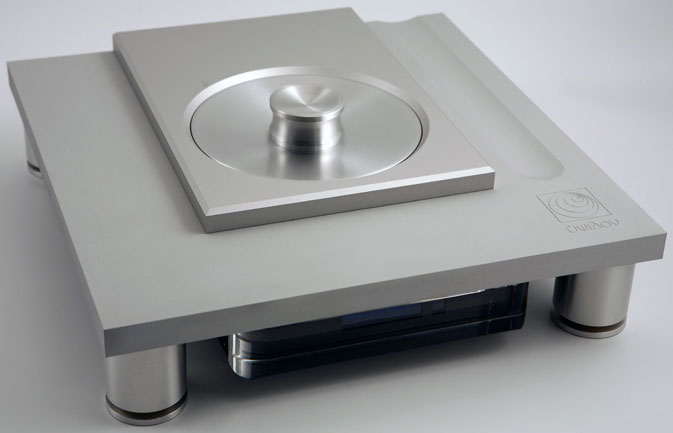
The Ypsilon CDT and DAC 100 are both housed on very heavy aluminum chassis that is brushed silver. The look produces a very attractive combination of form and function. The CDT alone weighs a whopping 44 pounds. The transport is mounted in a 3/4 inch block of solid aluminum that sits on four well designed legs, which terminate into solid cones that are in turn engineered with special feet for them to sit into. The display is hung below the aluminum block and the unit is top loading.
The DAC 100, like I pointed out in the design goals, is a non–oversampling DAC which is made like a couple of my favorite DACs. Having said that, I should point out that in no way is the Ypsilon a copy of previous non-oversampling DACs. It is, as much as any DAC can be, its own design. Although having no up-sampling at all, it is designed with multi–bit DAC chips. The power supply uses shunt regulators, while the analog stage uses single-ended class A transformer coupled triodes with tube rectification and choke regulation. The tubes are the high mu, high transconductance, low-noise Siemens C3g NOS tubes.
The DAC 100 has two choices of inputs, either a SPDIF coaxial 75Ω next generation connector or a Neutric 5-pin analog current input. When the Neutric input is used with CDT 100 the digital part of the DAC is disabled and is powered off. So of course, this is the way the designers at Ypsilon want you to use it, which I did for most of the review.
Ypsilon builds all their transformers by hand in house. These transformers are fairly large and designed from what they consider to be the very best available materials. The wiring is all point-to-point with custom extruded silver wire. Then their engineers wind them in what they refer to as a highly technical way for achieving a totally transparent sound, and they have come very close. So let’s get started talking about how the Ypsilon sounded.
The System
I used the Ypsilon CDT and DAC 100 in my reference system downstairs. I simply plugged it into my Audience aR6-T, and and then connected the DAC 100 to my Shindo Monbrison preamp. The other source in the reference system consisted of a Clearaudio Anniversary AMG Wood CMB Turntable with two Clearaudio Satisfy tonearms, and an assortment of EMT, Benz, and Miyabi cartridges. Amplification was my Wavac EC300B driving a pair of Teresonic Ingenium Silvers. The interconnects were Teresonic’s Clarison 24kt Gold cables, and the speaker wires were Teresonic Clarison.
Digital Cable
Ypsilon provides you with a very exceptional analog input cable, but Brian Ackerman of Aaudio Imports supplied me with top-of-the-line, 1-meter Stage III A.S.P. Reference Chimaera 5-pin DIN digital cable ($5,300 per meter) with which to hook the Ypsilon CDT and DAC 100 up. I have to inform you that this digital cable made this exceptional digital source significantly quieter, more powerful, and improved the soundstage.
The Sound
I listened to the Ypsilon with almost every conceivable kind of music, and it was in my system long enough for others in the house to comment on how it sounds. I can tell you one thing, the Ypsilon was quiet, I mean quieter than any other source I have ever heard. I heard less digital hash, and it had a strikingly well developed and musical sound for digital. So, let’s see if I can tell you how it sounded.
Top-End and Midrange
The Ypsilon illuminated the whole frequency range from top to bottom, but the midrange and top end are the glory of this DAC. Even after a month of listening, I couldn’t seem to be able to get away from the way it spotlights the music and highlights individual instruments. Compared to VSEI Level 5+ Sony SACD or the Audio Note DAC 5 Special, it sounds like someone came along and turned on a spotlight switch so that you can hear everything clearer. Voices, strings, and horns all sound so clear that you can hear all the air and nuances around them. The nuances of recordings were made particularly easy to hear with this digital source. Whether or not this degree of clarity is more or less musical is a personnel decision, but for me it sometimes seemed a little clearer than life. The air and nuances of music was where I felt the VSEI modded SACD player and the Audio Note DAC 5 Special had bettered all other digital players. The Ypsilon gives the music listener a whole new standard in this area.
The detail is sharply focused, clear, and fast. There is no doubt about it, this unit is the yang – light to bright and more spectacular to the Audio Note DAC 5 Specials and the VSEI-modded Sony SACD 777ES’ warm to dark and involving ying, to borrow a description of a component’s character from HP.
Bass
The Ypsilon’s bass was undeniably impressive. It went very deep and had a really powerful impact. I think most would describe the Ypsilon digital’s bottom-end as deep, fast, and extremely powerful. What it didn’t have in the bass though was the kind of organic nuances and decay that bass instruments can have with the Audio Note DAC 5 Special or from the very best SACD. The Ypsilon had those nuances in the midrange and top-end, but not quite in the same way in the mid-bass or low-bass. The deep-bass and mid-bass both have a very tight, quick bass with a driving pace, but in my system it was just a little on the lean side.
Dynamics and Micro-dynamics
The dynamics and scale were simply stunning, and the width, depth, and vertical height were the most distinctive I have ever heard in my system. The Ypsilon created a truly big sound with a driving lifelike pace to the music. The micro-dynamics were also world class. This combination of world class dynamics and micro-dynamics give your system a chance to sound truly alive if the rest of your system is up to the job.
Soundstage and Imaging
This is area where I think most audiophiles will be blown away by the Ypsilon. The stage is wider and deeper than I realized digital could be in my system. I can only imagine how wonderful it would sound if played over a pair of monitors like the Raidho C1 mini-monitors I recently reviewed. The imaging was very pinpoint and unbelievably palpable. This is simply the kind of soundstage that most audiophiles dream of.
Specific Examples
One of my favorite digital recordings is King of the Cellist, Starker plays Kodaly. It is one of the most beautiful recordings of a cello I have ever heard, and it is inspiring to listen to the cuts that are of the cello and the violin. The Ypsilon illuminated the bass in a spectacular way, and on the cuts with both the bass and a violin it allowed you to feel like you can literally see the two instruments. It allowed you to hear the attack and the leading edge of each note more emphatically than I have ever heard before, and it was also easy to hear the bowing that is happening on each instrument within their own spaces.
Another recording I use in every review is Ella and Louis. On this recording, the voices were right there in the room with you. They sounded immediate and you could hear every breath they take. Both Ella and Louis had their own space even though that space was very close.
Even thought the Elvis is Back CD cannot hold a candle to the vinyl version, it still has Elvis’ version of ‘Fever’ on it and for me that’s enough to make me listen. This cut can have tremendous slam and startling dynamics. Here, the Ypsilon digital system brought the CD closer to the vinyl version than I thought possible. The Yipsilon produced powerful drive and the dynamics will make you sit up and listen. You could hear every nuance of Elvis’ voice and the presence factor was unbelievable.
Rickie Lee Jones’ Pop Pop CD is beautifully recorded. The Ypsilon let you hear every detail on this CD, and the soundstage was just spectacular. Truth is I’ve loved and listened to this CD for years and I would have never believed there were things on this recording I had not heard, but there were.
Art Garfunkel’s Angel Glare is a favorite album of mine in musicality but not sound quality; I’ve never heard a DAC or CD player that could make this CD sound natural, and I’m sorry to say as good as the Ypsilon was, it couldn’t make a bad CD like this sound good. I wasn’t surprised, but I had to try.
Conclusion
As incredible as the Ypsilon CDT and DAC 100 was at $54,000, I have to ask if there is any other redbook digital playback system equally good? I’ve heard two that I found as musically involving: The Audio Note DAC 5 Special and The Audio Note DAC 5 Signature. One is about the same price and the other a good bit more. The choice of which one you would buy would depend on your taste in music and your pocket book. I’m going to assume if you can afford any of these three units, that money is really no object. The Audio Notes are a little more organic sounding, to me a little more emotionally involving, and more relaxed sounding. This all adds up to what I called listenability in my review of the DAC 5 Special. If you are more into soundstage, imaging, detail, and speed though, the Ypsilon pair gives you a real option.
Still, the Ypsilon CDT and DAC 100 most assuredly look more expensive than the Audio Notes, and have much more of what I think many audiophiles are looking for. So there you have it: The pair from Ypsilon are one of the three or four best digital playback systems I have ever heard, and I bet for many of you it will be the best.
- (Page 1 of 1)