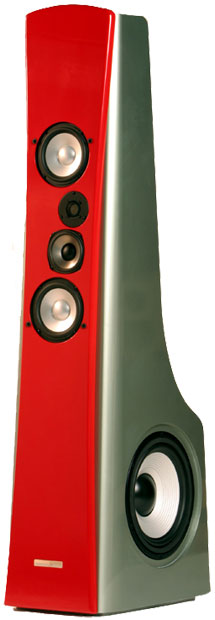
 I recently had a flood – a flood of new audio toys to try in my system. The tide brought in Nordost’s top-of-the-line Valhalla power cords, Sphinx’s very excellent Project Eight Reference Preamp and Project Eighteen Power Amp, and a pair of Genesis 6 speakers, which are the subject of this review.
This Is Your Low-End Speaker?!
Insofar as main front speakers go, Genesis makes the G1.1, the G201, the G3 (coming in the Fall of 2006), the G5.2, the G6 and the G7.1c (which can also actually be used as a center speaker). As many of you probably know, the G1.1 is a cost-no-object assault on Sonic Nirvana, and the G201 is similarly out of reach of most audiophiles. The G6 is a much more affordable speaker, but still financially formidable at $11,800 to $13,300 per pair, depending on finish.
G201 I was very interested in listening to these speakers for three reasons. First, they are dipoles, and most of the speakers I’ve heard use point-source dynamic drivers. Designers of dipole speakers believe that the reflected sound from the front wall enhances musical realism because that is the way we hear sound at live performances. I have found that dipoles can add a strong sense of depth and realism to music. Second, the Genesis 6 is somewhat of a hybrid. A ribbon tweeter is coupled with cone midrange drivers and woofers. Ribbons have a certain speed and agility that comes from their ability to respond quickly to transient signals, such as plucks of a guitar. The resulting sound quality can be stunning. Finally, the G6 incorporates powered servo-driven woofers. This automatically turns your two-channel system into a biamped system, with all the sonic benefits that confers. This simultaneously gives the user a very wide choice of amplifier types to use with these speakers.
Set’em Up!
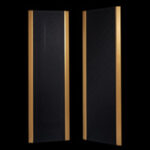
The Genesis 6’s were delivered by Brian Tucker, the Genesis Director of Sales, who not only delivered the G6’s, but also graciously helped me move my existing 275 pound (each) B&W Nautilus 800D. The Genesis are not exactly small, each being 60” tall, 17” wide and 22” deep (only at the base – they are less deep) and weighing in at 136 pounds each, but they are sculpted in a way that makes them seem smaller than they are.
According to Genesis, this is an intended effect of the speaker’s exterior design.
The very complete Genesis manual is extremely helpful, which is important because these are not your typical plug-and-play speakers. The G6’s not only come with powered woofers that allow you to adjust the bass gain and crossover, they also permit adjustment of the treble and midrange. The manual contains advice not only about basic setup, but also excellent advice about small adjustments designed to get the most out of these elegant speakers.
As I began to describe above, each speaker incorporates two of Genesis’ famous Kapton ribbon tweeters, which handle frequencies up to above 35k Hz. (Before you engineers get mad at me, let me state that the Genesis tweeter may technically be what’s called a “planar magnetic driver”, not a ribbon. I don’t really know – I just know they sound great.) One tweeter is front-firing and the other is rear-firing, creating a dipole. The titanium midrange and the aluminum mid-bass couplers also work as dipoles by being housed in an enclosure that is open in the back. Finally, each speaker has two side-firing 12” aluminum cone woofers which are driven by a built-in 500 watt class D servo amplifier. The back of the bass enclosure has high level bass inputs and a line level bass input (selectable by a switch), LFE IN and LFE OUT, a voltage selector switch, an on/off power button for the amp, LFE GAIN, BASS GAIN and LOW PASS adjustment knobs, and tweeter and midrange adjustment knobs.
Though this sounds complicated, I found the G6’s extremely easy and intuitive to set up. My listening room is 28’ by 24’ with an 8.5’ ceiling. It is set up “width-wise”, with the speakers positioned 6 feet out from one of the long walls, facing the other long wall. I initially set up the speakers about 8 feet apart, with each speaker about 10 feet from each side wall and toed in directly at the listening position. (This is wider placement and greater toe-in than recommended in the manual, but more on this later.) As suggested by the manual, I set all the knobs (except the LOW PASS filter) to the 12’clock position, connected the speaker cables and plugged in the power cord. I set the LOW PASS filter to it lowest level, 71 Hz, because I knew that my Electrocompaniet Nemo monoblocks have no power shortage, and I figured that I’d let the Genesis’s built-in 500 watt amp focus all of its attention of the low bass. (Please note that the manual suggests an initial low pass setting of 105Hz, which I found to be good advice when I used the G6’s with a much lower-powered amp. I also found that the higher setting worked better for other reasons – see below)
Listen To This!
After performing this initial setup I played a few familiar tunes to determine what initial adjustments I should perform. It initially seemed that that using the lowest LOW PASS setting had been the right choice, so I left that setting alone. (In fact, freeing up the Nemos from any low bass duty caused the music to virtually jump out of the speakers with explosive energy.) I also found that the initial settings of “6” worked well for the midrange and treble. As a result, the only knob I actually adjusted was the BASS GAIN, which I increased from “6” to “7”. This resulted in bass output that was relatively more similar in volume to that put out by my reference speakers. I also moved each speaker about 6 inches toward the other, thus reducing the separation between the speakers by about a foot. Finally, I reduced the toein significantly, to about 5°. With these adjustments, I sat down for a short listen before the customary overnight burn-in.
Brian Tucker had mentioned that the G6’s had been designed with symphonic music in mind, so I pulled out Peter Tchaikovsky’s Symphony No.1 in G minor, op. 13 (Deutsche Grammophon). I periodically go to hear the Chicago Symphony at Orchestra Hall, and one thing I always notice when attending a concert, is that there is the sense of space that is evident during performances. If you close your eyes you can hear to the back corners of the stage and have a clear sense of the size of the orchestra. I immediately noticed this in the Genesis’ presentation. I next played a few tracks from Holst’s The Planets (JVC), which confirmed this impression.
I then elected to get away from symphonic music and played Peres Prado’s The Best of Mambo (JVC), which is obviously not symphonic, but which is still a “big” band. Dagogo readers familiar with this disc know that it’s energetic music that makes you want to get up and dance. The pace of the music was even quicker than usual (although some of this could be attributed to the fact that the Nemos didn’t have to drive the deep bass). Finally, I played Chicago’s (then the “Chicago Transit Authority”) first album (Rhino) to get a sense of the Genesis 6’s handling of “popular” music/rock. The G6’s reproduction of Chicago’s horns immediately struck me as the best I had ever heard. With those few discs under my belt I decided to leave the system on all night playing music at low levels.
During listening sessions with the G6, my front end (Esoteric P-70/D-70 transport/DAC) remained the same throughout. However, that front-end was run with the following configurations: a) D-70 connected to the Nemos via Nordost Valkyrja interconnect and EVS Ultimate Nude Attenuators (passive mode); D-70 connected to the Sphinx Project Eight preamp via Bybee Slipstream Golden Goddess interconnects and from the Project Eight via Valkyrja cables to the Nemos; D-70 connected to Sphinx Project Eighteen Dual Mono Stereo amp via Nordost Valkyrja interconnect and EVS Ultinate Nude Attenuators (passive mode); and D-70 connected to Sphinx Project Eight preamp via Bybee Slipstream Golden Goddess interconnects and from the Project Eight via Valkyrja cables to the Sphinx Project Eighteen amp.
My listening sessions covered 3 weeks, rotating through several variations of associated equipment described above. Most of my listening was done alone, but for several hours on one Saturday I had some additional listeners over and obtained their comments. For comparison purposes, on 2 occasions I listened to the Genesis 6’s, then replaced them with my B&W Nautilus 800D’s for a few hours, then put the G6’s back in. I used a very large variety of music, including classical symphonies, big band jazz, solo vocalists, bluegrass, hard rock, jazz combos, electronica and a cappella quartets. Some of the recordings were world-class, while others were very average. In all cases, the character of the Genesis’ remained consistent.
I won’t beat around the bush and take you through a dozen discs that you may or my not have heard. Instead, I’ll get right to the point. The Genesis 6’s were stellar performers in every way, but for my tastes they were especially wonderful on all orchestral and band music, providing classical music aficionados an affordable way to get a taste of the sound enjoyed by the privileged few who own G1.1’s or G201’s.
The music was always spacious. I could hear to the corners of the hall. Energetic pieces made me marvel at the effortless pace of the music. Dynamics and PRAT were very good, thanks in part to the built-in 500 watt woofer amp, which allowed the main amps to do their thing without having to lug the lower bass around. The bass sound was very good for tympanis, cellos and upright bass, with the kind of body and reverberation I hear in symphonic concerts. Individual instrument sections were clearly discernible without interfering with the overall presentation of the performance. The clarity of the instruments and the handling of transients was very good; I especially enjoyed horns and strings, and must say that horns in any musical genre knocked my socks off. The Genesis’ are clearly high-end performers.
Some More Tweaks
I originally thought that the G6’s could use a little more bass directionality when playing small combo music. However, Gary Koh of Genesis pointed out that the low pass setting I was using may be affecting the 6’s perceived bass directionality. As you may recall from my setup description, I originally set the low pass setting to 71Hz. Gary suggested that I set the low pass filter to their recommended setting of 105Hz. He was correct. I had made a wrong assumption about how the low pass filter worked and had inadvertently eliminated some of the frequencies between 72Hz and 100Hz, which can affect perceived directionality. As a result, I fiddled with the low pass setting and, after a little experimentation, settled in at 100Hz. This clarified small combo bass directionality and sent me off on some extended sessions re-listening to recordings I had previously listened to with the low pass setting at 72Hz. Any excuse to keep these speakers a little longer!
One Nit
Since high-end speakers generally do a very good job on the vast majority of audiophile criteria, you often need to focus on very specific characteristics to end up with a meaningful review. If you don’t, the reader won’t get any sense of the difference between those high-end speakers. So here’s the “nit”. I was less sure of the G6’s with small combos. I don’t mean to imply that I did not like small combos reproduced through the Genesis 6’s. In fact, I liked several such recordings very much. In particular, I liked the G6’s rendering of vocalists, which can be a problem with some all-ribbon speaker designs. Those other ribbons seem to me to create the image of a larger “head” than is natural on a vocalist. If you close your eyes and listen, he or she seems really BIG in comparison the piano that is right next to them. I have heard this comment several times from other listeners. Unlike those other ribbons, the Genesis produces an excellent proportional image of vocalists, and scores very high in this regard. My nit is more subtle and has to do with how I think of small group music in small venues.
After all the other audiophile qualities are satisfied (they are definitely satisfied by the G6’s), I look for a proper sense of size of the performance venue. (This also applies to large-scale music, but Genesis has that angle covered in spades.) I have the sense that the Genesis 6’s made some small venues sound a little bigger and more recessed than is appropriate. It is as though the small combo is performing in a smaller version of Symphony Hall instead of a club setting.
I know – you’re saying “That’s your nit!?! You must be looking for an excuse to criticize!” OK –maybe I am, but that’s me. In any event, I found that I liked small combos a little better on my B&W 800D’s. This was the case with several jazz pieces, and was the case with several different types of rock (although “arena rock” really sounds realistic). Having said that, I should point out that the fact that the 800D’s are $8,000 to $9,000 more expensive (maybe more – I’m not sure about recent pricing). In fact, the Genesis 6’s are the second from the bottom of the Genesis line of speakers, while the B&W 800D’s are the second from the top of the B&W line.
Values To Keep In Mind
One thing that I would like to highlight is the ability to tweak the Genesis 6’s for your room and your tastes. This is in direct contrast to my reference speakers, the B&W’s. The British speakers sound best in a large room, and attention to room treatment can make or break the sound. In addition, they are “normal” speakers in the sense that you can’t adjust the treble, midrange or bass and have no built-in amp whose crossover you can adjust. Adjustments must come from speaker placement (not easy to do with 275 lb. speakers) and room treatments. On the other hand, a Genesis 6 user can make small adjustments to each speaker’s settings which enhance the listening experience, and may be able to avoid room treatments for some room conditions.
Another thing to highlight about the G6 is the fact that you automatically get biamping. This feature gives you the ability to drive it with a huge variety of amplifiers. This lets you (a) use an amp that suits your musical taste and (b) save money (or put more money into quality and less into power). My experience with using the Genesis 6’s with the 160 watt Sphinx Project Eighteen was instructive in this regard. The Project 18 (review to come) is much less powerful than the Nemos, but has excellent sound quality. I found that a good 160 watt amp sounded way more powerful than its specs when used with the G6’s. Since the low pass filter goes up to 135Hz, you can theoretically try low-powered amps, including tube amps, without sacrificing bass. I did not have any tube amps to try, but I would have liked to experiment with some. (However, the Genesis manual states that the G6 sounds best in “most” rooms using a crossover setting of 105 Hz, so don’t assume that any 5-6 watt amp will work well with the G6’s merely because you set the crossover 135Hz. In fact, Gary Koh does not believe that a 5-6 watt SET amp will have the current or reserves to properly replicate musical dynamics. As always, audition at home before buying.)
A third thing to note is that the Genesis manual recommends the removal of deadening material behind the G6, stating that the speakers are dipoles that perform best with a “live” front wall (the wall behind the speakers). I make extensive use of ASC Tube Traps and Wall Panels in my listening room, with the Wall Panels covering most of the wall between and behind the speakers. I removed about half of the Wall Panels to see if I could further improve the sound, but did not detect a large difference. Perhaps it was because the Wall Panels are both absorptive and reflective, with beveled sides. On the other hand, the G6’s were definitely better without deadening material behind them when they were moved backwards to a point 2 or 3 feet from the front wall. This is critical for those who want depth to their sound stage but are compelled to place their front speakers within 2-3 feet of the front wall. (In addition to the adjustments you can make to the treble and midrange, this is another factor that may allow you to save on acoustic materials.)
Finally, I should note something that I did not mention in what is really a 2-channel review. The G6’s are terrific surround system speakers for those who want to integrate an excellent 2-channel system with a home theater. I spent a little time using the speakers in this application and really enjoyed the results.
For starters, the G6’s present a broad and deep soundstage and have a slightly diffuse bass, both characteristics that are very good for home theater. You get two built-in subwoofers that can play down to 16Hz and can be connected directly to your home theater processors LFE output – the G6 has a “LFE IN” connector. The LFE input bypasses the internal crossover and uses your home theater processor’s crossover. The LFE’s output is adjustable by an LFE GAIN knob (which is different from the BASS GAIN knob) so that you can have the G6 plugged into both your 2-channel system and your home theater while still maintaining a separate gain structure for each system. This can provide great value for those looking for a reasonably-priced, but high end, 2-channel/surround sound system.
The Genesis 6’s also have an LFE output that allows you to daisy-chain separate subwoofers through the speaker’s bass section. This opens up some great possibilities to distribute the bass throughout your room and significantly reduce room modes, thus providing more articulate bass. I have used multiple subwoofers in both 2-channel and home theater applications and can testify to the improvements you can get.
Let’s Wrap It Up
The Genesis 6’s are very fine speakers that provide excellent “bang for the buck” in high end speakers. In addition to all of the musical qualities described above, you get built-in biamping, which allows you to use a variety of mid-powered amps without losing bass impact, dipole configuration that provides a deep soundstage even when the speakers must be placed relatively close to the front wall, and adjustable treble, midrange and bass to help tame your room.
Great for anyone, but especially recommended for classical and big-band aficionados, string and horn enthusiasts, and those who must place their speakers closer to their front walls.
- (Page 1 of 1)