Staff |  Window Shopper |  Press Releases |  Reader Response |  Advertise |  Front Covers |  Contact
RSS Feed
 
  
Advertisements
Equipment Reviews more reviews »
March 2009
Bookmark and Share

Power corrupts more than we ever knew! Jack Roberts' quest for clean AC via the Synergistic Research Tesla PowerCell & Active Power Cords


Jack Roberts

 
Specifications:

MSRPs: 

Tesla PowerCell 10SE (comes with an $1,875 power cord): $5,000

Hologram A power cord (5 feet): $2,600 each

Tesla T2 power cord (5 feet): $550 each


Manufacturer:


Synergistic Research
17401 Armstrong Avenue
Suite 102
Irvine, CA 92614


Tel. 1-800-578-6489


URL: http://www.synergisticresearch.com/page/home

Email: online form 


Synergistic PowerCell 1(1)


A Little Luck Along the Way 

Without a doubt this has been one of the most fascinating and educational products, or might I say “system of products”, that I have ever reviewed. Reviewing is a lot more work than most readers would ever guess, but every once in a while you hit pay dirt and feel like you're a really lucky guy. For me, such products as Shindo preamps, Wavac SET amplifiers, Ikonoklast and Teresonic speakers, and the Benz Ebony TR cartridge, have all made me feel really lucky to be a reviewer.


When I think about it, I have spent over 20 years trying to get the AC right in my different systems and, for the last six years, I thought I had gotten it just about as good as it could get. I honestly didn't think spending mega bucks on AC cables and power conditioners could improve my system enough to matter musically; I was quite satisfied with the excellent Audience power cords and their wonderful little aR1P conditioner. Yes, I liked the similarly priced Shindo premium power cords a little better on their equipment, and I changed from the JC Audio ISOs to the Audience aR1p, because it was better and quieter; but for the most part, it was because I hadn't heard anything from the mega buck cords and conditioners to interest me. I was so convinced that no expensive cords and conditioners could be significantly better that I wasn't even looking to review any power conditioners or power cords.


Then, at the  2008 Rocky Mountain Audio Fest, I went to the Synergistic Research room and I was pretty impressed by their demonstration of the Acoustic ART system, as well as their PowerCell power conditioner. At the show, the PowerCell didn't make as big an impression on me as the Acoustic ART system; who would have guessed it would be just the opposite in my room. So a few weeks later, when I was asked if I would be interested in going down to southern California to hear Synergistic's reference system and to tour their facility, I jumped at it. Let me tell you, after I heard what the Tesla PowerCell and power cords did in their system I couldn't wait to have them put into my system. Even after hearing the results at the RMAF and the Synergistic facility, it still came as quite a surprise to hear what a Tesla PowerCell and a complete set of Tesla active power cords did for the musicality of my system. I must add that I had not expected much of an improvement, and even worse to admit, I hadn't wanted to hear one. I mean, let's be honest, who wants to spend more money on power conditioners and power cords when there are LPs, tonearms, cartridges, and SET amps to spend it on?


One more thing I should mention before we get started: I would have never believed there was so much room for improvement in the area of AC conditioning. To put it another way, I never would have dreamed there was so much noise getting into my system through the AC. I now believe if you have anything above an entry level high-end system, the PowerCell will improve your system more than any other similarly priced update to your system, more than the things a source component, an amp, a preamp, or even speakers can do.


In early December Ted Denney, founder and chief engineer of Synergistic Research, installed in my downstairs main system the complete Synergistic Tesla power conditioning system. It consisted of a Tesla PowerCell 10SE and all Tesla Active Power Cords. At both the CES and RMAF, these have caused quite a stir, and as you will read below there are plenty of reasons for this. On the Synergistic Research website Ted says:


"The most important source of one's music system lurks behind the facings and controls of the audio equipment… Look farther, deeper, back through the tangle of power cords, interconnects, and speaker wire. The source you're looking for begins at the AC wall socket and beyond. The quality, structure, and efficiency of the AC entering your music play a profound role in the musicality and dimensionality of the music your system can reproduce."


I don't know if I would agree that AC is the most important source, but without any hesitation I agree that its condition has a profound effect on the musicality of an audio system; I now know it has a greater impact than I had ever dreamed. I began to discover that AC conditioning made a profound difference in the early eighties. Even since then, my wife has kidded me about my quest to fine "good electricity". For as long as I can remember, most audiophiles have agreed that their system sounded best late at night. It was also obvious when I lived in Texas, that my system sounded especially crappy in the summer when everyone was running their air-conditioners twenty-four/seven.


Then, by chance I made an interesting observation, some equipment I had sent off to be modified to have beefier power supplies didn't seem to be quite as vulnerable to these phenomena. About the same time, I heard about people who were using products designed to regulate the power for computers and for medical equipment on their audio equipment. I began to play around with some of these and discovered that they did change the sound, but in the long run I found most of them did more harm than good. I won't bore you a description of everything I tried, but here is a list of all the products I can remember having tried in alphabetical order: Audience, Chang Lightspeed, Ensemble, JC Audio, Monster, Panamax, PS Audio, Richard Grey, Shunyata, Tice, and, Tripp Lite.


Man, seeing that list in print is disturbing. Maybe my wife was right when she said I was crazy.


Looking at this list, I feel I should point out that I've only used two of these in the past six years: the JC Audio ISOs and the Audience. They were both by far the best of all the ones I have tried, and the Audience was much more versatile and less expensive. If you can find the ISOs used, and if you are willing to buy a separate ISO for each component and, of course, a separate power cord for each ISO, the JC Audio ISOs would still be one of the top three.  At my house, the ISOs also tended to have a bit of transformer hum when the AC was really acting up. All of this history should give us some perspective as we begin to evaluate the Synergistic Research's Tesla PowerCell 10 SE and Tesla Active power cords, which set a whole new bar in power conditioning. 


Description 

Synergistic PowerCell 2


I'm going to give you a couple of paragraphs to describe the Tesla PowerCell; if you want more, there are pages of it on Synergistic's website. No one could fault Ted Denny for not trying to let you know how his stuff works. On the website, he gives abundant information, with great enthusiasm.


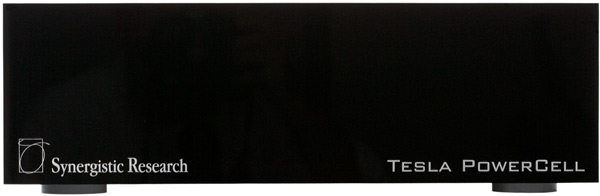
The PowerCell is Ted's new patent pending AC line conditioner. It is based on electromagnetic cell technology, and is available as the PowerCell 6, PowerCell 10, and the PowerCell 10 Special Edition; these numbers correspond to the number of AC outlets each unit has. The PowerCell basically conditions the current by sending the AC signal through an electromagnetic cell. This technology works outside of the signal path to condition alternating current with differential electromagnetic fields, in contrast to most line conditioners that work by placing transformers or chokes in the signal path. The PowerCell uses isolated circuits for each pair of its Teslaplex AC outlets, and the Active EM filter is powered by a 30-volt MPC power supply.


The PowerCell 10 Special Edition is different from the PowerCell 6 and 10 by using an even higher performance active EM filter and an additional Quantum Tunneling process. The PowerCell 6 and 10 have 20-amp IECs for AC connectivity, while the PowerCell 10 SE has a 32-amp Powercon connector. The 10SE also comes with the Tesla Precision AC Active power cord. Both the 10 and 10 SE each has five completely isolated circuits. Ted says it practically gives you five designated circuits.


The PowerCell is sealed and I could find no way to open it without doing damage to the beautifully finished chassis. When I was touring Synergistic Research, Eliott Nomensen asked me not to photograph the inside of the original plywood PowerCell prototype to protect what they believe is groundbreaking technology with applications that reach beyond home audio. This desire to conceal the inside of such devices is often seen by the skeptics as hiding the fact that there is not much in it. I can tell you: My eyes saw plenty inside the one I didn't photograph, starting with an absence of the things I usually see inside power conditioners like  transformers, chokes and capacitors. Instead, inside the PowerCell was a large EM cell mounted on what appeared to be resonance isolating shock absorbers. The whole thing seems to be about how the current comes into and through the EM cell to the 5 individually isolated Synergistic AC outlets. I only share all this because I may not know what's inside all the sealed black boxes, but I promise you there really is something pretty impressive inside this one. In the end, like all things audio, we have to trust our ears. 


The Powercell Story

Synergistic PowerCell 3

When Synergistic Research built the first PowerCell, Ted was eager to test his concept. In his hurry, he did not wait for the metal chassis that was being built and just used plywood, instead, to fabricate a 'make do' chassis for the prototype. After an initial disappointment, the PowerCell begin to break in.


When the PowerCell had broken-in, the system began to be transformed, it opened up and had transparency it did not have before. Ted says, for the next following days, the system continued to improve with a holographic realism, more low frequency impact and high frequency air. It now surpassed anything he had yet achieved in his reference system before. Still, he continued to work on the evolution of the PowerCell's circuitry. First, he added a filter plate for the return AC and then another filter plate  for  the  ground.   It  became  the   third generation of the circuit, and it had by far the best sound, but now they were only a few weeks out from the 2007 RMAF.


Ted wanted to take his prototype to the show so they put a PowerCell into the classy-looking aluminum chassis they had built. Then, they listened and broke-in the final production PowerCell, and much to their surprise, the new metal chassis negated most of the benefits of the PowerCell. They quickly compared the aluminum version to the wooden one, and without a doubt, the wooden chassis significantly outperformed the  aluminum chassis version. So the PowerCell made its debut at the RMAF under a blanket to hide its homemade looking plywood shell.


After the show, they began to look for a suitable material that would allow the electromagnetic filter technology to perform to its full potential. With more time to study the performance differences between metal and wood, they also discovered that the wood outperformed the metal whether the PowerCell was in active (on) or passive (off) mode. So not only was the wooden chassis "invisible" to the electromagnetic cell, it was also doing a better job of absorbing mechanical vibration from AC. It also turned out that the metal chassis transferred mechanical vibration to  the power cords and this created confusion and a loss of clarity in the sound.


Ted began to look for a substance that would not nullify the positive effects of the EM cell and would also absorb as much of the mechanical vibration from the AC as possible. He and his team found a company in southern California that made CNC composite materials into medical and chemical fluid delivery systems. This material turned out to be ideal but, was difficult to fabricate and much more expensive than a conventional steel or aluminum chassis. Ted also insisted on finding a coating for the material that would maintain the piano black finish while being very scratch resistant. So, according to Ted, the final PowerCell uses the latest electromagnetic filter technology with a brand new composite chassis that is electromagnetically inert, with three times the mechanical vibration isolation of carbon fiber, and will keep looking great to boot.


How the Tesla Powercell Affects the Sound of Your System 

Let's start by just talking about how the PowerCell affects the sound, then we will move on and talk later about the whole system. I picked Ted up at the Oakland Airport and we headed to my house to install the Synergistic Tesla PowerCell and Active power cord system. Well, UPS had a different idea, for some reason they put the PowerCell and a couple of power cords on one truck that arrived by ten, but the rest of the cables and active power supplies on another truck that didn't show up until 6:15 that evening. Really, that worked out all right though, because that gave me a whole day to listen to just the PowerCell with my own power cords.


I had already removed my Audience aR1p power conditioners from the system the night before, so all Ted had to do was sit the PowerCell 10 SE on the bottom shelf and plug everything in. Now, the power cord that came with the 10 SE was active so he also plugged in the little wall-wart power supply that would connect to the pigtail from the power cord. There was no power light on the front of the PowerCell, but you could see the blue LEDs on the back. We left it on while we went to Peet's for coffee, and then came back and began to listen.


The PowerCell using my Shindo power cords sounded just wonderful. The bass fleshed out without any boominess, the soundstage was deeper, yet still coherent and whole, the top-end was prettier, and the midrange was faster and more transparent. If you’re worried about plugging a power amp into it, all I can tell you is that my system sounded slightly more powerful and had even greater dynamics and micro-dynamics with the Wavac plugged into the PowerCell then it did before.


The best power conditioners I have used in the past make a fundamental difference in the musicality of my system. They have had the ability to improve the overall detail, transparency and clarity of the sound. The two best that I've used can even do this without inhibiting dynamics, micro-dynamics; or even obscuring the natural rhythm and pace of music.  Now, the Tesla PowerCell does all this, but in a more complete way. For example, the PowerCell does more than just not inhibiting dynamics and micro-dynamics, it furnishes your system with the power that can actually increases them. The PowerCell also increased the musical flow of my system and significantly augmented the system's overall PRaT.


If you are a regular reader of my reviews, you know that holographic soundstaging isn't my highest priority, but that doesn't mean that I don't appreciate a good soundstage and there is no doubt that the Synergistic products release your system to produce a very lifelike soundstage. There is no doubt in my mind that the Tesla PowerCell 10 SE is a cutting edge power conditioner that sets your system free to reproduce recorded music in a way that sound more dimensionally lifelike and more musically alive.

Synergistic PowerCell 4


The Tesla Powercell and Active Power Cord System 

Synergistic PowerCell 5

As good as I thought the PowerCell was with my power cords, you really need to hear what the complete PowerCell and Active power cord system sounds like. When you add Synergistic's active power cords to the PowerCell, it's a whole new ball game. I need to take a moment and explain a couple of things. Yes, it will help your system to add one or two of the Tesla active power cords, but the real magic comes when you put in the last one.


I have played around with taking different cords in and out, if the last cable to go in is the turntable's power cord, then it seems to be the one that makes the biggest difference by far, but if it's the amp's or preamp's power cord then it seems that's the one that makes the biggest difference. Maybe it's because the PowerCell not only treats the current going out to each piece of equipment, but also the current that flows back the other way. Whatever the reason, when you get a complete Active Tesla PowerCell System, it is something very special, so let's get busy talking about it.


Setup


One of the interesting things about Ted is that he doesn't recommend that you put the most expensive power cord everywhere. He feels that some of his power cords work best with different pieces of equipment. My system is pretty simple, it only needs three power cords in addition to the one that goes to the PowerCell. Ted suggested for me to use the Tesla T2 power cords on both my Shindo Masseto preamp and my Clearaudio Synchro Speed Controller. We tried both of Synergistic Research’s T2 and Hologram A power cords on the Wavac EC-300B integrated amplifier, this review was done with the T2 on the amp. Remember when planning your setup, that each of the power cords has a pig tale with a wall-wart that also has to be plugged in also.


What Are Tesla Active Power Cords


I realize I have talked a lot about these power cords without explaining what they are. Nearly all Tesla products have been through what Synergistic calls Quantum Tunneling.


According to Ted, while Quantum tunneling is perhaps their most startling discovery and it came at great cost in terms of trial and error, he says they fried a mountain of cable before the exact formula could be worked out. This process has led to several patents that are pending. Their website has a video so you can watch. The website also says, "Quantum Tunneling is a process that changes the way a cable conducts signal at the sub atomic level affecting the entire cable assembly, connectors, solder joints, dielectric and ground conductors are all transformed and integrated as a single unit." This is done by applying a two-million-volt, extreme high frequency signal to a cable at a specific pulse modulation and frequency for an exact duration of time. Synergistic says this alters the entire cable at molecular level. Even though Synergistic did not finalize the formula until February 2007, most TESLA cables purchased before February 2007 can be returned to the factory for a free treatment.


Not only are the Tesla power cords Quantum Tunneled, but the T2s and up are also active cables. In fact, they use a Zero Capacitance Active Shielding circuitry. Another thing actively loading the dielectric does is saturating the dielectric so that the signal cannot bounce back and forth between the dielectric and the current- or signal-carrying wire. There are other active cables, but as far as I know, no one else has taken it as far as Synergistic has. By the way, the active shielding is the reason the power cords have the pig tales and wall-warts.


Bottom Line: How Did The "Tesla PowerCell and Active Power Cord System" Affect My Sound? 

A whole lot and for the better is the simple answer, but you want to know more, don't you?


I can hear more layering and more tonal nuances than before. The bass goes deeper while it is much quicker and has more impact. The PaceRhythmAndTiming are rather dramatically increased. Dynamics are startling and micro-dynamics are more lifelike than I have ever heard. The soundstage is much more three-dimensional and expansive.  With it in my system, I get the clearest and biggest window on the performance I have ever heard in my room, and I find the musical experience more emotionally engaging than I have felt before. Simply put, the Tesla PowerCell and Active power cord system let my system have a soundstage you would have to hear to believe.


Compared to No Power Conditioning                                                                                   

My descriptions so far of the differences I heard with the Tesla PowerCell and Active power cords was in comparison to the sound I had before I installed them, which included the use of the Audience aR1p conditioners. During the review, I decided to take PowerCell and all the Tesla Active power cords out of the system. I plugged everything into the wall using my Shindo power cords.


The difference was dramatic. The top-end was kind of hazy-sounding and even a little ragged, voices had more grain, dynamics decreased, and the soundstage was not as lifelike. I could go on, but it just wasn't nearly as good. I dare say it was a bigger difference than there would be between the Wavac MD-300B amp ($8500 with WE tubes) and the Wavac EC-300B ($28,500 with WE tubes). In fact, I'm pretty sure I would rather have the little Wavac amp and the Shindo Aurieges MM preamp with the Tesla PowerCell and Active power cord than my current reference system plugged straight into the wall, but then I would never have it plugged straight into the wall to start with. Still, I think this says something important about how important a really first-class power conditioner is to the sound you get from your system.


In Conclusion

I find the PowerCell not only doesn't limit dynamics, it improves them as well as flow, and PRaT. It removes haze and blurring, as well as brings magic to your system’s soundstage. The last thing I would like to address is the question of price. As I mentioned in the review, to me it's a lot more fun to buy most anything but power cords and conditioners. Still in the end, I concluded that the addition of the PowerCell made a bigger difference than a $20,000 upgrade in amplification had in my system. So, if you have a system that you feel has reached some definition of "high-end," then it seems that to me that the Tesla PowerCell and Active cables are a very good investment in better sound.


In fact, I would go so far as to say that, compared to what it would cost to get this kind of sound upgrade through other equipment, the Tesla system is even a bargain. I'll tell you I don't plan to go back to my old power conditioners.


Home  |  Event Reports  |  Equipment Reviews  |  Spotlight  |  Music  |  The Columns  |  Dagogo Classics
Staff  |  Window Shopper  |  Press Releases  |  Reader Response  |  Advertise  |  Contact  |  Sitemap  |  RSS Feed
© Dagogo 2009  |  created by dca/dcpr