Staff |  Window Shopper |  Press Releases |  Reader Response |  Advertise |  Front Covers |  Contact
RSS Feed
Equipment Reviews more reviews »
October 2005
Bookmark and Share

Constantine Soo listens to the Enlightened Audio Designs Ovation Plus as modified by Boelen/Noble Electronics


Constantine Soo

 
Specifications:

Digital Frequency Response: DC ~ 20kHz ± 0.1dB
Analog Frequency Response: 10Hz ~ 20kHz ± 1dB
Signal to Noise Ratio: >120dB (typical)
Dynamic Range: >110dB (typical)
THD+Noise: <-92dB (typical)
Stopband Attenuation: <-120dB
Passband Ripple: <0.0001dB
Phase Linearity: ± 0.1º (20kHz)
Maximum HF Jitter: <10 picoseconds rms (at 20kHz)
ADC Precision Dynamic Range: >95dB
THD+Noise: <-88dB
Stopband Attenuation: <-80dB
Digital Inputs/Outputs:
Bi-phase Mark Code, 32-48 kHz,
SPDIF, AES/EBU, 16~24-bit linear PCM,
16-bit Dolby AC-3 bitstream,
16-bit DTS bitstream,
16-bit MPEG2 bitstream,
HDCD-encoded linear PCM
Optical Inputs: Glass/ST connector x 1, TOSLINK
Coax: 75Ω, 1 Volt p-p
Analog Input Sensitivity:
2 Volts rms (0 dB)
4 Volts rms (-6 dB)
Analog Output Voltage:
8 Vrms (RCA)
8 + 8 Vrms (XLR)
Analog Output Impedance: 50Ω (RCA), 110 + 110Ω (XLR)
Power Consumption: 20 Watts
AC Power Fuse: 400 mA 250 Volt slow blow
Dimensions: 17" x 11" x 4"
Weight: 20 lbs

Manufacturer:
Enlightened Audio Designs
(closed)

Modification:
Noble Electronics Inc
1973 155th Street
Fairfield, IA 52556
Tel: 641-469-5092
Email: greg@nobleElectronics.net


This review addresses the Boelen-modified EAD Ovation Plus’ 2-channel audio performance.  Boelen-Noble Electronics offered me the Ovation in its original form for a first audition, which was returned later to them for modification.  This review addresses performances of the Ovation in these two periods.

For background on Boelen Electronics, please see the Introduction section in the Digital-Precise Review.

Background

In the 25 years since the first market appearance of separate digital-to-analog converters in the late 80’s to the present day, most manufacturers have been designing their products to serve 2-channel audiophiles, except for EAD (Enlightened Audio Designs). 

EAD was founded by Alastair Roxburgh and John Hagelin of Fairfield, Iowa, in 1990, until its acquisition by Alpha Digital Technologies of Ashland, Oregon in 2001.  Since then, Frank Boelen’s Boelen Electronics had been offering modifications and repair to EAD owners, until that portion of the business was taken over by Greg Palma’s Noble Electronics in late 2005.  Though no longer providing modification and repair to EAD owners, Boelen Electronics continued to market the Boelen Digital-Precise digital cable that Dagogo reviewed in March 2005.

As the modification operations changed during the finalization of this review, Boelen/Noble will be mentioned simultaneously in this space.

The PLUS modification performed on the EAD Ovation was a collaboration between the newly formed Boelen/Noble Electronics and Midwest Research Corporation, the latter of which was also founded recently, and headed by Greg’s brother, Robert E. Palma Jr., MRC’s very own President and Chief Engineer.  An important article authored by Robert E Palma Jr., titled Rocket Science Applied To Extreme Audio, will be published here on Dagogo shortly.

According to Greg Palma, EAD’s then-Director of Manufacturing, and Boelen Electronics’ Director of R&D, now Noble Electronics’ President and Director of R&D, EAD began work on Rotel’s then-$499 RCD-855 CD player as its first modification project.  In light of positive reviews on EAD’s Accu-Linear™-based modification, Greg was hired in April 1991 as the third member of the squad to help with the demand growth. 

EAD proceeded to create its first stand-alone DAC in the ensuing months and coined it the DSP 7000.  Fitted with a gold faceplate, this unit was shown to audiophiles in a show in June 1991, and generated a number of orders so significant, that its payroll leaped from that of 4 employees to 20 in a matter of weeks. 

As pointed out by Greg, who had the double duty as the QC Manager in charge of training new employees, 1995 was the year when EAD employed 54+ employees, many of whom were musicians selected by Greg to be trained as assemblyman, for their ability to demonstrate “good skills with their hands”.

Between the interim of September 2001 and December 2004, Alpha Digital Technologies of Ashland Oregon took over and relabeled several products.  The original, 6-channel, TheaterMaster Encore/Ovation/Signature became the TM 6000 series for their 6-channel application, and similarly, TM 8000. 

It was during the same period that Frank Boelen founded Boelen Electronics to provide repair and augmentation services to EAD products, until the founding of Noble Electronics recently.

Per Greg, Alpha Digital ceased EAD manufacture operations around December 31, 2004, and it was not yet known whether EAD would be revived at the time of this writing.
     
A rough history of EAD products:

1990 to 1991: Rotel 855 CD player
1991 to (no data): DSP 7000 DAC
1991 to 1992: T 7000 laser disc/CD player
1992 to (no data): DSP 1000 DAC (an economy version of the DSP 7000)
1992 to (no data): T8000 laserdisc/CD player
1992: Theatervision laser disc/CD player
1992: DSP 9000 pro DAC
1994 to 1997: TheaterMaster (classic)
1994 to 1997: Smart Cable RF demodulator T8000
199?: T1000 CD player
1996: DV1000 DVD player designed with Faroudja
1997: TheaterMaster Encore/0vation/Signature
1997: Ultradisc 2000 CD player
1997: Ultradisc 2000 T CD transport, PowerMaster 2000 (5-channel, 400 watts per channel), PowerMaster 500 (5-channel, 100 watts per channel), PowerMaster 1000 (5-channel, 200 watts per channel)
1999 to 2001: Theatervision P DVD player (with progressive scan output)
2000: Ultradisc Pro DVD player (which later became DVDmaster), PowerMaster (8-channel, which later became PowerMaster 8300 series of development), 8- channel Upgrade for the TheaterMaster E/O/S
     
Ovation Plus

EAD’s TheaterMaster Ovation offered audiophile 2-channel playback on top of the lower model, Encore-based 5.1-channel surround sound playback.  Therefore, inclusive of the various Encore amenities, such as Dolby Digital® 5.1 surround sound, DTS Digital Surround™, Dolby Pro Logic®, MPEG2 decoding, DSP-based 4th order crossover networks, sibilance-reducing CINEQ™ equalization, 6-video-input integrated video switching and RS-232 compatibility, the Ovation was added HDCD® decoding, 6 precision Burr Brown PCM1702 20-bit DACs, EAD-exclusive AccuLinear current-to-voltage conversion chip, Digital Flywheel™ jitter reduction, balanced stereo outputs and remote volume control.

Boelen/Noble Electronics’ modification bestowed the PLUS designation onto Ovation, and its “Mods” sheet stated its goal on the modification of the EAD TheaterMaster Ovation in the following:

“By reducing the power supply noise, eliminating unwanted energy and reduceing the
non musical content in the music pass band, what remains is a more transparent
natural sound.  Boelen Electronics has developed these components and techniques
from many months of R&D in our lab.  These mods have also been field-tested by many
audiophiles who all agreed that the changes and improvements we have made that can
be measured by our scopes, spectrum analyzers and other equipment indeed has a
direct positive impact in the audio range.”


Modification involved the following:

• Replacing 8 original rectifier diodes on the motherboard with a Fairchild “Stealth” soft recovery Diode, to minimize switching transits and ringing in the main power supply circuits
• Adding 8 Boelen/Noble Electronics proprietary DNA (Dissipative Noise Attenuation) circuits to the DAC outputs on LF, RF (RCA & XLR), LR and RR, for reducing unwanted power supplies energy/noise
• Adding 15 Black Gate capacitors for power supply de-coupling in the DAC board’s analog output power supply circuit
• Adding 12 Rubycon capacitors for power supply de-coupling in the 6 DAC’s analog power supply circuit
• Adding low pass filter (LPF) to the LF, RF, LR, RR, Center, RCA and XLR outputs for reducing noise inherent in analog amplifier/driver amplifier, as well as the conversion noise of the DACs.

Operating Ovation Plus


The Ovation Plus came with a blacklit LCD touch-screen remote control and a setup microphone, which is for output level calibration on speakers in a surround sound setup.

All functionalities were accessible only via the touch-screen remote, and the flexibility of the remote in accommodating all functions was impressive, but no more impressive than the array of arsenals presented by the Ovation Plus.  The included microphone with its some 12-foot long cord was to be held at ear level at the center listening position, allowing it to engage the automatic calibration of respective speaker’s output for a uniformly timed sound field from all five speakers. 

Though simpler than a five-speaker setup, my 2-channel, stereo arrangement nevertheless couldn’t escape fault-detection by the EAD OP.  After the automatic setup via the microphone, it showed the output levels of 15.9dB and 16.8dB respectively from the left and right speakers to the listening position.  This is most useful in fine-tuning speakers distancing, especially to a stereo setup like mine.

The Ovation Plus’ 2-channel operation required a few preliminary preparatory steps for performance optimization.  Once set, regular operation afterwards was relatively straightforward and intuitive, but regular reference to the manual proved to be educational and indispensable continuously.
     
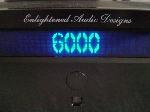
The OP was designed to be on constant standby with the rear power switch set to ON, with full operation to be reactivated only via the supplied LCD display remote.  Upon activation, the blue letters 6000 were displayed, followed sequentially by half a dozen protocol recognition displays, such as “High-End Surround Sound Processor”, “HDCD Audio MPEG2 Digital Audio”, “Premium 20-bit D/A 20-bit ΔΣA/D”, “Switched Resistive Array Volume Control”, and a few luminous others, like that of AccuLinear® and Digital Flywheel®.

The Owner’s Manual, dated 6/9/98, mentioned the need for connecting speakers capable of full-range performance in the 2-channel, stereo listening to the OP in ordert to preserve advantages accorded in HDCD® playback.  The onboard 4th order, user-adjustable crossover was not to roll off lower frequencies from compact front speakers to be sent to a subwoofer, or to release those speakers of reproducing lower frequencies.  Instead, the crossover would send such frequencies to a subwoofer only for augmentation of the front speakers’ output. 
     
For audio, the EAD OP has 3 pairs of ANALOG AUDIO RCA inputs, 3 DIGITAL AUDIO RCA inputs and one ST-type input.  For the purpose of this review, one of the RCA digital inputs were used.


The display of 6000 upon power-on was a remnant of latter software upgrade via an EPROM (erasable programmable read-only memory) computer chip change, when Alpha Digital renamed the series from that of Encore/Ovation/Signature to 6000/8000.  Per Greg, the software upgrade took place after the AD acquisition, which addressed minor system bugs and assured operational reliability.  Although there had been customer suggestions of restoring the display to show Encore/Ovation/Signature, it was never addressed on time.

Set-Up & Auditioning

In the place of a DAC and a preamplifier, the Boelen/Noble-modified EAD Ovation Plus was steered by the 47 Lab PiTracer CD transport, and drove various solid-state power amplifications, including the Audia Flight 100 solid-state power amplifier and the Linn Klimax Twin, as well as the Harmonix Reimyo PAT-777 SET amplifier.  In other times, Audia Flight’s Pre served as the preamplifier.

Primary loudspeakers rotated for this review included the very efficient Acapella La Campanella, and the inefficient Apogee Duetta Signature.  Boelen Electronics’ Digital-Precise linked up the PiTracer to the Ovation Plus, and Audio Note’s AN-Vx silver interconnects ran from the OP to power amplifier, while AN’s AN-SPx silver speaker cable fed the speakers.

Initial auditions on the original Ovation revealed the necessity of coupling it to a high-quality active preamplifier, having failed in my hands to produce the dynamics I crave for when asked to drive a power amplifier directly.  Without a preamp, it sounded mildly compressed at times, especially when playing back dynamic and natural-sounding CDs, such as those from JVC’s XRCDs, and not very extended at the otherwise rich and smooth top-end.

Retrospectively, the factory-Ovation already produced rich top-ends and excellent dimensionality in direct connection to power amplifiers.  Its competence in low-level detailing and ambience decay remained commensurate of a modern, top-quality DAC, thus represented a tremendous value for many audiophiles in the used market. 

Without a preamp, whether it was with the Harmonix Reimyo PAT-777/Acapella La Campanella system, or the Audia Flight 100/Celestion SL700 system, the factory-EAD consistently manifested an inability to attain my preferred dynamic threshold.  Yet, in terms of output, the factory-EAD was already adequately loud at -25dB attenuation on its own, albeit truncated dynamics.

After experimenting with its coupling to the Audia Flight Pre, I found the factory-Ovation to be not summarily devoid of merits in dynamics.  Once arriving at 0dB attenuation in tandem to the Audia Flight, it was transformed, its feeble signal being seemingly accelerated and enriched via the external preamplification.  Consequently, transients became more incisive, giving recreation of instruments enhanced distinction.

I would’ve been twice as enthusiastic had the Boelen/Noble folks just boasted a little about what their work would do to the factory-EAD, for I was less than impressed when the factory-Ovation left, but considerably shaken when it came back modified.

Upon its return, the Ovation became Ovation Plus, a new entity refitted with 15 Black Gate capacitors, 12 Rubycon capacitors, Fairchild “Stealth” soft recovery Diode, Boelen/Noble’s own concoction of Dissipative Noise Attenuation and some low pass filters, displayed its foremost metamorphosis in the newfound dynamic capacity and tonal complexity.  For I inserted it back into the system sans a preamplifier, and there it performed to my approval until the day of its imminent departure. 

This time, the Ovation Plus was able to drive power amplifiers directly without the mildly truncated dynamics, showing no strain in producing gratifying transient swings.  The same -25dB of volume summoned persistent displays of dynamic and tonal sophistication.
     
For example, the stark contrasts in dynamics between the Japanese 3-string shamisen and rumbling taiko from the JVC XRCD2 Ondekoza (JVC XRCD2 SVCD-1027) were presented in invigorating drama by the Ovation Plus, with differentiating scales and vigor, conveying a most convincing reenactment of the event.

Piano, the one instrument harnessing a consummate spectrum, is always the most revelatory in caliber of an audio system used for reproducing its sound.  In this case, classical piano in the hands of Sviatoslav Richter in yet another JVC XRCD (Beethoven: "Appassionata" & "Funeral March" sonatas, JM-XR24017), also dazzled with fine layers of hovering, complex tonality via the Ovation Plus, and was anchored appropriately by the reverberating, resounding hammering of the piano.  It was one of the rare occasions in my system that a DAC had reproduced a variety of instruments in such realism sans a preamplifier.

Putting the Audia Flight Pre back into the loop, with the OP set to 0dB attenuation again, I was in receipt of a second astonishment. 

In addition to dynamic and tonal finesse, there was an unimpeded spectral clarity and bottom-end solidity, rivaling the best in today's solid-state DACs I’ve experienced. Undoubtedly, the Pacific Microsonic™ HDCD® scheme, being an integral part of the audiophile 2-channel playback, contributed to the uniqueness of the Ovation Plus.  Frankly, it became hard to tear myself away from listening to music via the EAD OP.

Conclusion

The Boelen/Noble Electronics-modified Enlightened Audio Designs TheaterMaster® Ovation Plus asserted a higher plain of performance classification than the original version, and surpassed my expectations of a DAC/preamplifier combination.  The value of the modification is further enhanced for latecomers purchasing a used EAD Ovation or 6000 and then opting for the Noble upgrade.

Modified, the Ovation Plus of Boelen/Noble is an embodiment of brilliant re-engineering of sorts, and for readers who invested into this machine, the $1,295 modification cost will at the least bring the stock unit’s performance up to par with some of today’s best under $5k. 

Therefore, it is most definitely to the audiophiles' advantage that one of EAD’s former principal employees is utilizing his experience from EAD and continuing to offer post-purchase modifications to EAD owners.

In its heydays, Enlightened Audio Designs was a much celebrated new wave in its forward design and thoughtful engineering, and its products helped propagate a memorable momentum in audiophiles’ adaptation of DAC/preamp designs.  Though now defunct, EAD’s worthy products were designed with upgradeability in mind with the highly modular platform, and Boelen/Noble Electronics’ has proved to be most competent and instrumental in serving EAD-philes.

It is surprising that with such elaborate signal processing going on, the defunct Enlightened Audio Designs’ TheaterMaster® Ovation signal processor’s 2-channel music presentation could still attain such level of sonic competence even to today’s standards.  Buy an EAD Ovation/6000 now before everyone finds out – before the worth of these marvelous machines are bid up in various venues.
     

Comments from Noble Electronics


Dear Constantine,

Thank you so much for that wonderful review.  You truly have a gift for describing all the
subtleties in musical playback. Your poetic words are very charming and kind.  You did
a great job of the history of EAD.  The whole review was like a piece of music where one
segment would segue into another.

Thanks again Constantine for the kind review.  It's a pleasure working with you, and I
look forward to our next collaboration.

Warm regards,

Greg

Greg Palma
Noble Electronics Inc

The new home of EAD service and Boelen Mods
1973 155th Street
Fairfield, Iowa 52556
USA
greg@nobleElectronics.net
641.469.5092


Home  |  Event Reports  |  Equipment Reviews  |  Spotlight  |  Music  |  The Columns  |  Dagogo Classics
Staff  |  Window Shopper  |  Press Releases  |  Reader Response  |  Advertise  |  Contact  |  Sitemap  |  RSS Feed
© Dagogo 2009  |  created by dca/dcpr