
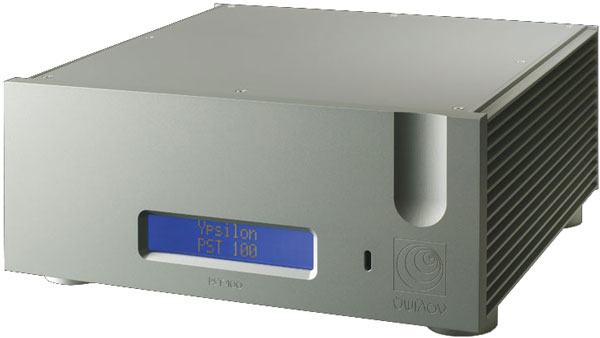
 WARNING: Any audiophile who has no self-control over his or her audio spending (unless you’re very wealthy) should not read this review!
“A Really, really (really!) High End Company”
As you can guess from the opening sentence of this review, Ypsilon components are expensive – $36,000 for the PST 100 MK2, the subject of this review. As you can also guess from that paragraph, they are really, really good. How good, and how does it compare? So good that I won’t be spending a lot of time splitting hairs. The Ypsilon PST 100’s strengths are so obvious that I can get right to the point and hope my editor doesn’t think that I need to make this review more detailed. (We’ll see. –Ed.)
The maker of this fantabulous (fantastic + fabulous) preamp is a Greek company named Ypsilon. I’ll need to ask them how and why they chose that name. Perhaps it’s linguistic. Wikipedia indicates that upsilon (uppercase Υ, lowercase υ; Greek: Ύψιλον) is the 20th letter of the Greek alphabet. In addition, in the system of Greek numerals it has a value of 400. In early Greek, it was pronounced like oo. In Classical Greek, it was pronounced like French u or German ü — a sound that is not found in most dialects of English. In Modern Greek it is pronounced like continental i or English ee.
On the other hand, maybe it’s scientific. Also according to Wikipedia, the Upsilon meson (ϒ) is a flavorless meson formed from a bottom quark and its antiparticle. It was discovered by the E288 collaboration, headed by Leon Lederman, at Fermilab in 1977, and was the first particle containing a bottom quark to be discovered because it is the lightest that can be produced without additional massive particles. It has a lifetime of 1.21×10⁻²⁰ seconds and a mass about 10 GeV. I knew you’d want to know.
What I do know is that Ypsilon has built quite a reputation in other parts of the world and has retained Brian Ackerman’s Aaudio Imports as its US distributor. Brian has done an amazing job in finding fabulous audiophile gear and bringing it to the US, so when he said he had found a great preamp, I love to listen. In our July Issue, Constantine Soo reviewed the Ypsilon SET 100 monoblock amps, and this month I have the privilege of writing about the matching,Ypsilon PST-100 MK2 preamp.
The Design
I almost said “who cares?” to this section. The Ypsilon PST 100 MK2’s design defies categorization. Oh yes – it seems simple. It’s a tube preamp using two Siemens C3m triode tubes. However, the preamplifier requires that you forget most of what you know about how preamps sound. As Ypsilon’s website states:
“Conventional wisdom suggests that the most critical part of a preamplifier is the active circuit design. Ypsilon, however, believe that the means of signal attenuation (the volume control) is the most critical to the overall sound of a preamplifier.”
Ypsilon believes that even the best resistor-based volume controls are too noisy to achieve the best sound, which they define as the sound of live performances. They prefer transformer-based volume controls:
“In a transformer, however, the magnetic circuit can be ultra linear when the very best core materials are used. The sound of such materials is much more musical and detailed compared with the best resistors. So Ypsilon produced, in-house, a special transformer attenuator with 31 taps.” The following is table of the volume attenuation levels in both active and passive modes:
for passive mode
up to ” 5 ” 3db
up to “10” 2db
up to “28” 1.5db
up to “31” 1db
for active mode
up to “11” 3db
up to “16” 2db
up to “34” 1.5db
up to “37” 1db
Ypsilon also believes very strongly in single-ended design, and has incorporated such design in its power products.
“The active gain stage is a no–feedback S.E. triode, transformer coupled. The power supply uses valve rectification and choke regulation. Wiring is made with custom made pure silver wire. The transformer attenuator is placed after the valve stage, preserving the purity and micro details of the signal.”
The use of a single-ended design is interesting not only from a design standpoint, but also from a “feature” standpoint. As you will note from the picture at the beginning of this article, the PST 100 MK2 sports one XLR input and one XLR output in addition to its single-ended inputs and one single-ended output. These XLR connections are not balanced. If you want balanced operation you need to get Ypsilon’s BC1 Transformers for the output. Fully balanced operation with the BC1’s adds $3600 per pair, not to mention the cost of another pair of cables. BC1’s are great products in their own right, adding isolation which results in lowering the noise floor and letting through even more natural-sounding detail. I hope to do a separate review in the next few weeks.
The tubes used in the PST 100 MK2 are Siemens C3m, obtainable for $20 each. Ypsilon claims that the PST 100’s tubes should be good for up to 15 years or 10,000 hours of operation. This is totally contrary to my prior but admittedly dated experience with tube preamps, where expensive tubes were necessary to get the best sound, and where I seemed to be replacing a tube every several months. Maybe I’m exaggerating a bit, but it sure felt that way when a tube went bad during a Saturday listening session and I had no replacement on hand. In my book, this ability to operate on the same set of tubes for an extended time is a substantial benefit.
Features
Let’s take the natural segue and talk briefly about features. Compared to the plethora of features built into my MBL 6010, the PST 100 is almost bare-bones.
This is reflected in the very sturdy and substantial remote control, which has only 6 buttons: 2 for VOLUME (up and down); 2 for INPUT SELECTION (cycling through the available inputs either forward or backward); 1 for POWER on/off and 1 for selecting either active or passive mode. I mention the remote right up front, because the PST 100 is only controllable by the remote – there are no controls on the preamp itself. I’m not a big fan of this approach in audio components, but I will also say that it didn’t affect my usage.
There are 6 inputs – four pairs of RCAs, one in XLR single-ended configuration and one pair of RCA that can be used for the recording function.
The two outputs (RCA and XLR) are usable simultaneously.
One of the key features that sets the PST 100 apart is the option of operating it in purely passive mode. The ability to select active or passive operation was extremely instructive, and illustrated the importance of your front-end’s output level. I operated happily in passive mode of preamplification for many years, so I am very familiar with its advantages and disadvantages. The Ypsilon’s ability to operate in one or the other gives you the opportunity to maximize the purity and/or strength of your signal. In terms of tonal purity, the PST 100 can be really stunning in the passive mode.
If you choose the entirely passive mode, you will get no gain at all. If you use the active mode (the default mode), it’s passive to –38dB, at which point the active mode routs the signal through a triode stage before the transformers. Active mode leaves the lowest volume settings entirely passive up to “6”, and upward to a maximum of ‘37’, gain is applied.
The PST 100’s maximum attenuation is 52dB, and maximum gain is 16.9dB, all in 1.5dB steps. I would have preferred slightly smaller steps, such as 1.0dB (or even smaller), but I had no problems with volume level. According to the manual, passive mode is best suited for use with source components possessing less than 3k ohm output impedance. Otherwise, or if gain above unity level is desired, you should use the active mode.
PST 100 is available without the valve, active stage if you don’t require additional gain. This version is equipped with the transformer attenuators and is called PST 100 TA. It is fully upgradeable to the full version at any time by returning to factory. Retail for the PST 100 TA is $25,000.
The Test System
The front-end, digital room correction and speakers of the test system were consistent throughout: my own specially modded (by The Upgrade Company) Esoteric P-70/D-70 transport/DAC tethered by three Transparent Reference Digital cables; Lyngdorf RP-1 room correction (specially modded by the Upgrade Company) and Bowers & Wilkins 800D speakers. The amps were Shengya PSM-600 (review to come), Plinius Reference (two, used as monoblocks; review to come) and Electrocompaniet Nemo monos. The cables were either my own Silent Source Signature interconnects and speaker cables or Aural Symponics Hybrid v2 biwire speaker cables and Chrono interconnects. The following preamps were used head-to-head with the Ypsilon PST 100: Shengya CS-6 (review to come), Pass Labs XP-20 (see the July 2009 edition of Dagogo) and MBL 6010.
Disappearing Act
I mean it. I don’t know if things “disappear” any more if you use the Ypsilon PST 100 with the Ypsilon SET 100s and the Ypsilon CDT 100/DAC 100 transport/DAC (reviewed by Jack Roberts), but the effect was unmistakable. Performer separation was absolutely phenomenal, and mine was pretty good to begin with. Each performer was in a distinct space, yet the music emanated naturally from that space to every corner of the room. I have listened to several components that accomplish excellent separation (the excellent Pass XP-20, the YG Acoustics Kipod speakers and a few high-end monitors), but the Ypsilon PST 100 does this more naturally than anything I’ve encountered.
Of course, separation must be coupled with integration, or you risk losing the overall presentation of the orchestra. Yet, in my view, the PST 100 MK2 gets it just right. This combination of separation and integration makes for an amazingly transparent soundstage which nonetheless carries an excellent weight and body in the bass and midrange. In my experience, when you combine this type of separation with good tonality you can experience “fool me” moments when you can swear that the players are in the room.
Speaking of tonality…
Timbre and Tonality
My first listen with the PST 100 in the system caused me to think that its tonality was really good. My second listen made me think that it’s the best I’ve ever heard. My third listen made it clear that the PST’s tonality is ridiculously good.
This characteristic covered the entire sonic spectrum, from pipe organs to piccolos. I listened to some orchestral music (Holst’s The Planets) which I’m used to hearing through my MBL 6010. I noticed that the tympanis, standing bass and horns sounded lighter when listening through the PST 100 and thought “Ha! It doesn’t reproduce “heavy” tones as well as the 6010!” So I teed up a really “heavy” tune: Robert Palmer’s “Addicted to Love”, which starts with a very heavy rhythm that incorporates a grinding bass. Much to my surprise, the PST 100 reproduced this sound in a manner that was virtually identical to the way it sounds through the MBL 6010, just less congested. I went back to the previous track on The Planets and listened more carefully through the PST 100. After a few minutes I realized that the sound of the horns was more accurate. After making a point of paying special attention at live performances, I came to the realization that I had simply gotten used to the sound through the 6010, which apparently “prettifies” the horns a bit while the PST 100 plays them as they sound live.
This experience was repeated on some other pieces of music, such as the Subdudes Miracle Mule, which has a very “live” sound that mimics the band’s live performances. I listened to the CD and subsequently attended one of their performances. It became clear that the Ypsilon PST 100 was simply better at projecting the small nuances in some instruments’ tone and timbre. This is an amazing accomplishment in light of the fact that the MBL is one hell of a preamp.
The PST 100’s tonal purity was great in either the passive or active mode, but on certain pieces of quiet and delicate music, notably with piano, flute, violin and clarinet, the passive mode produced an absolutely heavenly sound that made you feel as though the performer was in the room.
Speed and PRAT
I’ll keep this short. I absolutely crave top-notch speed, pace, rhythm and timing and rapidly discard any component that isn’t up to snuff. Moreover, I demand it without any loss of body or musical weight, which is not easy if you run full-range. My general experience is that components that are transparent and have good tonality are generally good at reproducing the speed, pace, rhythm and timing of every kind of music, and the PST 100 is no exception. In fact, it’s in the top echelon of preamps in this category, along with the Pass Labs XP-20, and the Ayre K-1xe (I haven’t heard the Ayre KX-R). Turning again to Robert Palmer, a particularly telling piece is “Bad Case of Loving You (Doctor, Doctor)”. The kick drum actually lags behind the music in any full-range system that doesn’t have top notch speed and PRAT. The PST 100 gets it perfectly without skimping on the weight or tonality of the bass. I’ve had several very expensive preamps in my system that simply don’t keep proper time when this piece is playing.
Dynamics
The Ypsilon had very good dynamics, superior to the vast majority of preamps I’ve heard. In this case however, my MBL 6010 proved to be a bit better. From sonic memory, it may be that CTC Blowtorch would also be more dynamic. In fact, I’d love to hear a head-to-head of the PST 100 with the Blowtorch! In The Planets, the crescendos in “Jupiter” absolutely explode from the speakers, and good preamps really highlight this explosion. The PST 100 does very fine job with this, but the MBL 6010 makes you jump out of your seat. Nonetheless, it is unlikely you will be disappointed with the PST100’s dynamics.
Conclusion
I wish I could have listened to the Ypsilon PST 100 with other Ypsilon components. Its superior sonic qualities stand out even when compared to very good preamps, and even when compared to some of the best preamps available. How good would it sound when coupled with components it was specifically designed to work with?
When compared directly to my own MBL 6010, with its extremely extensive features and multiple separately-controlled outputs, the PST 100 seems like a stripped-down pre. Yet, except for its dynamics, which are “merely” very good, I have to admit that the PST 100 demonstrates what “cutting edge” really means.
The $36,000 price tag naturally raises the issue of value. I have struggled with this over the past two years as I’ve had the luck to review some of the best, and most expensive, components made. Are only the very wealthy destined to be able to afford such sound? Nonetheless, there is no disputing the fact that this is a preamp that stands at the pinnacle of sonic splendor.
- (Page 1 of 1)








Where in the chain did you have the RP-1?
As a user of a PST 100 MK II SE, I agree in full about the outstanding sonic qualities of this wonderful preamp. Highly recommended.