Constantine Soo reports on living with objects created by master craftsmen and national living treasure of Japan that is the Feastrex Makoto loudspeaker system
Constantine Soo
Specifications:
Type: Single-driver, transmission line
Driver: 5-inch field coil
Efficiency: 100dB/16Ω
Dimensions: 70.5" H x 8.75" D x 9.5" W (rear tower), 47.5: H x 6.5" D x 9.5" W (front tower)
MSRP: $69,500/pair
Manufacturer:
IBI Co., Ltd.
Aesthetics Development Division.
7841 Anayamacho,
Nirasaki, Yamanashi 407-0263 Japan.
Because of scarcity of resources and prejudices in differences, the world we are living in is not a peaceful one. The modern day economic engine harbors the hopes of many for a more peaceful and tolerant global village, one that is blessed by equality in not only social and economic statuses, but also one that equalizes the distribution of necessities of daily living, so that every one of us, regardless of race and creed, will know contentment and happiness, thus becoming a member of an unceasing global movement toward peace and prosperity.
Conversely, progression into such a new world will initially result in homogeneity of consumer goods, and we are witnessing the metamorphosis of the old world into the new world with what we use and drive, that is, what we need to conduct our daily activities. Scarcer and scarcer are high-quality, traditional handmade crafts that we will never be able to behold and appreciate.
Amidst the stream of progress is the Feastrex Makoto, an outgrowth of a treasure of labor of love from three artisans, Mr. Haruhiko “Hal” Teramoto, designer of Feastrex drivers, Mr. Ichibei Iwano, master Japanese traditional washi papermaker and a designated Japanese National Living Treasure and Mr. Makoto Tanaka, master nushiya wood craftsman.
Feastrex features six complete loudspeaker systems, and five of the enclosures of these models are manufactured by Sakae Kogei, a Japanese specialized loudspeaker enclosure manufacturer. The Makoto’s cabinet is custom made by Mr. Makoto Tanaka and carries a price tag of $23,000 the pair. It is a Douglas Fir plywood enclosure with as many as 40 layers of urushi lacquer.
The Driver
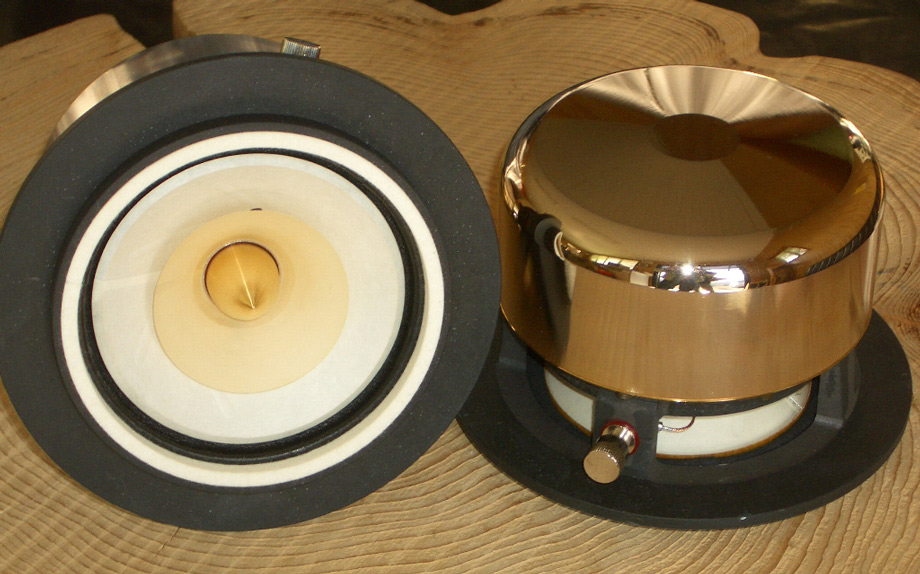
▲Feastrex D5e Type III
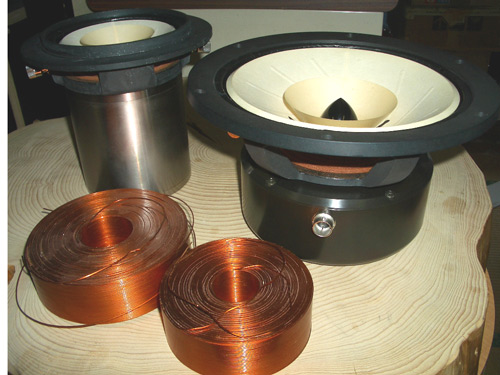
The Feastrex driver appointed to the Makoto cabinet is the D5e Type III, a $46,500 pair of 5-inch field coil version of the company’s all-Permendur alloy driver assembly. The Feastrex Makoto sports a nominal sensitivity of 100dB at 16 ohms.
Permendur possesses the highest known saturation induction of any material, and in magnetic fields above 16,000 Gauss, superior permeability than iron or iron silicon, thus assuring the highest level of dynamic transients and signal purity in drivers made with it. Permendur is first machined extremely carefully, as it is very difficult to be made into the continuously curved shapes required by the driver’s magnetic circuit. The parts are later annealed in a pure hydrogen environment for the better part of a day. The frame, pole piece and yoke are then machined separately and press fit. According to Joe Cohen of Lotus Group USA, Feastrex’s U.S. Distributor, “The exterior of the yoke is Nickel and then Gold plated with the top and bottom portions buffed smooth. The middle section has very fine and faint machine marks left on it which display something of a moiré pattern when highlighted.”
Cone material chosen to fully convey the power and control as asserted by the Permendur construct was what Mr. Teramoto considered as the most natural-sounding: a high-grade Japanese traditional washi paper made from mulberry called ho-sho-shi. This paper was developed in the Japanese middle ages for recording edicts from the Shogan, with the official Shogunate signature and seal for promulgation as law. Because it is not made from wood pulp like other papers but entirely from the inner bark of the mulberry tree, it garners tremendous strength for its tight, random interlock of fibers. As a cone material, Mr. Teramoto was of the opinion that paper would garner the least artificial tonality among all driver materials, be it metallic or mineral, and the traditional Japanese washi paper became his first choice for its unusual density.
D5 & D9e▼
Mr. Teramoto solicited the help of one Mr. Ichibei Iwano, a ninth-generation family washi paper maker who was designated ‘a Holder of the Intangible Cultural Asset, the Techniques of Echizen Paper (the official designation of a "Living National Treasure") in June 2000 (Source: http://www.kougei.or.jp/english/crafts/1004/d1004-5.html).
According to Joe, the Iwano washi paper hones a density of fiber many times that of ordinary paper. In fact, the Iwano washi paper is worn as part of a traditional Japanese ceremonial attire. After the manufacturing process, the washi cone was incorporated with spiral pattern with embossed ridges manually by Mr. and Mrs. Teramoto to enhance its rigidity. The end result is a paper fiber cone with density several times higher than other paper cones, one that is also devoid of residual starch or nutrient content, enabling the final product to be free from being fed on by insects, thus lasting for centuries. Even the driver’s surround was made with lamb skin, casting a stark contrast with all other foam material that corrodes over time.
Mr. Teramoto’s fanatic drive for perfection is further illustrated with the use of titanium screws on the driver. Readers interested in learning more about the washi used in the D5e III can visit the English site.
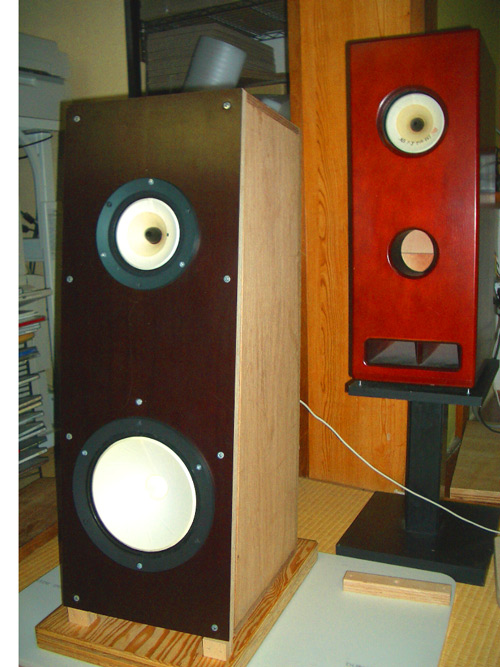
While the Makoto cabinet can be fitted with any Feastrex driver, there are five less labor-intensive complete systems of the same plywood material as mentioned earlier without the urushi lacquer. The top 3 systems comprise the Permendur alloy field coil driver series of the DM-5e3 with D5e Type III driver, the DM-5e2 with the Type II driver and pure-iron DM-5e1 ($16,500/pair) with Type I driver in the 70-liter internal volume cabinets. The other two systems comprise the Monster Alnico-equipped DM-5 ($15,500/pair) and the Naturflux field coil driver-equipped DM-5nf ($8,700/pair) in 60-liter internal volume cabinets.
All individual Feastrex drivers are also available for custom builders. There are a total of six 5-inch drivers and five 9-inch drivers. In the 5-inch family, they are the D5nf Alnico ($4,300/pair), Nf 5ex Naturflux field coil ($5,900/pair), D5 Monster Alnico ($11,150/pair), D5e Type I field coil ($11,350/pair), D5e II and D5e III. The 9-inch drivers include the D9nf Alnico ($7,950/pair), D9 Monster Alnico ($23,000/pair), D9e Type I field coil ($12,100), D9e II and D9e III.
The top two drivers in the D5e and D9e series culminate progressive use of the Permendur alloy in the driver assembly, beginning with the Type I’s iron-only monocoque (one-piece) face plate, yoke and pole piece driver. Type II drivers feature Permendur pole piece and face plate, with an iron yoke. The Type III drivers feature all the Type II amenities, with upgrade options for adding urushi lacquer on the frames ($8,300 for 5-inch, $13,000 for 9-inch), plus ebony phase plug and voice coil ($1,000 for 5-inch, $1,300 for 9-inch). A phosphor bronze frame with urushi lacquer marked the ultimate upgrade for the Type III. All Feastrex drivers come with cast aluminum frames as standard.
Because of the heavy applications of the Permendur alloy in Type II and Type II drivers in the D5e and D9e series, the actual pricing of the Permendur-rich Type II and III drivers and their respective complete loudspeaker systems is contingent upon the pricing indexes of the metal market at time of order.
Field coil drivers loses its magnetic charge when the power is turned off. In actual operation, each D5e III in the FM is connected to the accompanied PS-1 power supply via a Neutrik™ connector port next to the speaker binding posts. When energized, the magnetic permeability of the D5e III reaches 10,000 mµ with a magnetic flux density of 20,600 Gauss. Normal speakers are capable of less than 2/3 of such magnetic strength. Even the iron-only Type I is capable of a magnetic permeability of 4,000 mµ, and a magnetic flux density of 16,000 Gauss.
The PS-1 power supply allows a choice of 10, 12 and 15 volts setting. Per Joe, the sound would be more relaxed at the lower settings, and the highs and lows will tighten up at higher settings. In the words of Joe, “The D9e defines transparency, is the king of microdynamics and the emperor of inner detail. It operates at speeds not normally experienced by ordinary folk and deals in unlimited space as a sideline. It tickles and warms, but cracks like lightning. It says, ‘I am what you didn't even know to ask for, but when I show up, you know what I am.’"
The Enclosure
In Dr. J.J. Rein’s The Industries of Japan (1889), a classic on Japanese traditional crafts, he wrote about the urushi lacquer ware in the following excerpts: “Among the many well-developed branches of Japanese art industry, lacquer work undoubtedly takes the first place…..in no other have they so surely won eminence among all civilized people…..in scarcely any other branch of their industry is the employment and use of the raw material so varied, the purposes and excellence of the articles it serves to adorn so manifold, as in the case of the Japanese lacquer-work, and the industry which gives it value.” The above quote is taken from the Feastrex Makoto Background whitepaper.
Mr. Makoto Tanaka studied woodwork under the tutelage of Mr. Kiyotsugu Nakagawa, a designated national living treasure by Japan’s Ministry of Education, Culture, Sports, Science and Technology. Mr. Tanaka himself is an award-winning member of the Nihon Kogeikai, Museum of Japanese Traditional Art Crafts. Most importantly, Mr. Tanaka is also an audiophile and a single-driver enthusiast, having built many of his own designs since teenage years. He heard about the Feastrex D5e Type III field coil drivers, and visited Feastrex’s Nirasaki headquarters to get a pair, the rest was history.
Because the D5e’s field coil frame operates in temperatures not burning hot but nonetheless very hot to the touch, temperature differences between the field coil and the rest of several prototypes’ solid wood baffles caused the baffle to crack. Hence, ¾ inch plywood was adopted for the final prototype.
The Feastrex Makoto is a vented design. The flow of air from the back of the cabinet is routed down the front pipe and then up the rear pipe, exiting on top. Because of its resemblance to the Loch Ness Monster, Feastrex dubbed the cabinet “Nessie”.
The Feastrex Makoto is not Mr. Tanaka’s first urushi-lacquered loudspeaker cabinet design, having created urushi loudspeakers for many of his clients, who reported very positive results on the sound quality. The Feastrex Makoto whitepaper titled, “Background information on urushi & nushiya Makoto Tanaka’s Feastrex loudspeaker enclosures” begins with the following description: “Urushi is obtained as grayish-yellow milk-like sap from a small deciduous tree (Toxicodendron vernicifluum or formerly Rhus verniciflua) in the cashew family which originally came from the low-lying parts of the Himalaya Mountains (near Bhutan), but has since been established in many other countries, with the most significant being Japan, China and Korea.”
In Japan, urushi lacquer ware has long been created in the form of highly-prized artwork and tableware for centuries. The main active ingredient in refined urushi is urushiol, an organic oil toxin that loses its allergenic properties and becomes completely safe after it is bonded to the surface in the finishing process. The urushi finish is also antimicrobial, thus allowing many lacquered products to retain its beauty and becoming beloved heirloom pieces, being passed on within the family from one generation to the next.
The urushi lacquer used in the Feastrex Makoto is of the finest grades from Japan, where the urushi tree is grown to around 3 meters in height for a period of up to 20 years. At which point, every day from April to late October, the urushi sap is extracted from male urushi trees in a process called kakitori, during which an incision of 15 to 20 centimeters is made on the trunk to extract the urushi sap. At the end of October, “each urushi tree is girdled, extracting the last bit of sap but killing the tree in the process.” Each tree can have as many as 1,000 incisions, producing anywhere from 150 to 200 cc of raw urushi.
On the Feastrex Makoto, each layer of the urushi varnish on the enclosure requires a solidification period, which generally lasts 12 to 14 hours. It is then painstakingly hand buffed to perfection. The entire Feastrex Makoto is completely urushi-lacquered inside out, for each panel of the speaker cabinet is completely lacquered on both sides prior to assembly, with areas containing as many as 40 layers of lacquering. The urushi finish continues to harden following initial application, and is very susceptible to scratches for the first six months. Afterwards, the finish will have cured to a hardness suitable for normal use. Final hardness of the lacquer will take another decade or two to materialize, but the first two years will see a hardening of the lacquer close to the final hardness.
Dagogo readers may remember the “hands-off” signs at the Feastrex/Lotus Group USA Exhibits at 2008 Rocky Mountain Audio Fest and 2009 CES. The cause for such precautionary measure is at once appreciated when one realizes the Makoto’s urushi-lacquered finish is, at that time, at a very soft HB pencil lead hardness. While fingerprints could be removed with a “super” clean, slightly damp cloth, permanent impressions could be left by the slightest of touches, such as fingernails. Per Joe Cohen, dry cloths are not allowed to clean the finishes, as the dust particles contained within are as hard as diamonds and will mar the surface. The fact that Joe entrusted his Makoto with me for review is a serious honor bestowed. I dare not dust the Makoto myself.
Because the urushi lacquer is extracted from trees, it is definitively environmental-friendlier than finishes derived from petroleum.
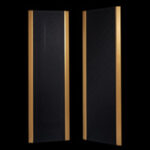
The Makoto enclosure is a combination of two towers, with the rear, taller tower measuring 70.5-inch tall by 8.75-inch deep by 9.5-inch wide, factoring in the ¾-inch panel thickness on each side, coming in at around 4,002 cubic inches for internal volume, or 65.4 liters. The front, smaller tower housing the D5e III measures 47.5-inch tall by 6.5-inch deep by 9.5-inch wide, translating into 1,840 cubic inches of internal volume, or 30 liters. Hence, the Feastrex Makoto has a total internal volume of 95.4 liters.
Setup
The Feastrex Makoto had a slender physique and an estimated weight of around 150lb. The 9.5-inch width and the 16-inch depth of the FM was the second slenderest, sleekest looking full-range loudspeakers I’ve had the pleasure of reviewing, next to the Bӧsendorfer VC 7 at 52.4-inch tall by 7.7-inch wide by 15.9-inch deep, although the Feastrex is much taller with its rear tower.
The Feastrex was comparatively easy to move around on carpet, and after finding satisfactory results in no less than 3 positions, namely closer together and largely toed-out, further apart and completely toed-in and furthest apart with over-toed-in, I decided to reap the benefit of super stable soundstaging with least side-wall interaction in the last placement option. The caveat is, with the Feastrex so easy to move around, I can see myself toeing them out once in a while just to soak up some of the ambience of a church or concert hall. Spikes were threaded through woodblocks underneath the speakers that extended to the outside of the speakers, and could be unscrewed to facilitate moving of the speakers.
For well over five years, I have relied on my 47 Laboratory 4704 PiTracer CD transport and my Audio Note DAC5 Special for the most superlative source signal. The one preamplifier that I have found to be consistent in providing the utmost signal integrity has been my discontinued Pass Labs X0.2 3-chassis system. I have been told by Pass Labs that their latest XP-20 2-chassis preamplifier would be superior. We shall see.
Amplifiers rotated in driving the Feastrex Makoto were the $28,500 8wpc, 300B-based push-pull integrated Audio Tekne TFM-9412 Pre Main Amplifier and the $17,000 Pass Labs XA100.5 solid-state class A monoblocks, in spite of the fact that the Feastrex was 100dB sensitive. Wireworld’s latest Platinum Eclipse Reference XLR and Gold Eclipse XLR partook in routing signal from the DAC to the preamp, and preamp to power amp. In the case of the Audio Tekne TFM-9412, the Platinum Eclipse Reference was put into place. Acapella’s $23,200, 3-meter pair of the pure solid silver, ceramic insulated, mechanically damped La Musika Reference single-wired speaker cable and Wireworld’s $13,200 pair of Platinum Eclipse Reference speaker cable in 2-meter length alternated in linking the amplifiers to the speakers. Power cabling for the Audio Tekne was via the company’s own AC cord and the attendant ALT-8905 AC Conditioner, while Isoclean’s Super Focus power cables powered the Pass Labs monoblocks.
The Feastrex PS-1 external power supply’s primary purpose was to provide critical voltage stabilization toward magnetization of the field coil drivers. Without the PS-1, the individual drivers would become highly sensitive to incoming wattage from amplifiers and be easily burned up. In selecting between the operating voltages of 10, 12 and 15 volts, my preference was consistently the 15 volts, which I thought was the only choice if we were to reap the fullest extent of the D5e III’s dynamic transients, top-to-bottom coherency and a full development of the three-dimensionality. To avoid imminent driver damage, no signal is to be inputted into the driver’s voice coil when the field coil exciter power supply is turned off.
New Craving
The mere presence of a super-sensitive speaker would be more than enough for the most diligent among us to do an about face in amplification choice and rekindle our devilish fantasy for a 3-watt SET amplifier. Well, as a former owner of one of the best SET amplifiers, the Harmonix Reimyo PAT-777, I did not find my listening experience shortchanged with either the Audio Tekne TFM-9412 or the Pass Labs XA100.5 monoblocks. Because long-term exposure to the Feastrex nourished my craving for audiophile recordings with airy highs, sparkling midrange, realistic dynamics and lifelike dimensionality to the nth degree. The Acapella La Muskia Reference speaker cable empowered weightier and more developed presentation both spatially and tonally through the Feastrex, while the Wireworld Platinum Eclipse Reference indulged my frenzy for the Feastrex transparency with tonality that was a little leaner and a soundfield that was a less spacious but a little more exacting. Both, at the end, were considerably superior to my Audio Note AN-SPx.
Although conventional, proven wisdom taught us that low-wattage SETs should always be preferred when driving high-sensitivity speakers so as to harness the uniqueness of the SET, in the Feastrex’s case, that would be an oversimplification. The Audio Tekne, despite not being an SET but a push-pull design, was nonetheless perfectly complimentary in inducing magically layered and rich midrange from the Feastrex, breathing new life into standard classical repertoire, such as the Carlos Kleiber standard of Beethoven Symphony No. 5 on Deutsche Grammophon. Also accompanying this utter sonic serenity was a weightier bottom-end atypical of tube amplification, culminating in an amplifier/speaker package that was immensely satisfying.
New State of Sound
The Feastrex’s sensitivity meant the quality of the first few watts would define its performance, so the idea of pairing the speakers with the 100 watts Pass Labs would seemingly border on the extraneous and not very good sense. Yet, the difference was there.
I felt initially worrisome driving the Feastrex with the Pass Labs solid-state behemoths, never mind they also operated in pure class A. The revelation here was the resolution the Pass Labs brought to the party, and how very condensed a sonic picture each of the first watts had compelled the Feastrex to create. Whether it was the incessant electric bass guitar of the Metallica or the divine vision of Dame Kiri TeKanawa in her rendition of Heaven in Mahler’s Symphony No. 4, there was not a moment of derelict indiscreetness in the most comprehensive and exacting reenactment in the mood and intensity of the moment. It was presumably the result of a high-density paper fiber cone being propelled by an otherworldly massive magnetic construct, being infused in turn with pure class A power.
Of course, there was also the impeccable system synergy between Pass Labs’ own X0.2 preamplification system and the XA100.5 monoblocks via the Wireworld Platinum Eclipse Reference XLR, and visitors never failed to marvel repeatedly at the level of glare-free sonority of the system. Yet, I must share the following account with you. The Audio Tekne was retrieved eventually by Yujean Kang of Tangram Audio, Audio Tekne’s U.S. Distributor, and I began a prolonged, extended auditioning of the Feastrex Makoto as driven by the Pass Labs. The degree of complex tonalities emanating from this setup was unexpected and incomprehensible; there was this unmistakable three-dimensionality and tonal vibrancy reminiscent of the Audio Tekne. True, the Audio Tekne was a natural element toward honing the most beautiful aspects of the speaker because of the speaker’s divine sensitivity, but what this system demonstrated was that the $46,500 field coil drivers possessed such intrinsic tonal contrasting propensity, that even a solid-state amplification pairing would do no sonic impediment to their nature. Therefore, again, not that I could ever wax overly lavish lyric on the virtue of the quietness of the Pass Labs and the benefits it introduced, I was at once content and captivated by what I thought as the truer sound of both the Nelson Pass and the Feastrex.
▲Artist's Seal of Authenticity
Speaking of Fundamentals
On the other hand, the bottom-end of the Feastrex would not impress audiophiles looking for the most miraculous and mind-numbing bass prowess in a single-driver design. I did experience upper 40Hz bass attacks in surprising weight and definition, namely from Telarc CDs and a few other Electronica tracks. It seems to me that in my search for the most definitive and realistic bottom-end performance in loudspeakers in the confines of my home, either via active servo subwoofers, planar woofers, 15-inch woofers in ported cabinets, corner horns, small-diameter drivers in pseudo bass horn configurations, et cetera, I continuously find myself circling back to what the MaxxHorn Immersion has accomplished, namely a tractrix horn-coupled forward-firing, small diameter single-driver system. In such concoction, the integration was breathtaking and the coherency was to die for, although the resultant bottom-end from such method would not satisfy the 18Hz, earth-quaking bass enthusiasts. We Californians are never too caught up about those anyway.
In retrospect, though not a horn, the Feastrex Makoto loudspeaker system had even more breathtaking presentation than the MaxxHorn, surpassing the latter with faster dynamic transients, tracking each and every instrument’s intrinsic dynamic characteristics leisurely but masterfully. For the playback of jazz music, the Feastrex dazzled me; especially audiophile quality jazz. One listen to the Feastrex playing “Jazz Patrol” from DMP Record’s 1988 Further Adventures by Film & The BB’s and you will lament on the slowness of all speakers before it. The saxophone sounded so agile and free, the instrument took on a life of its own through the Feastrex, and it was fun, real, intoxicating, and wonderfully musical. With the Feastrex, I felt I’ve reached the ultimate limit in transient surrealism in hi-fi.
Tonal coherency has always been an advantage of single-driver speakers due to the lack of crossover-induced colorations and phase shifts. Reproduction of vocals and single instruments through the Pass Labs/Feastrex was particularly vibrant, full of nuances that would morph the air between you and the speakers into a world of its own. I closed my eyes in every session and the softness of human vocals would penetrate the air with the lightness and totality of it. Of course, if you are used to the big, 15-inch Dual-Concentric way of sound propagation, or the myriad of mid-bass, midrange, tweeter and super-tweeter in action producing the human voice, you could easily feel shortchanged.
Asking an audiophile cultivated in the sentiments of multi-driver audiophilia to appreciate the sound of the Feastrex is like asking someone who’s fixated on super-rich bisque to render judgment on a hasty tasting of the Japanese Miso soup: the latter would taste bland like water. I spent over a month getting used to the Feastrex method, and I found refuge in its effortless presentations. The Feastrex sought not to convey an enveloping wall of music, nor did it convey heightened tonal vividness; yet, few speakers can match the Feastrex’s effortless transients and texturing, or the way it gently caresses your sensibility and put music forth subliminally. It was a stunning exercise of the ideal of producing the most truthful, expeditious dynamics and tonality of instruments with the smallest of driver.
Conclusion
The purpose of all audio system is to reproduce music in the most alluring manner possible, and sometimes certain designs may conjure up incredible levels of musicality and realism; but is it being reproduced at the expense of chronic fidelity? Certain performance parameters of many designs are often accomplished at the expense of the listener’s sanity, and we soon grow numb to all the hyper-spatiality and proceed to regard less detailed-sounding designs as inferior.
The nature of resolution of the Feastrex Makoto was unlike those of many other speakers, and even the Tannoy Churchill Wideband and MaxxHorn Immersion could be regarded as more hi-fi-ish. Then again, where can one ever hear such massive dynamics and probing prowess coming from not the largest of drivers with all its atmospheric pressure, but from a compact 5-inch that is as comfortable to the eardrum as the most tender of steak to the palette?
As expensive as the Permendur alloy incorporated Feastrex field-coil driver is, even a miniscule application of the alloy, such as that in Audio Note UK’s top MC cartridge, the IoLtd, commands an MSRP of $17,225, complete with its own outboard DC power supply for the electromagnet coils, in a similar operating system that is as visionary as that of the Feastrex driver. For something at the Feastrex’s level, the question is not whether it is worth my or your pouring tens of thousands of our hard earned dollars into it, but if an extremely wealthy connoisseur who, being used to spending this kind of money, can close his eyes when listening to the Feastrex and know for sure he has invested in an extremely refined products, one that is entirely handmade by the concerted efforts of three individuals: a designated national living treasure, an award-winning master craftsman of yet another designated national living treasure and finally, a visionary driver designer.
In order for any given reviewer to appreciate the uniqueness of such unusual product as the Feastrex Makoto properly, he has to have the necessary personal and professional background, or the complete lack of it, so that he is either capable of the utmost in objectivity even in the face of utter unfamiliarity with a certain type of speaker design, or he is not tainted by his own preferences because he doesn’t have one. I ain’t speaking for myself. But for a design as substantial and vested as the Feastrex Makoto to be in the hands of inexperienced reviewers is utterly unthinkable and counterproductive, while the more experienced reviewer who is completely bias-free doesn’t exist.
Reviewers can muster tremendous influence, and negative comments from one such reviewer on the sound of a pair of loudspeakers in show conditions can often obliterate the future of that company. For the benefit of our readers, I feel it is important to cast contrasts on sonic preferences. If you have been listening to multi-driver designs with complex crossover networks, it will be reasonable to believe that you will not be drawn to the sound of single-driver designs, much less so in show conditions.
The audio hobby today is as much about the beauty of sound as that of aesthetics, although we prefer that a predominant cost of any given budget component to be vested in the pursuit of superior sonics and not so much of its exterior adornments. However, if we have to pay an extravagant amount of money on a CD player, for example, we will demand that it looks as good as it sounds, otherwise it will not be worthy of a prominent display in our system, apart from the risk of certain doom for us in front of our spouses.
When the time comes for those among us with significant disposable income to start shopping around, it can become a very different experience than what the rest of us know of in our normal, budget-conscious endeavors. In our humbleness, we say we hope that such distinguished connoisseur is constantly contributing to a charity of his own heart, and that he bases his audio purchase decision not solely on the flamboyancy factors of the products but the more intrinsic elements of its coming into being.
To such connoisseur, I recommend the Feastrex Makoto loudspeaker system. For the Feastrex Makoto is a result of a convergence of artistic visions from Mr. Haruhiko “Hal” Teramoto, Mr. Ichibei Iwano and Mr. Makoto Tanaka, a triple-collaboration of masters in their own craft, and an unprecedented feat not likely to be seen in any other audio products.
As we move forward, audiophiles worldwide will soon realize the meaning of products as unique and rare as the Feastrex Makoto, and will marvel at the vision at its conception and the beauty of the result.
The decision to acquire the review subject or not will not merely be about one’s sonic priorities, or if the friends of the owner will approve of its sound, or even if there will be a used market for it. Consider an object created meticulously and painstaking by hand, via the most superior and stringent engineering parameters, employing materials crafted from the hands of a nation’s officially designated living treasure, and finally wrapped up in an exterior only the most prized heirloom pieces are known for.
The decision to acquire the Feastrex Makoto will be if the wealthy buyer is a true connoisseur who looks at a piece of art beyond its intended functionality. Of course, the Feastrex is a no-brainer for the guy with the dough who, instead of getting the same kind of watch for himself every birthday, gets the Feastrex Makoto and displays it proudly in his system. Soon, this lucky individual will know such sounds of music that the rest of us will never have the chance to; me excluded of course.