I mentioned in our 2010 CES at Venetian Snapshots posting about the nicely dressed businessmen at CES, I also want to mention the air of professionalism and sincerity they brought to the event. In stunning contrast were the semi-naked waitresses and the majority, non-audiophile participants of CES, puffing away with their cigarettes and an indifferent air. I probably couldn’t connect with any of them on subjects of audio and music. It is no wonder that I feel more at home at the Rocky Mountain Audio Fest and AKFEST, venues where the attendees are music-loving audiophiles, and where the overall air is smoke-free and one of passion and pure artistic engagement. And we audiophiles value living in a smoke-free environment, although most of the time it is arguably out of the concern of the audio system’s well-being and not so much of our own. Therefore, if you are in this hobby, then you either place the enjoyment of a live musical event in your home as your top priority, or the beauty of sonic splendor produced by equipment, and that is good.
Acapella / Einstein
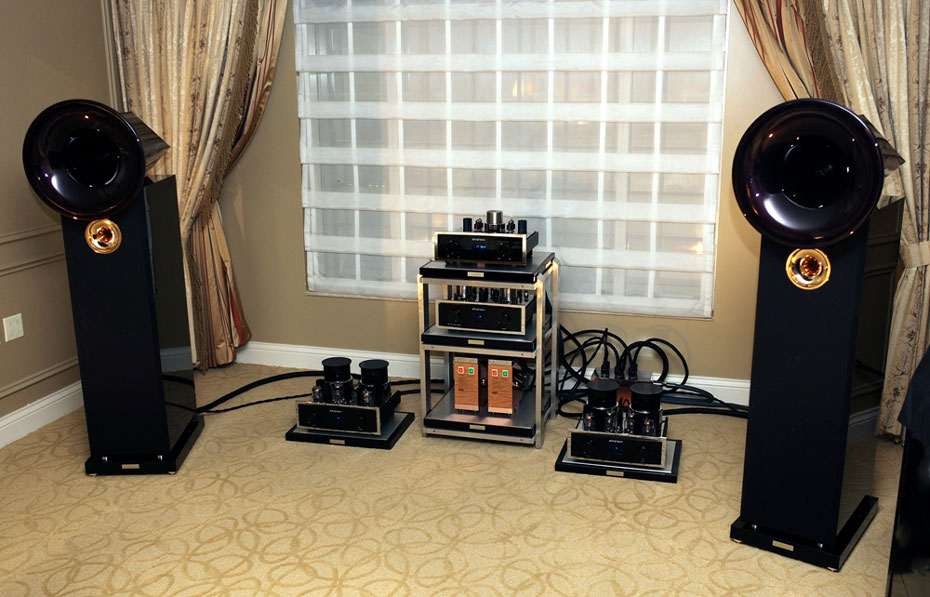
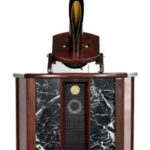
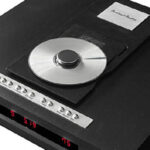
The debut of Acapella’s latest High Violoncello II loudspeaker ($80,500/pair) took place at this year’s CES. The High Violoncello II features the iconic Acapella ion tweeter, complete with a midrange horn atop, plus three woofers “dynamically adapted to the high speeds of the mid-range horn unit and the ion tweeter.” Each speak weighs 308lbs due to more massive bracing than the previous High Violon model. As driven by Einstein “The Final Cut” MK60 balanced OTL monoblock amplifiers ($34,900/pair), with Einstein’s own “The Tube” MKII balanced tube preamplifier ($18,400) and “The Source” balanced tube CD player ($18,400), the system exhibited impressive midrange to top-end flare, the sort that marries the virtues of some of the most refined horn dynamic scaling and a silk-dome+tube smoothness.
The bottom-end was musical and tonally sophisticated. A very well mixed blend of audiophile qualities and musicality. The spatiality this system gives to instruments is always a sound to behold.
The rest of the system is consisted of the following:
Stage III Gryphon XLR interconnects, 1.5m, $7,950/pair
Stage III Zyklop power cord, 2m, $8,300
Acapella Reference LaMusika speaker cables, 3m, $25,000/pair
Acapella High LaMusika power cords, 2m, $5,700
Acapella Big Block Resonance Control, $1,500 each
Acapella Fondato Silenzio Base isolation platform, $3,100 each
Dynaudio / Wadia Digital / Octave
In the Dynaudio / Wadia / Octave exhibit, there was unmistakable resolution via the Wadia 900 Series digital system. Then, ever so natural to the ear, almost stealthy processing of minute details amidst a sometimes overwhelming suite of dynamics only revealed the Dynaudio Consequence Ultimate Edition loudspeakers ($70,000/pair) as the most tonally delicate and dynamically mesmerizing loudspeaker. Having experienced the sound of the Tannoy Churchill Wideband’s 15-inch dual-concentric woofer in my home for several years, I thought the Dynaudio’s large woofer was on a magnitude more dynamically responsive and tonally faithful to instruments. Had I not heard the Dynaudio woofer arranged at such height, I would never have thought such experience of a woofer as possible.
The Dynaudio Consequence Ultimate Edition loudspeakers ($70,000/pair) is the most intriguing speaker design in years. The setup placed the speakers rather closely together considering the depth of the room. I sat initially in the center of the first row of seats, then I moved my chair forward singularly, only to realize the speakers were not designed for nearfield listening. Dynaudio had a glossy brochure on the speaker, the following are paragraphs from it:
“The distinctive driver array on the Consequence baffle is quite conspicuous. The loudspeaker appears to be standing upside down: The tweeters are integrated at the bottom, and the woofers are mounted above at the top. This positioning is important for achieving correct acoustical timing and coherence: There is a scientific purpose to this, as sound waves from different drivers propagate differently depending on their respective frequencies. Every subtle musical detail, from the highest to lowest frequency is made to reach the listener at exactly the same time in the Consequence Ultimate Edition.
Normally, loudspeakers attempt to compensate for frequency-dependent delays through the properties of their crossovers. This is not sufficient for the Consequence Ultimate Edition. Hence, Dynaudio takes the next step in development to achieve a perfect sound reproduction by adjusting and optimizing all complex parameters relative to driver dispersion and time-domain coherence. The “inverted” driver array on the baffle is one part of this concept, for each driver position factors in the respective frequency’s propagation and time-arrival properties relative to the listening position.
This time-delay correction with the five drivers is unique – but for a true loudspeaker specialist as Dynaudio, this is only the first step in the detailed optimization: The Chrome- or gold-plated tweeter and midrange driver front plates have been precisely shaped in countless development stages, accurate to a micrometer, to achieve an optimum measurement value and, most importantly, to enable optimal dispersion and sonic performance. They also serve to dampen possible vibrations and thus further reduce distortion. All high-grade crossover components have also been painstakingly selected for their individual sonic properties and matched to the tightest tolerances, thereby enabling the drivers to perform at their highest level.”
The rest of the Dynaudio system:
Clearaudio turntable/arm/cartridge
Octave Jubilee preamplifier, $35,00
Octave Phono Module, $TBA
Octave Jubilee monoblocks, $67,500/pair
Rockport / Blue Smoke/ Gryphon (Mirage Hotel)
Rockport Alya and Gryphon (center) Colosseum integrated amplifier.
Andy Payor of Rockport Technologies unveiled the near-production model of the small, 2-way Alya ($29,000/pair). Priced above the full-range, 3-way Ankaa ($27,500/pair), the Alya has one-piece aluminum main/front baffle construction. Specifications: 35 ~ 40kHz, -3dB, 85dB/6Ω, 120lbs each. Tweeter is a modified one-inch Scanspeak Beryllium dome, the woofer is a 6.5-inch custom Audiotechnology carbon fiber composite driver.
As I have been listening to Andy’s Mira Grand II in my home, which has the D’Appolito Configuration of MTM (midrange-tweeter-midrange), I did not expect any mere 2-way system to compete sonically against it, and I did not hear anything otherwise during the show. Well, it takes a Rockport to beat a Rockport, and the comparatively dimunitive Alya demonstrated the same level of dynamic and tonal finesse of the MG II, albeit a more modest scaling and bottom-end due to its more modest dimensions. Still, reproducing the solo piano of a 20-bit modern Chopin CD by pianist Evgeny Kissin, the expeditious transients and sophistication of texturing of the Alya proved how extraordinary the speaker was. The Alya’s enormous dynamic prowess may also be the result of its 18mm excursion capacity.
Gryphon Colosseum
Blue Smoke Entertainment Systems Black Box Hybrid Server
Rest of the system:
Blue Smoke Black Box Hybrid Server, $6,995 (includes proprietary digital cable & remote keyboard)
MSB DAC III with volume control, $8,495 (includes 32x filter, $3,495; Signature DACs, $6,995)
HRS SXR Audio Stand, S1 Isolation Base
Transparent Audio Reference MM2 speaker cable, from $19,945
Transparent Audio Reference XL interconnect, from $8,800
Accuphase / Genesis
For a solid-state system, the Accuphase system had tremendous tonal sophistication. Playing various tracks from one of my demo CDs, with music ranging from acoustic instrumental, heavy taiko drumming, to Shirley Bassey’s vocal, the system demonstrated an ability to track the instrinsic sound of the instruments faithfully. One caveat: the system was not the most spacious-sounding, although there was still a slew of spatiality and dimensionality. The soundfield just wasn’t the most expansive I’ve heard from the music. With all that said, I sat and listened track after track for nearly 30 minutes. I immersed myself into the tremendous subtleties and dynamics of the music. If any, the Accuphase/Genesis sound might actually be more accurate than many others. If there is one system that I think will open up the minds of wide-soundfield aficionados, this is it. We should all listen to this system so as to comprehend why the widest and biggest soundfield is not high on a great many audiophiles’ list.
The system:
Transrotor Darkstar turntable system, $5,500
Accuphase DP-600 SACD, $20,000
Accuphase C2810 preamp, $28,000
Accuphase A45 power amplifier, $15,000
Genesis 5.3 loudspeaker, $22,000/pair (plus $3,000 Genesis speaker cable prototype)
- (Page 1 of 1)