Similar to an Oswald Mills design, when a person spies a MADO (Merryweather Air Disturbing Object), they are viewing an acoustic work of art. Indeed, MADO’s owner and designer, Stephen Merryweather, describes himself as an artist who is making speakers. It shows, as the selection of solid woods with furniture grade woodwork and stone accents hearken to bespoke products. For those who wish to dive into the world of restoration and modification of vintage speakers, along with contemporary higher efficiency speaker designs, the MADO homepage makes for a good jumping off point.
I met Stephen at the 2026 AXPONA show and consider myself privileged to capture a review of one of the most talked about transducers, The Stony. The room was shared with Toolshed Amplifiers, and that company’s Transcendence DHT Stereo 300B Amplifier was to have driven the trio of MADO speakers shown. However, technical issues in preparation of the amplifier forced the speakers to be paired with Stephen’s personal tube amps. Last minute local sourcing of backup gear was possible since he lives about 10 minutes from the Renaissance Schaumburg, the show venue.
At the show I heard another MADO speaker, The Fork, which has a name showing influence of an artist, not a marketing department. Initially, I was under the impression that The Fork was being driven by the Toolshed amp, so I spoke with Matt Formanek, the Owner and President of Toolshed, about reviewing a MADO speaker along with Toolshed Amplification. In successive contact attempts following the show, I have not heard back from Matt. I hope he is doing well, but I cannot review a product of a company that for whatever reason is not establishing contact. After discussing the review proposal with Stephen, it was determined that I would review the flagship model, The Stony.
While on the topic of amplification, a factor which in the mind of some will impinge on the quality of this review is the lack of a low power tube amplifier. Some will be tempted to turn away at this point, as though a speaker of this sort can only shine with a putatively ideal genre of amplifier. Regarding amplifiers and their use in this review, I will state my biases clearly so that the reader can weigh my comments accordingly. I have moved away from reliance upon tube amplification over the past twenty years and am content to work with solid state equipment in establishing systems. It was not for lack of trying tube amps, as I have handled several notable products including Moscode, VAC, Ayon, and Einstein, among others. Generally, I cotton to higher power versus lower power, even in tube amplification, settling on 200wpc as a median. In recent years, in direct comparison, class D has played as well as solid state and tube amps. Below, I discuss my unusual Faux Mono Integrated Amplifier configuration (two stereo integrated amplifiers horizontally bi-amped) has outshone pricey separates. Thus, I had no hesitation to use iterations of that configuration for this review.
For those who are crestfallen that this review may share nothing about tubes, I have two sets of Faux Mono Integrated setups, the first with a couple of solid-state PS Audio Stellar Strata Mk2 Integrated Amplifiers, and the other with a pair of Heaven 11 Billie Amp Mk2. The latter have tubes in the preamp stage, and that integrated amp has a more romantic sound than the PS Audio. I dodged a bullet with that one, because we all know that a higher efficiency speaker cannot sound good without low power tube amplification. I’m being facetious. Guesswork in matching a tube amp with a speaker like The Stony can be a mistake. Even with the phenomenal configurability of the Faux Mono integrated amplifier configuration, I used creative system configurations to make the Heaven 11 amps work splendidly with The Stony.
Many low power, high efficiency systems that I have heard either privately or at shows seem plagued by a certain anemia, a thinness that my ears find unpleasant. Many of them are not particularly tonally appealing and others are insipid dynamically. As an example, PureAudioProject speakers (I have reviewed the Quintet15 Horn 1, and three versions of the Trio15, Tang Band, Voxativ, and my favorite, the 10” Coaxial, are often shown with lower powered tube amplification at shows, but I’m not a fan of that pairing. To my ears, such setups are underpowered and lacking in macrodynamics. Those speakers are more engaging to me when driven with higher power, as I do in my listening room. Simply pairing a lower powered amplifier with a MADO speaker does not assure an ideal outcome.

Pairing a set of integrated amplifiers, as I have done, increases the possibility of a highly desirable outcome, as I explain below. Consequently, this will not be another low power tube amp and high efficiency speaker article. Basically, the Faux mono configuration lends itself to maximize the characteristics of practically any passive, bi-wirable speaker, and especially with The Stony and its unique Koupler super tweeter, that is a bonus.
The many facets of MADO
There are many loose ends, threads of discussion, topics of direct and tangential importance, to be woven together when considering a MADO speaker. In writing this article, as I weave together my threads of thoughts, I recall being on a Footsteps of Paul (the Apostle) tour last year. While traversing Greece, we took a day trip over the border to Turkey to see the archaeological site of Ephesus. The visit included an obligatory stop at a Turkish rug factory, where my wife and I watched the ancient art of weaving, then splurged on a new rug for our entryway. As I listen to The Stony, I consider the artistic fashion in which it was designed and built as Stephen has artfully woven together seemingly disparate speaker design principles.
As an artist (the MADO website mentions that Stephen is a sculptor, musician, recording engineer, and speaker builder), Stephen is uninhibited by convention, living in a 6,000 square foot warehouse which serves as his home, shop, listening space, and storehouse for an ever-expanding collection of vintage parts, chiefly drivers. The artist births his speakers in that environment, not a controlled sound room. Further, specifications are important to Stephen, but not all-important. On one hand, he knows how to weed through a sea of drivers and utilize Chinese ones that have the desired specifications and are built well. That helps to keep the price of his speakers reasonable. It was difficult to nail him down on the brands and model numbers of the drivers used. Perhaps that is because he is an artist, or because he lives in a warehouse housing hundreds of drivers, or because he seems to continuously test new drivers in his designs. Not that I am concerned. After hearing dozens of brands and types of drivers, it becomes evident to me that a speaker either has good sounding drivers, or it does not. The Stony has good sounding drivers. There are some idiosyncrasies to their implementation, which I share below.
MADO Acoustics is not about showing the world a pretty specifications sheet. None appear to exist for his speakers; I had to chat with him for twenty minutes to get a feel for the driver selection and crossover design. I was edified in the process, as Stephen is highly knowledgeable especially about vintage speaker design, which he attempts to emulate in MADO designs.
A different kind of hybrid
I am going to go out on a limb, so to speak, and judge The Stony to be a hybrid between a lifestyle and audiophile speaker. One might say that the aesthetics are as important as the functional design of MADO speakers. Because of the aesthetics imposed upon the build, The Stony has a particular set of performance parameters, which I will elucidate in this article.
MADO is the aesthetically inclined person’s alternative to a Magnepan or Vandersteen speaker, which, especially in those brand’s lower models, lack character. There is little to show off about a grill cloth enshrouded speaker. Though not a direct comparison but an impression, as I owned both Maggies (MMG; 1.6QR) and Vandersteens (1b and 2CE), The Stony’s performance strikes me as engaging as these other brands’ affordable speakers but with much higher visual appeal.
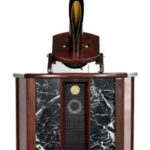
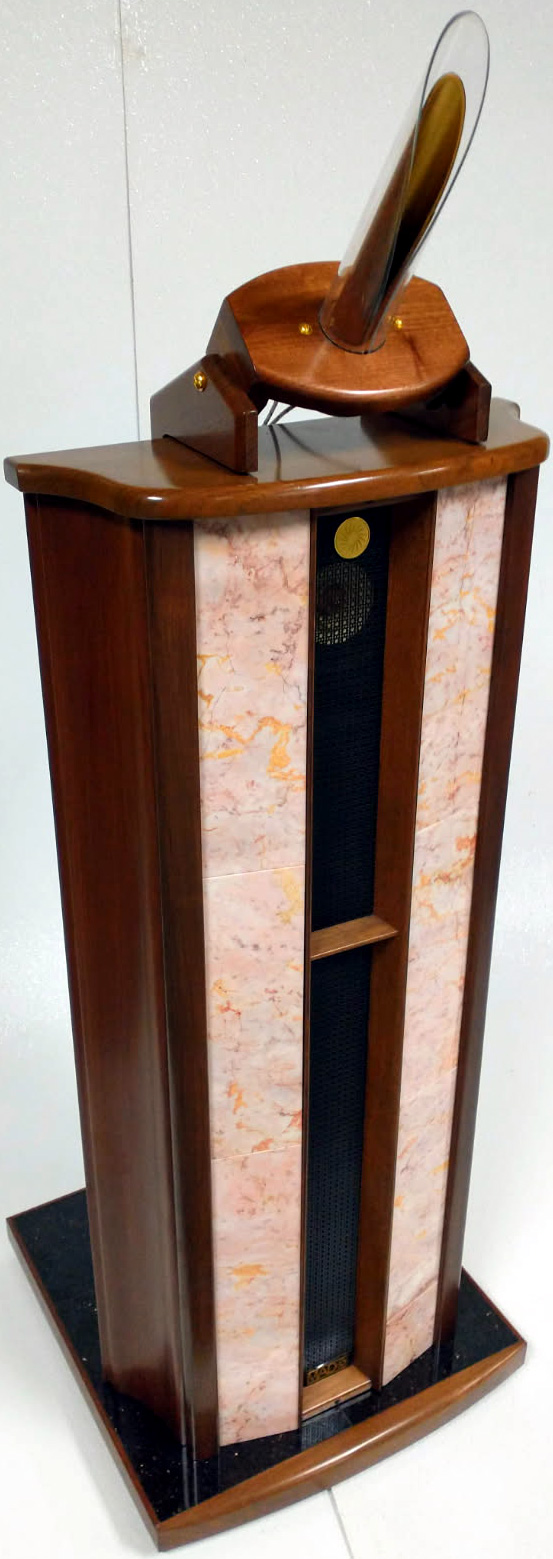
The Stony does not have the appearance of being a mass-produced product. The half-cabinet is made of solid wood; the review pair was walnut with a medium finish. Flanking the 2.5” (the slot is 3” at the front of the baffle, but tapers to 2.5” at the opening) vertical slot in the center are two inlaid runs of pink marble, which lends an exquisite character to the speaker. MADO speakers are customizable; the website discusses “reclaimed hardwoods” exotic veneers, and Carrera marble. The unusual Koupler driver sits perched atop, giving The Stony an exotic aura beyond its $7,000 price tag.
Stephen identifies The Stony as an open baffle design. Due to its unique features, namely a shallow open-back cabinet, I consider it to be a quasi-open baffle or a semi-dynamic speaker. Looking at the speaker from the front, one would be tempted to think it is a fancy dynamic speaker. In addition to the sides wrapped halfway around, on one side there is a half-height deflector or angled panel which aims the bass drivers’ rear wave launch toward the midline of the speaker. The deflector prohibits the bass waves from directly radiating outward on that side. Setup of the speakers can be determinative. When the deflectors are on the outside, the bass wave launch is toward the interior of the room. When the speakers are switched, the deflectors assist in directing the bass wave launch toward the side walls. This affords the owner two distinct setups influencing the bass response. I am not aware of an official recommended placement by MADO, but my principle in such matters is to try both options regardless of a manufacturer’s recommendation. As it concerns a static element of the speaker, it hurts nothing to try both placement options and the owner may have a strong preference for one.
(The bass deflectors are designed to direct the rear-firing low frequencies away from the listening area, toward the outside, in order to reduce phase cancellation between the front and rear emanations of the woofers. This phase cancellation reduces apparent bass output and is a major hurdle in open baffle design. – Stephen Merryweather)
- (Page 1 of 3)
- Next page →