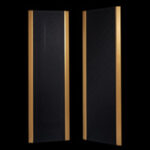
Overlapping driver output
One of the novel design features of The Stony is that the output of the drivers purposely overlaps more than conventional designs. Stephen likes to use 1st order crossovers when possible. Its shallow crossover slope of 6 dB per octave cuts off gently, so much so that the woofer and tweeter coalesce over a wide frequency range, thus widening the overlap. The result is that the speaker garnishes some characteristics of hybrid array speakers which use multiple drivers.
The Legacy Audio Whisper DSW Clarity Edition which I reviewed for Dagogo.com and own has four 7” silver graphite woven mid-bass drivers oriented equidistant from each other in a square arrangement. The multiplicity of the drivers adds to a sense of fullness and macrodynamic power but lowers the absolute linearity. It should be evident to the reader that four drivers playing in parallel cannot be more linear than one driver. Some hobbyists are fanatical about coherence, such that they would not tolerate any design which uses multiplicity of drivers.
To a degree, the intentional overlapping of frequencies of the drivers in The Stony moves the speaker partway into the category of a hybrid line source speaker. Such a design is not more linear than a conventional design that moderates overlap of frequencies. However, it contributes to a degree of fullness that more conventional designs may not achieve. The PureAudioProject Trio15 10” Coaxial, which I compared directly using the same system discussed below, was more linear sounding, one might say more precise. However, The Stony had a particular fullness from the overlapping drivers not found in the Trio15. The speakers are built with different design parameters and as such display distinct performance parameters.
I mention this not to suggest The Stony is not an accurate speaker, but to make potential owners aware that it is not designed as an all-out attempt to measure perfectly. Stephen is not beholden to measurements but enjoys tuning his designs by ear. If you are the type of audiophile who is maniacal about measurements or cannot tolerate the idea that drivers overlap beyond the bare minimum, you are likely not a MADO customer. If such discussion seems trivial and you would make your decision about The Stony based on other considerations, chiefly how well it connects with you emotionally, then this review is on the right track for you.
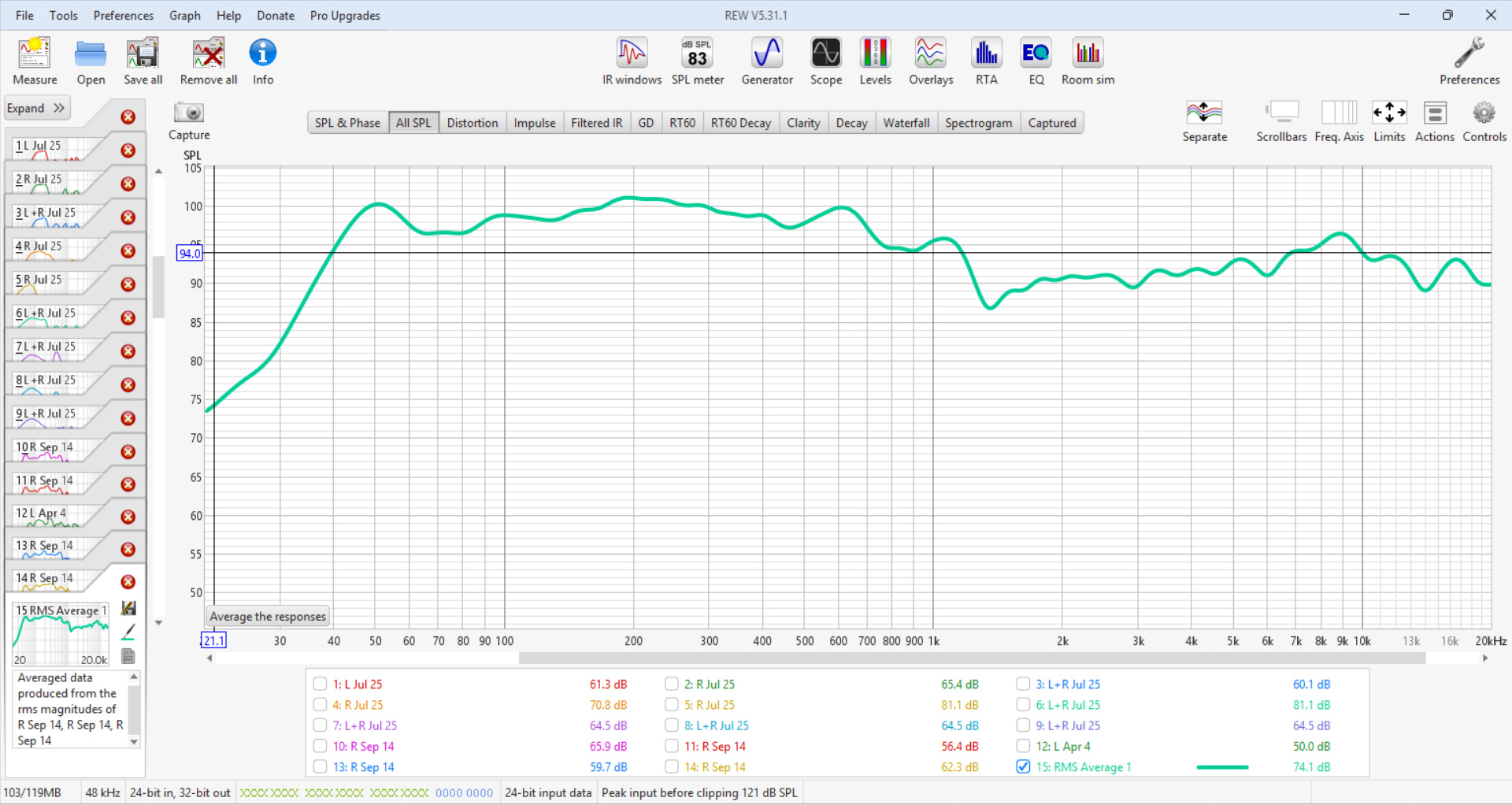
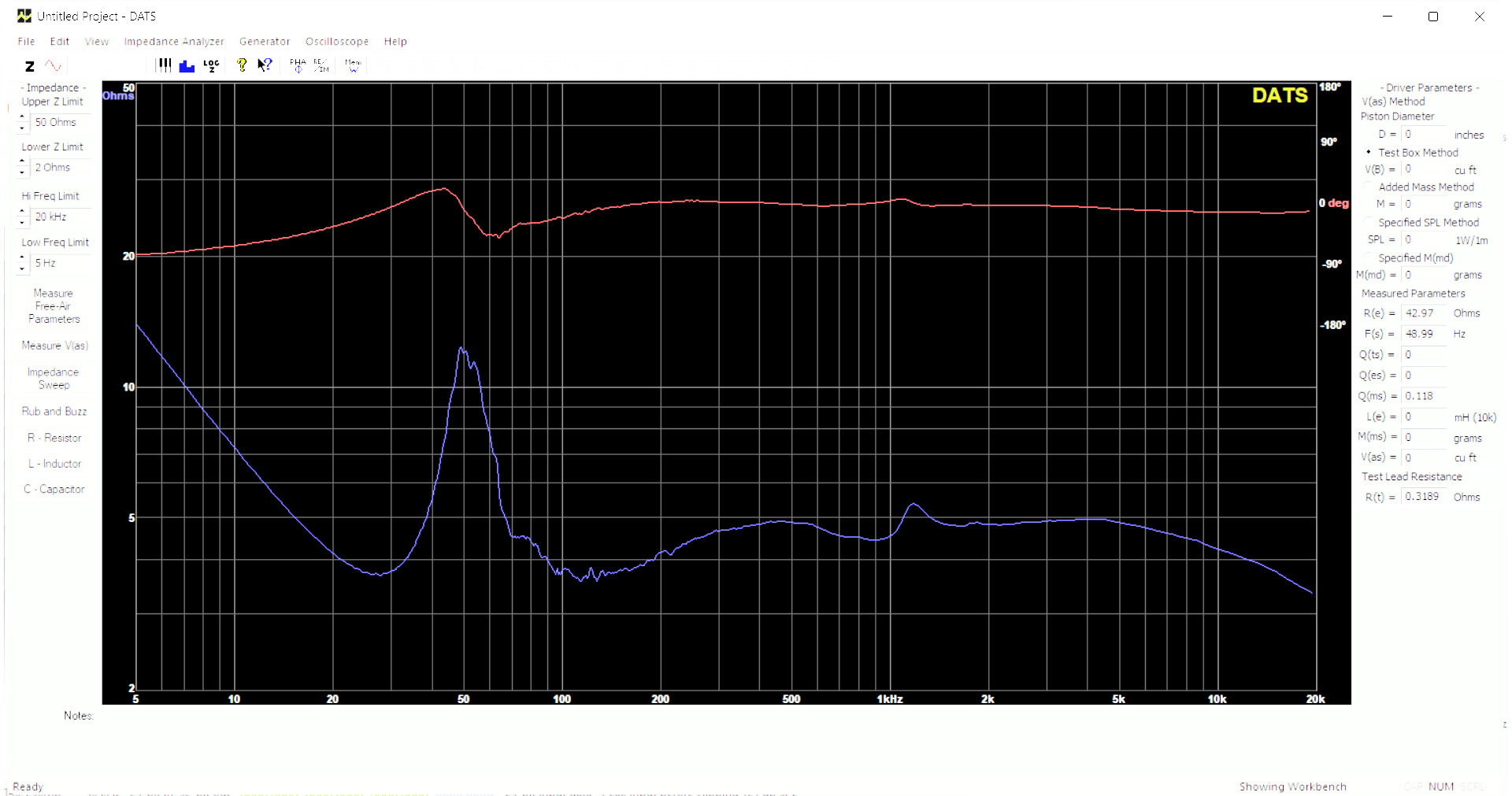
What I gleaned from Stephen regarding the driver complement of The Stony is informative. The super tweeter internal to the speaker uses a folded ribbon design and sits in a furtive mini-horn assembly tucked under the midrange driver. It is nearly impossible to see, even when a flashlight is shining on it. The 4” rice paper cone midrange incorporates a metal phase plug, which reaches down to 400-500 Hz and rises to 2,500 Hz and then rolls off mechanically. The upper woofer closest to the midrange has a 1st order crossover and rolls off at about 1,000 Hz. The Lower woofer has a 2nd order crossover at 200 Hz. Stephen said the speaker has a bottom end of 37 Hz.
Frequency response
Frequency and impedance
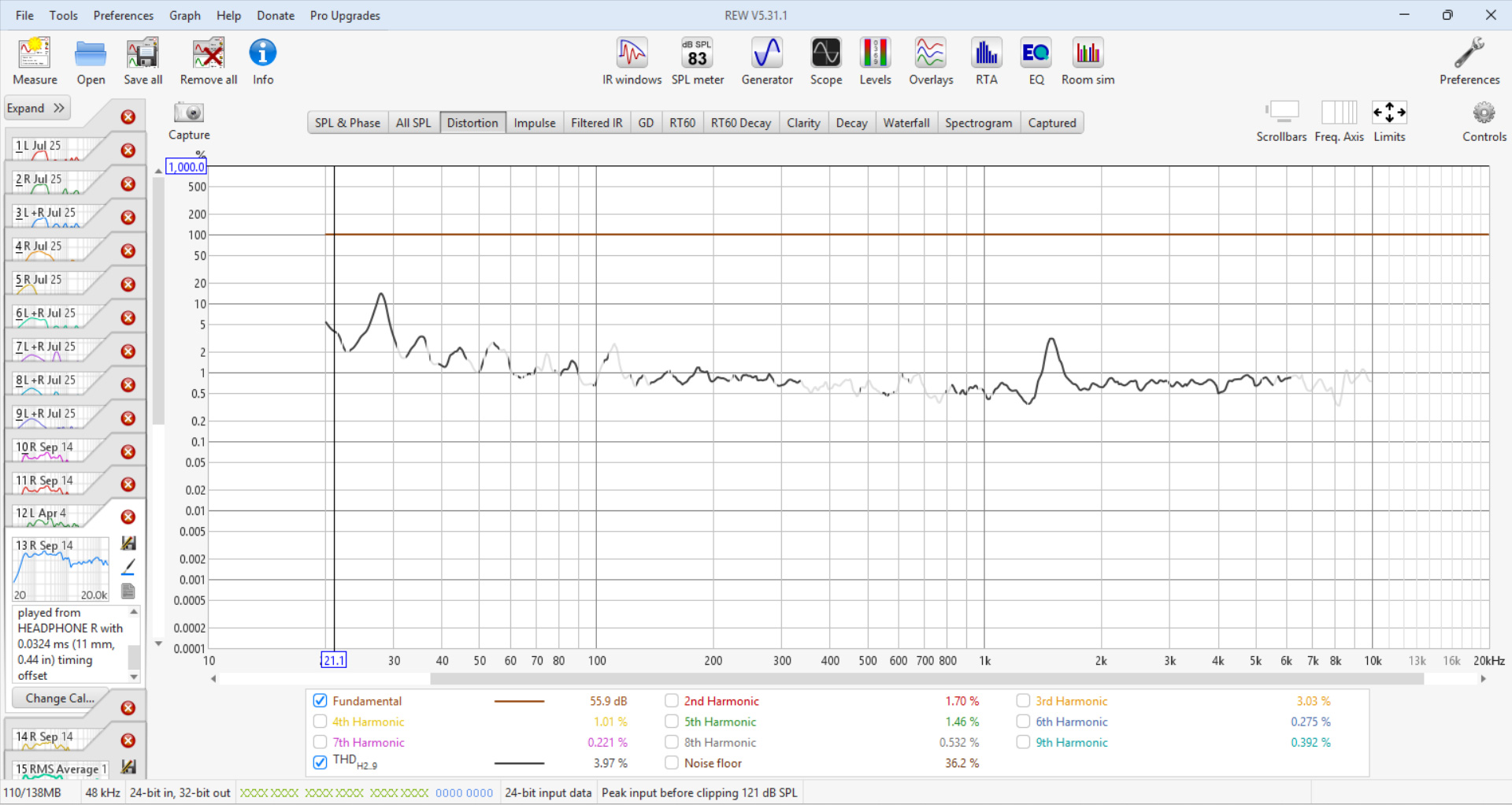
Distortions
Coup de grace, the Kouplers
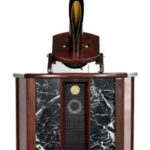
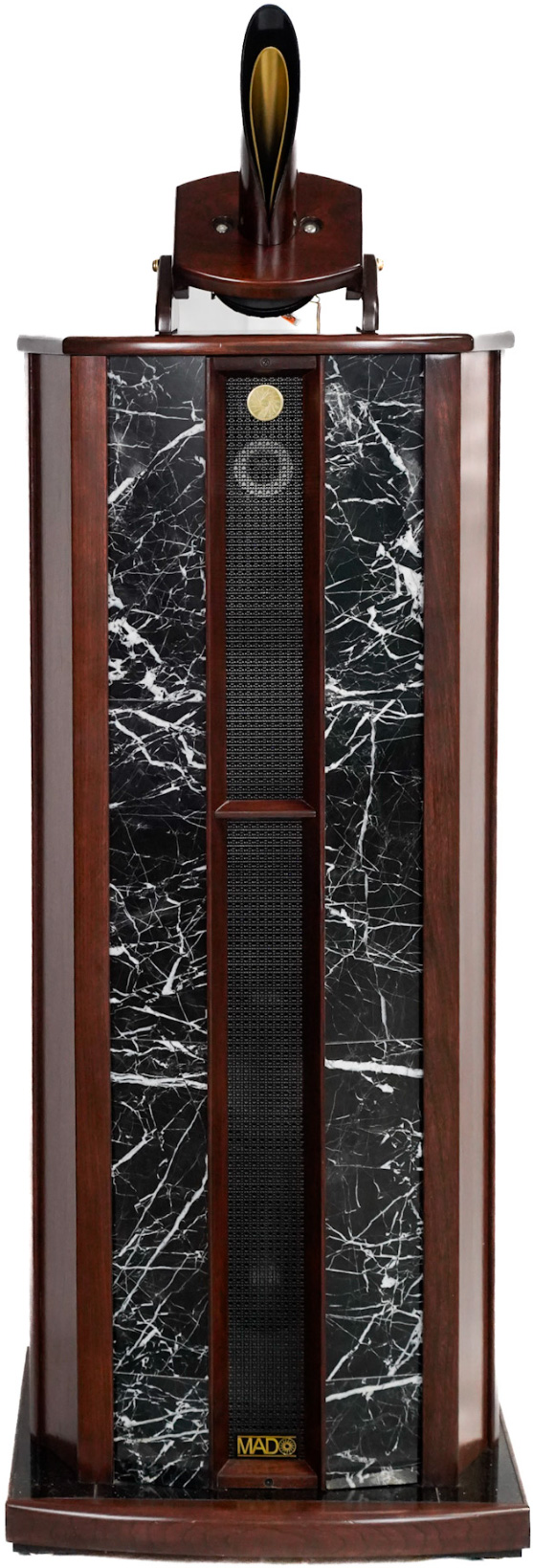
The most unusual aesthetic and functional feature of The Stony are the pair of Kouplers, perched like acoustic rifles atop each speaker. The “acoustic coupler” was introduced by John Karlson in the 1950’s. An acoustic coupler uses a tube with a slot to influence the wave launch of a tweeter. Stephen took the idea one step further by using a split double tube housing for a super tweeter and mounting it in a bracket that allows swiveling forward or backward 180 degrees. The Kouplers can be aimed directly at the listener’s ear, or anywhere along a vertical arc to 180 degrees opposite, toward the front wall behind the speakers. The Kouplers can be purchased separately and are MADO’s most popular product, as they can be made to work with other speakers. There may be some technical considerations involved in such a plan, and anyone interested in purchasing the Kouplers is advised to discuss their implementation with Stephen prior to purchase. That way, any logistical considerations, i.e., wiring, regarding powering the Kouplers can be ironed out prior to purchase. The MADO website shows a gallery of Koupler owners and the associated speakers.
The Koupler’s integrated wooden bracket allows it to slide onto The Stony’s top wooden half-baffle. Aesthetically, it integrates well with The Stony, lending a steampunk feel to the speaker’s design. It is a bonus that Kouplers are not built into The Stony but can be removed if desired. Because they are wired to the crossover network of The Stony, their wiring with banana terminations can be unplugged from the dedicated set of posts on the back of the speaker. That allows the owner to keep them in place for aesthetics while defeating their operation, if so desired.
Seasoned audiophiles have seen many iterations of speakers with extra tweeters firing back toward the front wall. The flexibility of positioning the Koupler reminds me of novel speaker designs like the BMC PureVOX Speakers, which have bass and tweeter drivers on the front baffle, and another set on a rearward baffle at a 45-degree angle! The other speaker which the novel design elements of The Stony remind me is the Kingsound King Tower, a hybrid omnidirectional speaker. The speaker in my possession which most closely mirrors the design of The Stony overall is the PureAudioProject Trio15 10” Coaxial Speaker, a true open baffle design. I spent the bulk of my time comparing them. Though I also spent several days comparing the Colibri C2 Stand-mount Loudspeaker, a product of Colibri’s parent company, Avantgarde Acoustics. It is a hybrid horn design. In terms of speaker cabinets, literally, The Stony stands between the Trio15 and the Colibri C2. The Trio15’s drivers have no cabinet, the drivers of The Stony are associated with a hybrid half-cabinet, and the drivers of the Colibri C2 are in a ported cabinet!
Design considerations and the Stony’s sound signature
The Stony incorporates a combination of design features that is not seen typically in contemporary speakers. As discussed previously, the overlap of drivers’ output brings a fullness to The Stony’s sound. Conversely, the 2.5” slot placed in front of the midrange and bass drivers, along with a thicker metal grill, partially inhibits the wave launch of those drivers. The partial cabinet which extends halfway around the speaker adds a degree of cabinet signature, but not so obtrusively as with dynamic speakers having full cabinets.
There is a trend rising in the speaker industry that is to me somewhat baffling, placing objects in front of a driver’s wave launch. Granted, grill cloth of varying thickness has been in use for better than a half century, and latticed or slatted wooden fixtures in front of speakers have been seen prior to The Stony. Paradigm uses a thick patterned grill in front of the midrange and high frequency drivers of its Persona range. Paradigm calls the thick, patterned grill a PPA (Perforated Phase-Aligning lens), which is said to act like a phase plug and block out-of-phase frequencies and smooth the high frequency response. La Dolce Audio is using a circular slot to load its 18” bass drivers in the Horn Level 1 and Horn Level 2 designs. Though these brands and speakers are fundamentally different, there are fans of both who claim these speakers have superb performance.
I struggle to see how putting any object in front of a driver absolutely improves its performance. It is easy to hear how removing a grill from a speaker improves its resolution. Why would these companies intentionally place thick grills or wooden slats in front of drivers? Because they claim it improves the sound of the speaker holistically. Thus, Stephen has designed The Stony with both a thick metal grill and slot loading for all the drivers except the Koupler. These items placed in the path of the drivers’ wave launch moderate the dynamic power and absolute resolution. However, they make The Stony a much less in-your-face speaker. Not everyone wants wall-to-wall definition and would gladly take the lovely aesthetics combined with sheer listenability.
The partial cabinet fronting The Stony’s bass drivers saps some of the dynamic output that otherwise would flood the room. That comment should not be taken to mean that the speaker cannot be made to sound powerful or that the bass is inherently anemic. The proper term would be controlled; the bass is controlled and directed so that it is experienced more like a large bookshelf speaker than a mid-sized floor standing speaker. I popped my Wharfedale Opus 2-M2 Bookshelf Speakers into the room for a day or so to assess that aspect of The Stony’s sound. The Wharfedale’s 8” dynamic driver yielded about the same impact as the twin 10” drivers of The Stony as heard through the 2.5” slot.
On the other end of the spectrum, the 4” paper cone midrange is distinct and stands out in comparison to the twin woofers. Along with the double tweeter system comprising the ribbon tweeter and the Koupler, the frequency energy of The Stony is characterized as an inverted triangle, with more energy up top and less energy down below. If you are expecting The Stony to be portentous such that you wish for it to play bombastic bass and LF at high levels, I think this is not the speaker for you. It is amenable to quieter music with acoustic instruments. As I work through my playlist selections and systems for this review, you will see methods I used to tease out striking differences in performance from The Stony.
- ← Previous page
- (Page 2 of 3)
- Next page →