The systems and music used for assessment
The Stony is meant to disturb the air in novel ways. The unusual design of the speaker inspired me to disturb the air to influence regions of the frequency spectrum. Why not use an analogy from the world of art? Recently, my mind has been toying with an illustration in which an audiophile speaker is like the canvas that frames and supports the visual art created by the components and cables. People treat speakers as though they can change their sound. Technically, they do not but have fixed parameters of performance. They are more like the canvas, with distinct fixed properties to which the media is applied. The electronics are endlessly variable in how the media is applied to the speaker, the canvas.
Sometimes artists alter the canvas, perhaps mixing in a variety of media to affect the surface, physically changing angles, etc. Sometimes, the canvas is subdivided into smaller parts to create a puzzle effect. Most speakers’ playback characteristics are fixed, like a certain sized canvas. However, The Stony has two distinct options to influence its “canvas”, one being the Koupler super-tweeters. The other is a technique which I introduce below to increase The Stony’s bass response without altering the components of the system.
As I begin to discuss manipulating The Stony’s performance, I will share the music selections used for assessment:
“Shape of My Heart” by Novecento
“Slap Battle” and “Piccolo Strings Bass Jam” by Davie504
“Time Machine” by Uffe Steen Trio
“Le Chat Noir” by Philippe Chretian
“Let Me Believe” by Shoshana Bean
“St. Louis Blues” by Peter Cincotti
“Narnia” by The Swingles
“Ultralight Beam” by The Michigan G-Men
“That’s Gonna Leave a Mark” by Molly Tuttle
An artful system configuration
For this review I relied upon one of my favorite system configurations, the Faux Mono Integrated configuration, which I discuss at length in my book, The Audiophile Laws, available at TheAudiophileLaws.com. It is achieved through use of two integrated amplifiers which are horizontally bi-wired to speakers with two sets of speaker posts suitable for bi-wiring. The L/R output of one integrated amplifier feeds the respective bass posts of both speakers, and the L/R output of the other integrated amplifier feeds the respective mid/treble posts of both speakers. That allows the system’s bass to be controlled by one integrated amp and the mid/treble to be controlled by the other. In such a setup, I can contour the frequency response of any speaker without a performance penalty!
Here is what the system looks like:
PS Audio AirLens streamer using Qobuz Connect and Tidal Connect
Audioquest Coffee Coax Digital Audio Cable with DBS, 1M
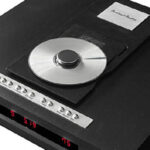
TEAC VRDS-701 CD Player/DAC/Preamp
Silent Source The Music Reference RCA Interconnect used as digital link
TEAC CG-10M-X Master Clock Generator
Amazon Toslink (fiber optic) Y-cable
Audioquest Vodka Toslink (Optical) Cable x2
PS Audio Stellar Strata Mk2 Integrated Amplifier x2 in horizontal bi-amp configuration
Iconoclast SPTPC (silver plated) Series 2 Speaker Cables for The Stony’s treble posts
Iconoclast TPC (copper) Series 2 Speaker Cables for The Stony’s bass posts
For those on a limited budget, the system can be streamlined by removing the TEAC components and via an RCA Y-cable sending the digital output of the streamer directly to the digital input of the integrated amplifiers. However, that does not ensure the best sound in all cases, and it removes the option of CD playback.
For most of the review period I used the twin integrated amplifiers level matched to replicate most audio systems which do not have a means of adjusting the bass or mid/treble on the fly. I played Novecento’s “Shape of My Heart”, and noted the clean, clear notes of the guitars. The bass was less weighty than I wished. Shoshona Bean’s “Let Me Believe” had a sparkling, crystalline character to her voice, which was appealing. The Swingles’ “Narnia” emphasized the tenor and soprano vocals of this acapella group. I wondered if using one of Stephen’s tube amps would bring a bit more warmth, but with the limited time frame of the review and my schedule, I did not commit to the time for two round trips to Chicago and several additional system configurations and listening sessions.
No trouble, I had an idea, a way to conveniently tune The Stony to my preference, and it is an idea that not only potential buyers of this speaker, but anyone who wishes their bi-wire capable speakers had more low-end output can implement! As I have several sets of speaker cables, I simply added another set parallel to the first set of speaker cables connected to The Stony’s bass posts! I doubled up the bass cables, using one set with spade terminations and another with banana terminations, and left the single mid/treble cables in place. I could do so because I was using one integrated amp for bass only. Anyone who is using a pair of stereo amplifiers for passive horizontal bi-amping can do so. Caution: Do NOT mismatch single and double sets of cables on one amp! Treat an amplifier consistently with Left and Right speaker connections! Never join the channels of a class D amplifier!
What is to be gained by doubling the bass speaker cables only? The impedance that the speaker sees is cut in half and the cables’ capacitance doubles. The result is more prodigious bass with an elevated output! By employing this fix, I elevated The Stony’s bass output and cleaned it up at the same time.
Now, to my ear the speaker was more level in its frequency response and did not sound shy in the bass output. The guitars in “Shape of My Heart” warmed up, as did the alto voice of Shoshona Bean. I was most pleased by the filling in of other vocal parts on “Narnia”. The midrange was still easily identifiable but so was the bass. Thus, like a portrait that shows different aspects of the subject’s face from different viewing angles, tuning the bass drivers of The Stony with either single or double (parallel) wiring to those drivers affords two portraits for listening! I do not dare to say which should be considered the best, as I suspect that differences in preference would be normal among a group of listeners who heard both configurations.
The Stony with Heaven 11 Billie Amp Mk2 Faux Mono Integrated
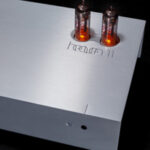
The other configuration of double integrated amplifiers featured a pair of Heaven 11 Billie Amp Mk2. As expected, the bottom end had more bloom, but unexpectedly, the midrange receded slightly. That was ok for me, as it lent some frequency balance I preferred.
As I worked through the music selections, I felt the need to bring the Kouplers back into play. Recall that I had doubled the speaker cables to the bass posts of The Stony. For my initial listening with the pair of Billie Mk2 Integrated Amps, I removed the second pair of speaker cables in a bid to return to the baseline sound of The Stony.
This time, the mid-treble was not so forward, but I still wanted a bit more low-end heft, so back onto the speakers went the second set of speaker cables. Now I had a similar tonal range emanating from the speaker but with a thinner but cleaner character which often accompanies tube amps. Here the Billie Amp Mk2’s signal tube, the JJ ECC99 Gold Pin, was bringing its magic.
During the review period, my wife and I had the pleasure of seeing Molly Tuttle perform at a local theater. She is a virtuoso with a guitar, and she has created a vibrant form of Bluegrass sound. I had listened through “That’s Gonna Leave a Mark” many times while reviewing before attending the concert. When I returned to play that song on The Stony’s, the Kouplers brought forward her picking and strumming, allowing me to appreciate her artistry. But her voice seemed to have more high-end energy than I recalled from the live show. I decided to tilt the Kouplers skyward, as opposed to the approximately 45-degree angle they had been set at during the installation. It helped take the edge off her voice.
Similarly, when the Koupler was aimed more directly, the forceful female chorus of the acapella piece, “Narnia”, was a bit irritating. When the Koupler was aimed higher, the irritation went away. A period of adjustment, literally, would pay off in terms of finding the Goldilocks position of the Kouplers.
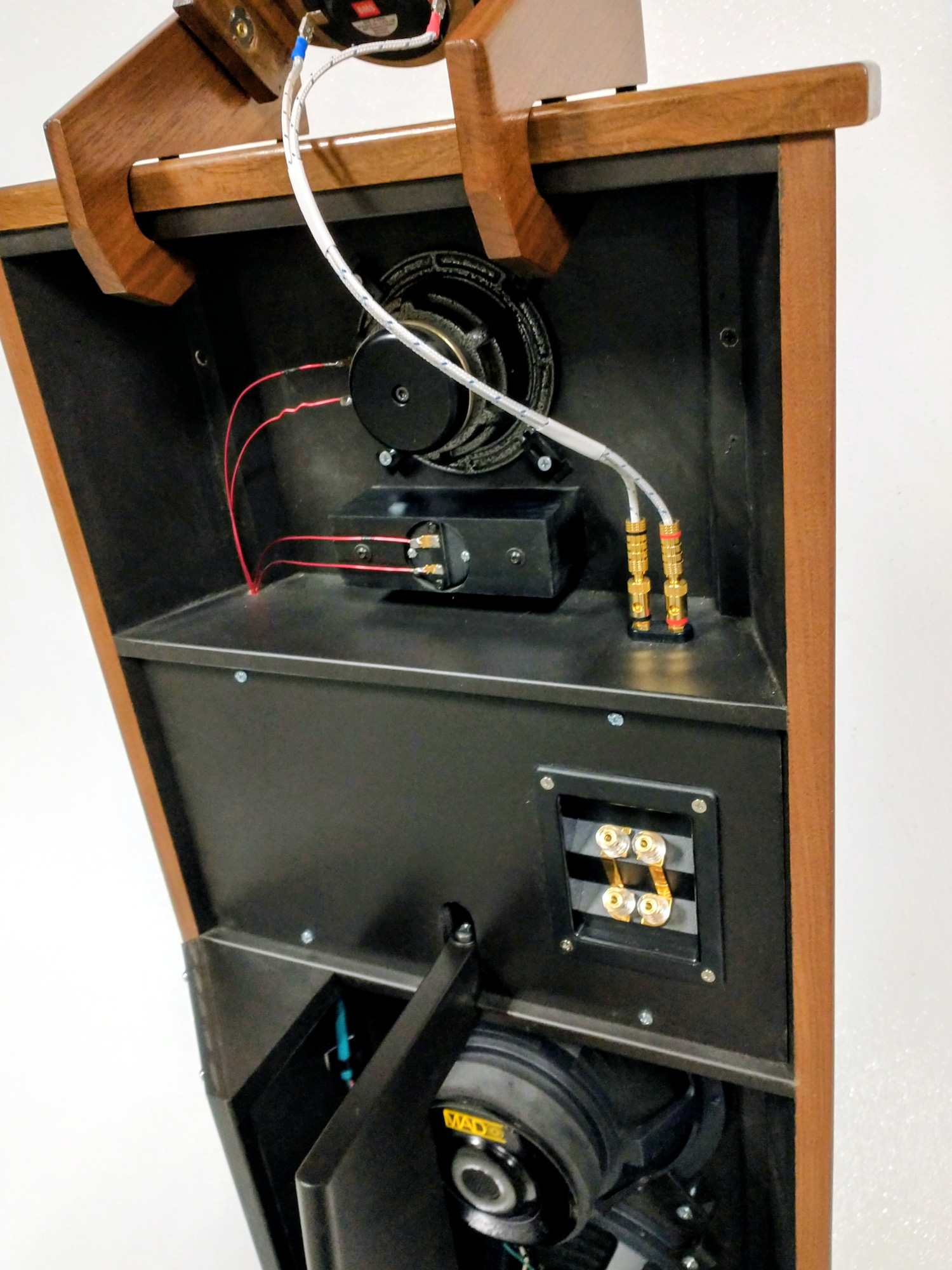
The Stony is a moderately sized speaker, but it plays in the low end closer to a large bookshelf speaker. That is not meant as a criticism but an observation. Due to the shrouding of the twin 10” bass drivers, their output is guided through the 2.5” slot like a horn guiding a compression driver. Consequently, if the Kouplers are aimed lower toward the listener and the equipment carries a highly detailed midrange and treble, it may call attention to itself over the bass response.
To my ear, The Stony, when used with both the built-in ribbon tweeter and the Koupler, has a moderate elevation of mid-treble output. I do not normally put a speaker under analysis of the sound spectrum, but I wished to confirm whether my perception that the speaker has an elevated mid-treble plateau was correct. I hasten to add that I am not attempting to provide in-depth analysis of the waveform but merely note the extra energy in the mid-treble region. I used my phone’s audio spectrum analyzer app to see the rise in that part of the frequency spectrum, from about 300Hz to 1,000Hz.
This is another aspect the design of The Stony which speaks to its being a piece of art, tuned by the ear of Stephen Merryweather, rather than the product of stringent management of specifications. The upshot is that most instruments and vocals stand out in the midrange distinct from the treble and bass. I am reminded of the Pathos Acoustics Classic One, all three iterations of which I reviewed, such as the Pathos Acoustics Classic One MkIII, which also had a characteristic emphasis in the midrange.
The midrange-treble plateau catches the ear immediately when first hearing The Stony because it draws attention to the vocals and lead instrument(s). It is a most pleasing effect if one wishes to have the attention placed on the spotlight performer. However, if one wishes that the entire performance be frequency equivalent, then the owner will need to make an adjustment or two to achieve that goal.
The emphasis in mid-treble is somewhat moderated by the partially covered 4” midrange driver. Perhaps .5” of the driver is overlapped by the speaker’s front baffle on both sides, and the thicker perforated grill reduces some of the intensity of the wave launch. Stephen seems to be balancing the emphasis of the driver in relation to the rest with moderating it by the other cabinet design methods.
An unusual comparison formed in my mind; The Stony’s tonal and dynamic character strikes me as being akin to a Quad ’57 or ’63! Like these others, the low end is reserved and the midrange is prominent. Like the old Quad speakers, the wave launch is not from a naked driver to the listener but moderated with a heavier grill fabric. Also, like the older Quad speakers, The Stony’s character will especially appeal to someone who holds the magic is in the midrange. If thumping bass is not your cup of tea, The Stony will likely appeal to you strongly.
A piece of art is not supposed to be hidden
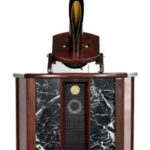
Everything about The Stony says, “Notice me!” At first glance, the obvious attention to detail and quality materials speaks to the thoughtfulness of production. The unique Koupler atop each speaker evokes curiosity how they will sound. The intentionally directed and midrange enhanced performance catches the ear of the listener.
Stephen will be able to set up potential buyers with good recommendations for tube amplification that can check all the boxes for the sound characteristics you desire. Here, then, is a canvas with flexibility, potential to alter the framework upon which your electronic media paints the picture of a performance. Especially if your system has sounded dull, lifeless, The Stony will vivify it. If you love the sound of the ’57 and ’63 quad speakers, or wish to advance beyond a larger bookshelf or smallish floor standing speaker, particularly in regard to increased low-end dynamics (but not necessarily frequency extension) on a larger scale, and with excellent center imaging, then The Stony is a strong contender for your next speaker. Use the available methods of tuning its frequency spectrum balance – Kouplers, speaker placement, and if relevant, double (parallel) wiring the bass drivers – and its holistic beauty will become a masterpiece!
(All graphics provided by the manufacturer.)
Associated Components:
Digital Sources: Bricasti M5 Network Player, PS Audio AirLens, TEAC VRDS-701 Dual Monaural USB/DAC CD Player/Pre-Amp/Headphone Amplifier and TEAC CG-10M-X Master Clock Generator
Streaming Music Service: Tidal premium; Qobuz
Interface: ROON; Audirvana
DAC: Eastern Electric Minimax with discrete opamps rolled in
Preamp: Cambridge Audio Azur 840E
Amps: Legacy Audio i.V4 Ultra
Integrated: Heaven 11 Billie Amp Mk2 (two units used in horizontal bi-amp configuration); PS Audio Stellar Strata Mk2 (two units used in horizontal bi-amp configuration)
Speakers: Legacy Audio DSW Clarity Edition; Kings Audio King III electrostatic speakers; Pure Audio Project Trio15 10” Coaxial version; Kings Audio King Tower omnidirectional; Aspen Acoustics Grand Aspen; Wharfedale Opus 2-M2 Monitors
Subwoofers: Perlisten D212s Subwoofers
IC’s: Iconoclast RCA and XLR Generation 2 with Ultra-Pure Ohno Continuous Cast Copper conductors
Speaker Cables: Iconoclast Series 2 TPC Speaker Cable; Iconoclast Series 2 SPTPC Speaker Cable
Digital Cables: AudioQuest Digital Coaxial Carbon 1.5m; AudioQuest Digital Coaxial Coffee 1.5m; Iconoclast RCA or XLR 2m Interconnect used as digital link; Audioquest
USB: AudioQuest Cinnamon USB 1.5m; Audioquest Coffee USB 1.5m; Clarity Cable Supernatural 1m
Power Cables: Iconoclast BAV Power Cord; Clarity Cable Vortex; Snake River Audio Signature Series
Power Conditioning: Wireworld Matrix Power Cord Extender; Tice Audio Solo
- ← Previous page
- (Page 3 of 3)