Almost every file player or streamer is a customized computer. And, despite of efforts of engineers and programmers, it is not possible to predict all interactions between hardware, software and data. It happens. I would like to check this case with Aurender N200. However I know that every device is different, because of auto software upgrade.
For future…It will be a simpler solution. Amanero has signal ( pin 7) indicated DSD stream. So, I can use it for mute.”
Perhaps I am biased in that I don’t use my laptop for music playback. Of the multitude of software I auditioned over the years, none has equaled hard drive cache playback from the Aurender.
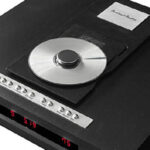
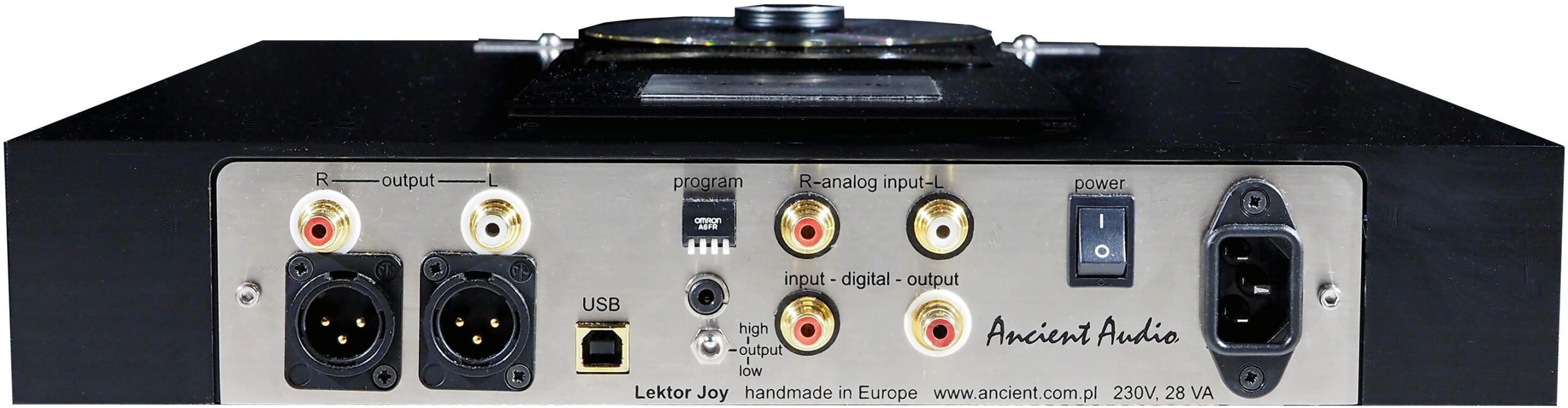
As the Lektor Joy features an exposed, top-loading CD transport with no lid, the company recommends always coupling a CD to the mechanism as a way of covering the laser head, lest exposing it to the elements. The machine comes with the company’s own demonstration CD so I covered the laser head with it. In addition, a CD must be placed on the transport and read before any other function can be engaged, including input selection.
Physical control buttons line the top forward panel, including the CD READ. Pressing the button is essential to load the table of contents of CDs, and it also does so automatically upon powering up. Changing discs and pressing PLAY without CD READ will prompt the player to play the first track only. The INPUT function rotates from CD to USB, COA (coaxial), LINE, which engages the one pair of RCA analog inputs, and then back to CD. The rear panel provides both XLR and RCA analog outputs. Also on the back panel is a maximum output signal switch selector for Low or High. The machine’s output is such that when connected to the Orchard Audio Starkrimson Mono Ultra Premium GaNFET monoblocks directly, even at the Low setting I could only raise the level up to 82 and no more, lest I blow out my eardrum.
The remote control is nicely fabricated with smooth surfaces and rounded edges. Among the myriad of functions, the remote does not control INPUT and CD READ. Meaning you’ll have to get up and press the physical buttons on the player to change sources. There is also no balance adjustment at all, and the display does not indicate the bit depth and sampling frequency of the audio file. Retrospectively, the concern of balance adjustment in relations to room acoustics is addressed if the user runs the Lektor Joy through a high quality preamplifier with independent left/right controls or power amplifiers equipped with input level control, although readers requiring channel corrections of recordings will need a corresponding preamplifier with single balance knob control.
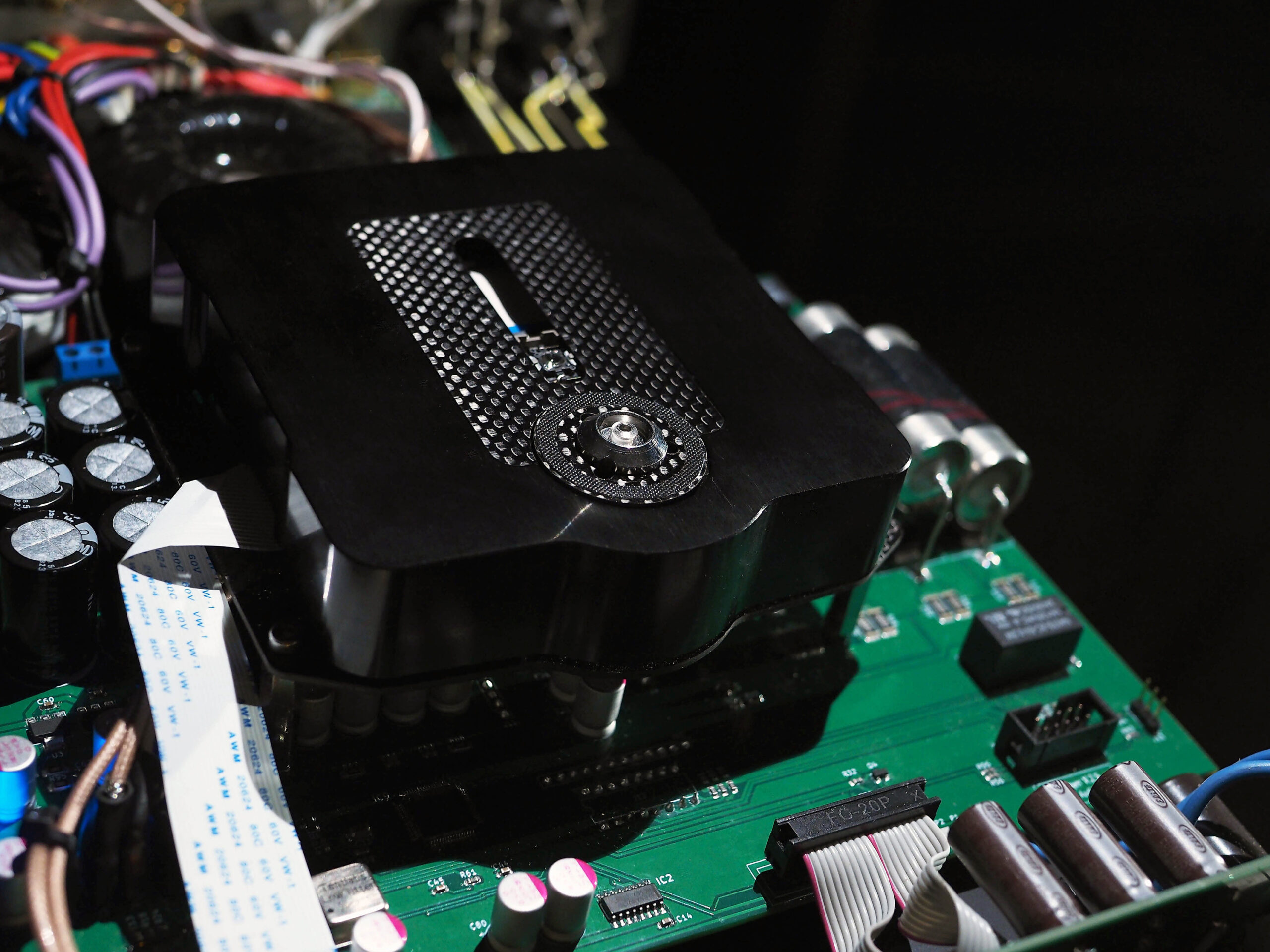
The Lektor Joy has two transformers, one for the CD-pro8 and display, the other for the DAC and analog components, which are further assisted by a bank of ultra-fast, low ESR capacitors for voltage stability and high current delivery. A point of particular merit is on the analog circuit of the Lektor Joy, which the company claims was developed over a span of fifteen years, resulting in replacement of Russian 6H30 tubes with MosFETs for increased gain and current, as well as maintenance free operation. V-Cap Oil Damped Advanced Metallized audio capacitors now adorn the output.
Due to the top-loading design, the Lektor Joy is another of those component that must sit atop others.
The greatest impediments to CD playback are in the signal processing of the servo software in mitigating the vibration of the transport structure when spinning the disc at several hundred RPM, in addition to accounting for the off-centered reading area, resulting in reduced resolution. The more aggressive corrective calculations the software has to employ to render the CD readable, the more resolution loss will result. The Lektor Joy demonstrated especially exceptional capabilities addressing these concerns when reading regular CDs, consistently, such as the 100 Greatest Classics Part VII (Encanto END-5207). Wildly off-centered when played on the memorable 47 Laboratory 4704 Pitracer over two decade ago, the CD sounded like an XRCD via the LJ. Brasses attained seemingly hi-res top-end composure and the orchestra delivered demonstration class dynamics through the LJ. Instruments separation was on a level of its own, and not just the resolution of it but also the nuance and smoothness of it, a feat I’ve never heard from other machines in the playing of such low-cost CDs. And then there was the air, the ambience that is so hard to obtain and yet reproduced in abundance in the LJ. Granted that by ripping the music to hard drive and then burning it back onto a blank CD-R will correct the off-centering, the Lektor Joy nonetheless presented a stunning solution to the world of CD.
The Lektor Joy also reconstituted the choir and vocals of the Prague Philharmonic Choir in the Deutsche Grammophon 1994 “4D” release of Mussorgsky choral and orchestral suites (DG 445 238-2) in stunning dynamics and tonality, as if the sound was in hi-res. The CD has been sounding flat, brittle and just lack-lustering overall since day one despite the 4D recording and mastering sophistication, but the Lektor Joy pulled such beautiful upper- to lower-midrange and explosive dynamics from the CD it turned the disc into a most satisfying musical experience. I’m sure I’m listening to the bank of V-Cap ODAM capacitors, the ESR capacitors, the MosFETs, the transformers, the ultra solid and precise CD-pro8 transport, and what not, but I’ve never heard ESS chips sounding this velvety and extended. It makes mass-production CDs sound like premium edition releases.
- ← Previous page
- (Page 2 of 3)
- Next page →