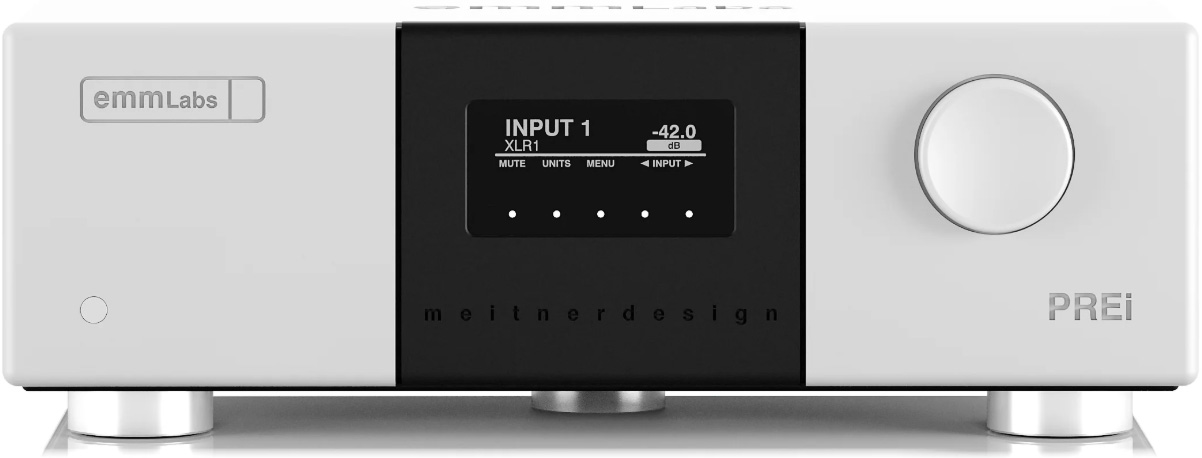
Introduction
I attended the Rocky Mountain Auudiofest every year for many years. It was for me an opportunity to renew acquaintances, preview new products and meet manufacturers. My first exposure to the “Meitner Mafia” (Amadeus, Susan and Ed) was at RMAF. If I remember correctly, EMM was showcasing their digital front end and their brand new MTRX amps. Ed and Susan were sequestered in an adjoining room, which is to say it was not obvious that they were attending. My friend Jim and I were much taken with the amps and the sound of the system. At some point, we were asked if we would like to meet the designer. That began a long relationship with Ed and eventually Amadeus. Several things were immediately clear, that Amadeus was protective of his father, that Ed was brutally honest and that he did not suffer fools lightly. Fortunately, he made an exception in my case.
If there is one thing that is predictable with Ed Meitner, it is that he is never satisfied with any of his designs. I am quite sure that this occasionally drives his son crazy. Often what he learns in working on one product can be applied to other products. In practice, this means that products are in a continuous state of flux. When enough changes accumulate or there is a breakthrough, a new model is introduced. This has been particularly true over the last two years which have been a particularly productive period culminating in the introduction of new products designated by an “i” at the end of their name; hence the PREi preamp.
Nuts and Bolts
The EMM PREi is a reference grade dual balanced, single chassis preamp which incorporates the following design features:
- Fully discrete, dual balanced signal paths
- Sophisticated contactless switching
- Software driven MVControl all analog volume control allowing adjustment in 0.5 db steps
- Meitner Audio Architecture circuits designed in-house
- Third generation MXPower switching power supply designed for stability, exceptionally low noise and transient response and high resistance to EMI and RFI carried by the powerline
- Custom MCeraTek ceramic circuit boards with gold traces for superior low level detail preservation, extremely low capacitance, and minimized parasitic oscillation
- Class A output stage
- High contrast OLED display
- A well laid out rear panel with good separation between connectors
- Custom designed voltage regulators on inputs and outputs
- Bandwidth extending to 200kHz
- Extremely short traces and symmetrical layout
- Unique charge management technology – a copper plate below the top panel with looping copper traces to deal with floating fields and reduce vibration
In summary, this is an extremely well thought out and well-engineered design.

Listening

Maurice Ravel, Complete Works for Solo Piano. Bertrand Chamayou, Erato, digital
‘Oiseaux tristes’ from Ravel’s “Miroirs” for piano was playing when I walked into the room. I had left the volume at a moderate level when I left the room earlier. Bertrand Chamayou was the pianist, on Erato, a very recent recording (also issued on LP).
I was immediately taken by the soft, gentle waves of the piano, and stopped, and shortly sat down. What startled me was that the source was not being played through my Audio Note M10 Signature pre-amp, with all its trusty and most musical vacuum tubes – my (apparent) guarantee of musicality. No, instead, this was being played via the EMM solid state preamp and monoblock combination.
The piano sound was gentle, as it should be, but is not necessarily the case with most solid-state electronics. The attacks felt real, the detail extraordinary. While the Audio Note cannot be beat for mid-range warmth, the PREi captured some edges of color and tonality that seemed beyond the Audio Note, particularly in the deep bass, and with the softest notes, enough to cause me to stop and listen. Which it continued to do for another 20 minutes before finally tearing myself away to deal with whatever quotidian task had brought me into the music room.

Miles Davis, Kind of Blue, Acoustic Sounds (corrected speed), 180 grams
Later the same day in the first real evaluative listening session, we decided to play the relatively new Acoustic Sounds reissue of Miles Davis’s Kind of Blue with side 1 reproduced at the correct speed. Since – presumably – the change in speed would have caused certain changes in the sound, small though they may have been, we approached this as an opportunity to rediscover the tunes on this side.
With the EMM, the soundstage was very clear. Mostly, the instruments were placed on each side, as was common with early stereo, but in ‘So What’, Miles’ horn came out from the right toward the center, with a remarkably three-dimensional effect. The result was spellbinding, as that solo can be. ‘Freddy Freeloader’ sounded as if it had been recorded with a different mic set up. It was still left-right, but the horns seemed more up front, with more space around them, and with a bit more warmth. The detail, again, was superb, but in the service of the music. Miles’ occasional hesitancies in his attacks, his sudden volume changes, and his other somewhat unusual expressive devices, were as – or more – clean and clear than I’ve ever heard.

Miles Davis, Kind of Blue, Acoustic Sounds UHQR
As a control we decided to listen to the same cuts on the Acoustic Sounds UHQR which is recorded at 45 rpm. There was more detail, the soundstage was more forward and full sounding. Miles’ trumpet was more full sounding, much more authentic and musical. The same was true of Coltrane and Bill Evans’s piano. In fact, after this, I would say that the corrected version is a real disappointment.
- (Page 1 of 3)
- Next page →