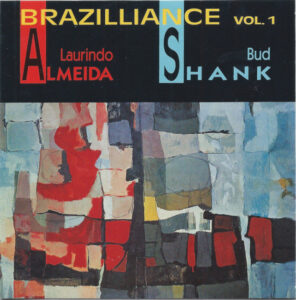
Laurendo Almeida featuring Bud Shanks, Braziliance, World Pacific Records
We then turned to Bud Shank’s Brazilliance. An issue of concern to me with any of my key components is how they treat less-than-ideal recordings whose musical value is such that I’d still like to listen to them. Bud Shank’s Brazilliance is a follow-on to several records he made much earlier with Laurendo Almieda of Brazilian-influenced jazz (before Stan Getz’s stumbling into Astrid Gilberto).
“Brazilliance” is a good early stereo issue that is a fun listen. Bud Shank is at least as good as Getz with smooth Brazilian grooves. Joao Gilberto was on the road to becoming one of Brazil’s better known jazz pianists. The rest of the band is excellent and includes Laurendo Almeida on guitar. The only fly in the ointment is that Donato’s piano was recorded very close. At times, you can hear slight distortion in the chording, mainly in the left hand. And occasionally the bass and the piano and bass together create a slight overload (mainly when they are clustering around the same note). These are really little things. But on some systems, they would be bigger things. In this case, the EMM let me know of these little issues, but not in an annoying way at all. Indeed, the quality of the recording otherwise was at such a high level that the quirks mentioned above largely slipped into the background, or when they were very occasionally noticeable, were just perceived as inconsequential artifacts.
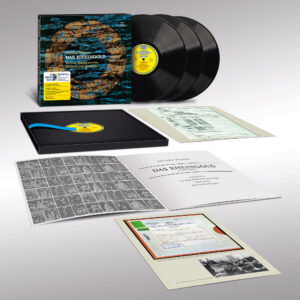
Wagner, Das Rheingold (complete). Karajan, DG The Original Source re-issues
Deutsche Grammophon has been creating waves in the audiophile community with exquisitely remastered recordings mainly from the 70’s. Karajan’s Wagner Ring was one of the prides of their catalog; DG’s competition to Decca’s Culshaw/Solti Ring. While the critical consensus has been that Decca won the contest, the Karajan is a strong contender. In truth, I’d never heard it until this reissue. It is a remarkable achievement, and a perfect complement to the EMM PREi.
For starters, the singers are spread across the stage in various locations, including forward and back. The EMM allows for effortless discernment of location. The detail of diction is quite remarkable. This is definitely a “you are there” type recording and succeeds superbly. (In fact, it may just be flawed memory, but the space around the voices seems in no way muddied by excessive reverb, which my memory tells me did sometimes occur in the Solti set.)
Like the voices, the orchestral placement is spot-on. I have no notion of how the recording was handled, but, while the orchestra is somewhat subordinate to the voices, the orchestra does not sound like it is buried in the pit. It is spread across the stage, seemingly somewhat below the singers, but just barely. The orchestral sound is fresh and rich and musical, and the bass penetrates to the floor. As with the voices, there is relatively little reverb. This does not cause an excessively forward sound – just a naturalness.
With this recording, I have a very satisfying sense of the PREi presenting what is there, and very quickly getting out of the way. It is so clean and articulate. Some of the best sound that I’ve heard…partly thanks to DG, and partly thanks to the PREi (and a few other pieces of gear in the chain, with which the PREi gets along quite superbly.
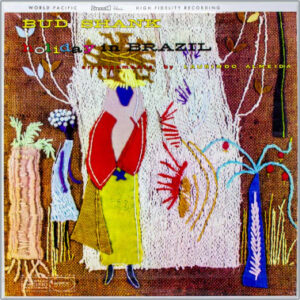
Bud Shanks, Holiday in Brazil, Impex IMP-6049
Unlike Brazilliance, also discussed in this review, Holiday in Brazil partners Shank with Laurendio Almeida, and was recently reissued by Impex on LP. The reissue quality is outstanding. The ensemble is smaller and does not include piano, which is perhaps one of the reasons why the sound is uniquely clean and precise, while still retaining a refreshing warmth. The guitar and sax have that “in the room” sound that is so pleasurable, as does the upright bass. The percussion has impact but is not edgy. It is “there,” strikingly so at times, but never unrealistically highlighted. The tail of the percussive sounds is exceptionally precise and accurate in a way that is really pleasurable to experience, and truly belies the age of the recording – the analog tube gear of the day was remarkably capable and musical stuff.
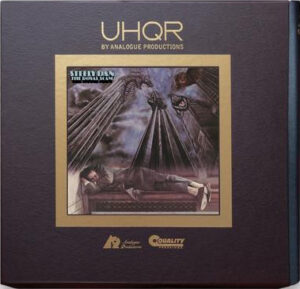
Steely Dan, Royal Scam, Acoustic Sounds UHQRSteely Dan, Royal Scam, Acoustic Sounds UHQR
I have the UHQR edition of this disc (two 45 LPs) and was curious how the standard edition would sound. It is made from the Bernie Grundman masters, digitized at a high level.
Earl recalls the first side from his college days, and – being lazy (his word), liked the idea of being able to listen to the whole side without having to turn it over, which is why he bought a copy of the 33 rpm version. Hence our testing it out via the EMM PREi. The 33 rpm is excellent. As with the UHQR, it was not hard to hear the differences in sound between the tracks, each of which were recorded with different players and to some extent in different settings. For example, Larry Carlton’s famous lead guitar work from the first tune ‘Kid Charlemagne’ sounded edgier and somewhat more processed than it did two songs later in ‘Don’t Take Me Alive’. The sound of the latter was especially strong, with excellent space and air not necessarily as present in some of the other tunes.
I was curious as to whether there might seem to be any artifacts related to the digitization. I did not notice a thing. While, overall, the 33 rpm sound could not match that of the UHQR, it was excellent. The PREi brought out all the good things to be heard…the tight snare of Bernard Purdie in ‘The Fez’, Chuck Rainey’s always captivating bass moving things right along while being fun to follow in its own right, the gorgeous blend of voices in the many tightly constructed harmonies.
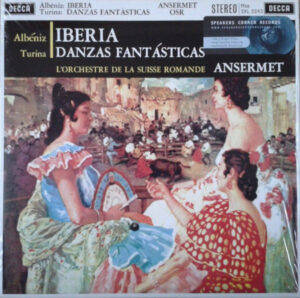
Ansermet, Albeniz “Iberia”, Turina “Danzas Fantasticas”, London CS 6194
This Ansermet London is one of Ansermet’s earlier stereo releases. The earliest can be iffy, with thin strings and less appealing sound stages; however, this Turina side is, instead, terrific. The spread of the orchestra across the soundstage is as good as it gets. The strings glisten with sparkling clarity. The brass and winds are placed across the stage with good accuracy, if not with the depth of some of the later Decca’s. The bass provides a solid bottom, the timpani a satisfying whack here and there.
Ansermet is, in general, not so highly regarded today. In some quarters, he never was. Neither was his orchestra. With a recording like this one, this lack of regard is not so easy to understand. Lesser known early 20th Century composers, especially of the colorful and less aggressively atonal kind, were his bread and butter. He knew and associated with many of them. Hearing Ansermet doing these Turina pieces is a great way to reach back to authenticity, and to hear it – largely – gorgeously done. The EMM PREi brings out all the best in the recording – indeed, causes me to marvel once again at the amazing quality of Decca recordings of the late 50’s – early 60’s…marvels even today.
- ← Previous page
- (Page 2 of 3)
- Next page →