Argenta, Falla, “Nights in the Gardens of Spain”, London CS 6046
Earl came across a very early pressing of this well-known audiophile recording, an FFSS Blueback. We are well-versed in the delicate beauty it can render, and have used it before in reviews, but typically with a Decca pressing, albeit later.
Records vary from pressing to pressing. We have heard differences between Decca’s and London’s – all pressed in the UK – and early versus late. In this instance, what we heard was a very nice pressing of a favorite recording – very quiet – very pleasant – but finally one of us said, “Are you hearing what I’m hearing?” “Not as good as the Decca pressings?” “Right. Early or late. Not as delicate.” “Yep.”
The PREi did its job. It also brought out much of the best in this less favored pressing. We did not take it off, but instead enjoyed the rest of it and simply accepted that the mastering and pressing of LPs is an art perhaps as much as a science. (Happily, we experienced no such irregularities with the PREi, which chugged along in its duties with accuracy and aplomb.)

Mendelssohn, “Symphony No. 3”, London CS 6191
This record is an early pressing of the “Mendelssohn 3rd” with ‘Fingal’s Cave’ as an appetizer. It has been released as a two-record 45 rpm a couple of times and is regarded as a notable audiophile issue. When it was issued in the 60’s, it likely retailed for perhaps $4.
This particular “$4” copy is perhaps the best copy I’ve heard, period. Of course, that may have something to do with the synergies of the gear on which it is being played. With my predeliction for tube gear, I must confess to having been surprised at the warmth of the strings coming through the PREi. Indeed, I have not heard a better version. The soundstage was wide, with excellent center fill. While there is warmth, there is also detail. The strings sound like a mass of instruments being played together very skillfully, as opposed to one giant violin (for example). The brass and winds are the same way, when they make the occasional appearance. The bottom end has appropriate depth and size, with, on one hand, no excessive leanness, but no lack of power, fully underpinning the rest of the orchestra.
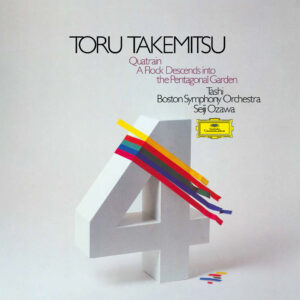
Takemitsu, “Quatrain; A Flock Descends into the Pentagonal Garden” Ozawa, Boston Symphony Orchestra, DG
DG recently reissued remastered versions of several of its Avante Garde releases from the 70s. These seem to have been remastered with similar care as the Original Source series that has been ongoing for several years. Toru Takemitsua, a Japanese composer championed by Seiji Ozawa, is one of the less blazingly edgy (or annoying, from my perspective) of the composers of this group of four. Indeed, some of his music has a sensitive fragility and quietness to it that it can be quite moving, even if not of the same musical “language” that we are used to.
Side 2 of this record (both sides of which are at 45 rpm) is a purely orchestral piece entitled ‘A Flock Descends Into the Pentagonal Garden”. Virtually all the resources of the orchestra are utilized, some in alternative methods of playing. The result is (mostly) a superb audio experience – if occasionally leaning into a slight horror movie soundtrack direction (easily overlooked, really). In the main, the piece is primarily a celebration of the mystery of musical sound. The sound is clean, and airy, if not quite as warm and lush as I would have liked. Which is sometimes the case with DGs.
Side 1 is more impressive. Peter Serkin and several other chamber players joined the orchestra this time, which increased the timbral interest. And, although there is greater activity among the two groups (orchestral and chamber) in the nature of dialogue, overall, this side is quieter than Side 2. The music is often more meditative. Side 1 then was worth the price of the record, and showed off the musicality of the PREi.
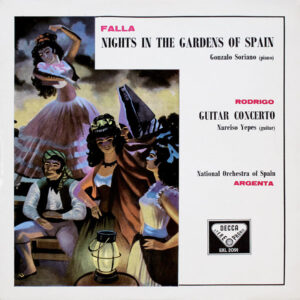
Argenta, Falla, “Nights in the gardens of Spain”, Decca SXL 2091Argenta, Falla, “Nights in the gardens of Spain”, Decca SXL 2091
Out of curiosity, we played this Decca issue of the Falla “Nights in the Gardens of Spain” in a listening session a couple of nights after we had listened to, and commented upon, the London issue of the same recording, which appeared to have been issued at about the same time.
If issued about the same time, they were certainly not pressed from the same masters. The Decca version was, in a word, magic. I rather dislike using a word like “magic” in this context, the same as I dislike pronouncing a Decca-branded pressing as superior to a London-branded pressing. I dislike the latter because it buys into a mythology that seems scientifically unjustifiable, since the Decca and London pressings of the day were all made in London by Decca, and engineers that were involved have argued vociferously that there were no fundamental differences in the masterings or pressings…although the issue remains controversial. My use of the term “magic” or “magical” is because there are some records that have such spectacular musicality – usually a combination of superb, masterful and inspired playing, with superb and masterful engineering, such that when I listen, I am transported to a place from which things like surface noise or hi-fi particulars are entirely forgotten.
This particular copy of this recording of the Falla – a piece that, to be honest, I once considered insipid – is transporting. It co-existed quite happily with the PREi. In fact the piano sounded particularly well-defined in attack, without being in any way aggressive.
Hearing this Decca copy after the disappointment of the London copy previously described mattered to me much more than I expected. In the end, what I’ve looked for in hi-fi gear, is gear that can help me get lost in the music. Now I know that the PREi can be an excellent partner in that process. That matters.
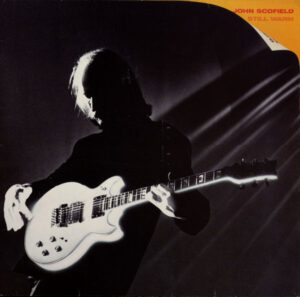
John Scofield, Still Warm, Gramavision 18-8508-1
Several of us happened to listen to this excellent mid-period John Scofield album shortly before I installed the EMM PREi, so it was fun to compare my memories of that listen to a fresh listen, particularly when joined with my listening buddy Earl Weed, who practically has the album memorized.
While, the record sounded great both times, I would have to give a bit of edge to the EMM in detail, air and space over my reference. The depth and location of the components of the drum set were quite remarkable; I guess it can get better than this, but, if so, I haven’t heard it, at least not on my system. I particularly loved the sound of the cymbals. Not a bit of inappropriate edge, but instead a beautiful, rich tonal balance. Likewise, the toms and snare were comfortably in hand during the several solo drum sections. Aggressive and pushy as was likely real – they are percussion after all – but controlled, or in hand, or however one might express it and a really gratifyingly wide sound stage. Great clarity among the instruments – if one wished to focus on the guitar, it was right there, separate but in the same musical world or Don Grolnick’s fine electric piano, even past its various effects.
Altogether a very satisfying experience.
Conclusions
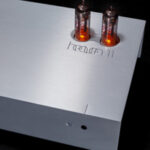
The PREi is a reference quality, all analog, stereo preamplifier incorporating an extremely low noise, switching power supply. The sound is characterized by vanishingly low distortion. The soundstage which it creates is quite large (in my room often wall-to-wall) with excellent depth and holographic imaging. Performers are distinctly positioned within their own air and space, making the acoustic venue easily recognizable on great recordings. Detail resolution is extremely high, as good as, if not better than, my reference which sells for about eight times the price. It is particularly good at retrieving low level detail, such as reverb, decay and ambient clues. The sound is highly dynamic with superb bass – deeper, tighter and more impactful than its predecessor with better control and pitch accuracy.
While delivering unprecedented resolution, subterranean bass and holographic imaging, it also has a unique ability to blend the transparency of the best solid state gear with the tonal warmth, color and emotional palpability that is normally only found in premium valve gear and which can on the right recording be “magical”. The EMM PREi is not colored or euphonic; it is accurate, almost to a fault. It does sometimes tell me a little more than I’d like to know about some of my records, and even more so CDs which, of course, have their own problems more so than LPs, typically, though much less so with SACDs. The PREi is the best solid state preamp I’ve heard, and certainly one of the best preamps of any type that I have heard. I have derived countless hours of musical pleasure and meaning from the music which it can produce. In fact, I purhased the review sample.
Given the price and single box architecture, many audiophiles will assume that the PREi is not competitive with or better than units which are priced in the six digits or consist of multiple chassis. That would in my opinion be a mistake.
Highly recommended.
- ← Previous page
- (Page 3 of 3)