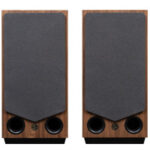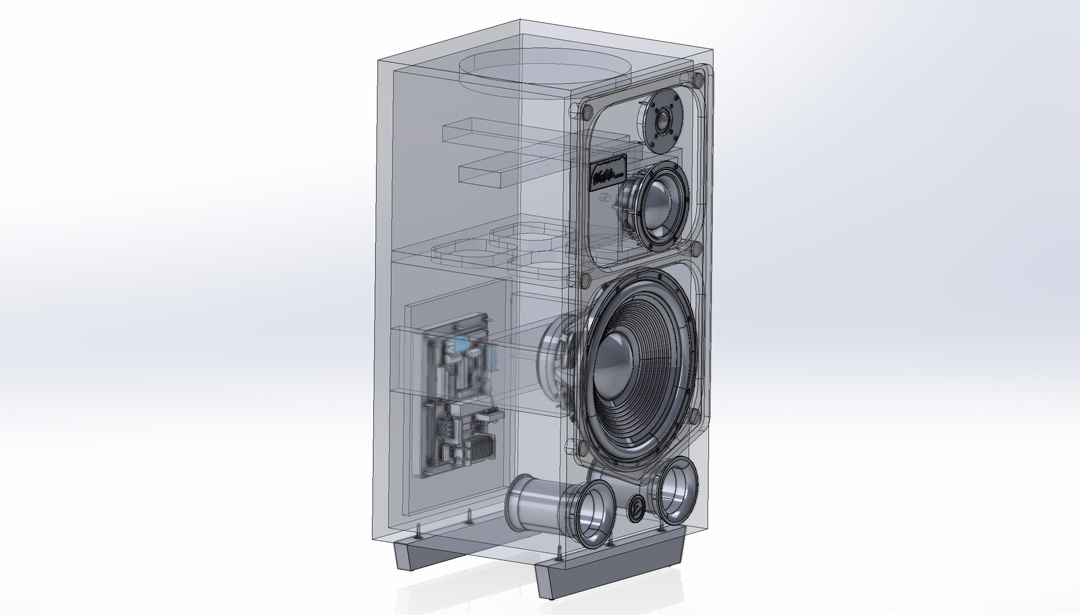
Flying the LB12 in either Portrait or Landscape Orientation is a glorious experience! The speaker is prodigious enough that it can mimic a big floor standing speaker well. In Portrait Orientation the stands lift the midrange and tweeter drivers well above my head, which is fine. That lends itself to creation of a much bigger sound stage and a sense of scale that cannot be achieved by keeping the speakers grounded. In addition, when subwoofers are in use and positioned with their drivers facing forward and near the LB12, their output can be turned up to simulate another, lower built-in subwoofer, as if listening to a enormous floor standing speaker. When the LB12 was on the ground, I had the subwoofers’ output turned down to blend the output of the speakers with the subs. But lofting them created a bit of a gap between the speakers’ woofers and the subs, which was addressed easily by increasing the subs’ output by 4-5dB. Perhaps you are beginning to see why I was so excited to find the LB12!
This system was excellent holistically, but I especially enjoyed its nuances serving pop, rock, and electronic music. Drums stood out as especially well rendered by the LB12, a prime example being Nils Lofgren’s “Bass and Drum Solo”. Wade Matthews, the bass player, gingerly plucks the opening higher notes, then snaps the strings on the lower notes. The drum rolls play across the soundstage, and the impact of each whack of the drum is gratifyingly propelled by the LB12. The quick fingering and kick drums are distinctly rendered without smearing.
I do not seek Country Rock or Outlaw Country music, but occasionally in sample listings a particular piece catches my ear. I use The Steel Woods’ “Straw in the Wind” as a demo piece, as it is cleanly recorded and has a sharpness to the vocals and strings that helps me root out any latent stridency in a system. It also has deep, thunderous bass. I don’t care for a seemingly whiny voice, which is how Wes Bayless’s voice seems as heard through many speakers. But the hyperdome brings a comportment, a refinement to razor sharp voices such that they are far less irritating.
Switching to tubes
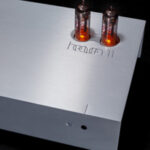
My other set of integrated amps for the Faux Mono configuration are the Heaven 11 Billie Amp Mk2. The Billie Amp Mk2 is a bit more crystalline, a touch more resolving, which allows one to hear a bit further into the soundstage. It does not have as much dynamic impact as the Stellar Strata Mk2, so they bring a different flavor to the LB12.
I enjoy quieter performances and ones with few acoustic instruments when the Billie Amp Mk2 and the LB12 are partnered. Lyle Lovett’s “North Dakota” from the Lyle Lovett Live in Texas entwines the vocals with the quiet guitar work, and both linger in the air. I have not heard better microdynamics from dipole speakers, dynamic, magnetic planar, or electrostatic, in my room. To be fair, I have not used these genres of speakers with the battery powered source components, and I expect them to perhaps supersede the intricacy of the LB12. However, it is a compliment to the Nostala that it can in any system outpace speakers of purported superior driver technology. That does not typically happen with budget speakers.
For the fun of it, I played the Spinners’ “Rubberband Man”, a funky tune that always gets my feet tapping. The LB12 peeled layers of aging, cloaking, smearing from this tune. The band sounded fuller, cleaner, and more like they were having fun when performing it. I was having more fun listening to it than I have for decades!
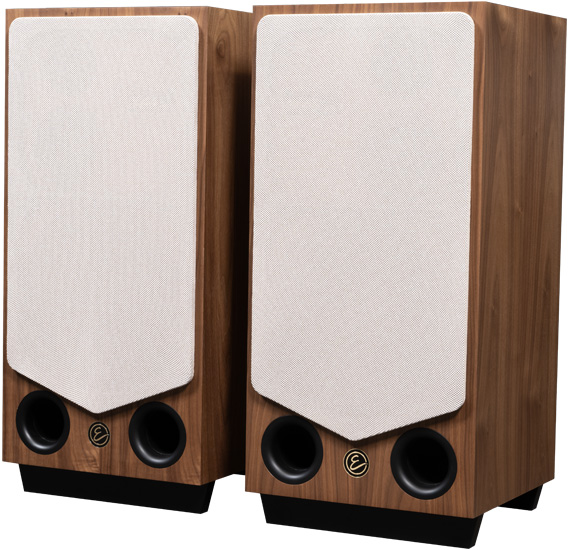
Finally, it was time to turn the speakers for use in Landscape Orientation with the midrange and treble drivers inward, and every positive attribute of the speaker was intensified. The Billie Amp Mk2 has a bit of emphasis on the top and bottom, and the LB12 has a glorious midrange. They complement each other and with the battery powered front end they reveal their strengths. The hyperdome midrange has more capacity to reveal nuance than I recall hearing from any other 3” soft dome midrange. Acoustic guitar recordings done well in a space with reverberation had terrifically extended decay of notes. The zing of the guitar string being plucked was distinct, and like a tightrope walker, the notes erred neither on the side of stridency or dullness.
I listened to several acoustic guitar artists while reviewing, including Michael Hedges, Craig Chaquico, and a lesser-known artist, Darren Naudorfer. I have grown tired of hearing Nils Lofgren’s “Keith, Don’t Go” dozens of times at shows. I suggest Naudorfer’s “Man Without a Clue” as a replacement. The guitar work is not as blazingly fast as Lofgren’s, but the recording is even better. The decay of the strings is exquisite, and the soft dome midrange and tweeter hold none of it back.
Was it nostalgia that had me thrilling to oldies with this setup, or was it the presence of tube amps in the signal path? I played some of my favorite songs of yesteryear, such as America’s “Tin Man”, and Crosby, Stills, and Nash’s “Delta”. Artists that are not pushing the frequency range to the extreme are showcased by the hyperdome midrange, and it brings a pleasing wholeness to the music. With the battery supply making the signal crystal clear, I played these artists at a higher level than usual because there was no sonic penalty for doing so. The speaker never hardened and became piercing but held its composure when driven hard.
I could listen longer at higher levels with the LB12 than with a hybrid horn like the Colibri C2 Loudspeaker. Speaking of higher levels, songs that practically demand to be played louder, such as Rodrigo y Gabriela’s “Orion”, and Gino Vanelli’s “Brother to Brother” did not sound strained. The LB12 can rock without becoming messy. I adjure anyone who is considering a rather expensive smallish monitor (I’m thinking of 12-15” tall speakers with a 5-6” bass driver and 1” tweeter, or similar) with a supposed higher pedigree to not hastily dismiss the LB12. Though perhaps not as blisteringly precise, it is likely to provide a more relaxed, mature, fuller performance.
A bit of conjecture
I have speculated and wondered about some aspects of the Nostala LB12’s performance, more so than in my typical reviews. I am in the early stages of ownership, and I fully expect the already striking performance of the Nostala will improve with time, not through break in but driving the system’s performance forward. In The Audiophile Laws I discuss the phenomenon of break in. I share my principles developed through actual comparison of not only a new versus broken in component, but systems of broken in versus brand new components. I have fairly disproven through comparison of systems any audible benefit from break in. Thus, the impressions and conclusions in this article are the result of building many systems, not building a system and waiting for something to happen.
For those who disagree, consider that my highly favorable impressions are with speakers that have not been intentionally broken in, which in the mind of some would make the favorable outcome all the better. Trust me, you would waste your audio life obsessing about break in and disdaining the benefit of the battery + pure sine wave inverter power supply for your system’s source components.
I close with a word of prediction, which can be dangerous, given the vicissitudes of the industry. The news just came out that the cable maker MIT is closing shop because Bruce Brisson is retiring. At one time I was an ardent MIT fan, but after extensive comparisons of sets of cables, I opted to stick with traditional wires sans built-in electronics. An audio company can be here in America today and gone tomorrow, such as Dynaudio, which is not closing but pulling out of the North American market.
With that caveat, as aforesaid, I think the Nostala LB12 has a good chance of being in short supply for an extended time. I also think that, along with the Eminent Technology LFT-8B, The Nostala LB12 is one of the vanishingly few speakers worthy to challenge Vandersteen and Magnepan’s lower models. Anyone looking for a well-made gorgeous sounding speaker that can handle any genre of music and doesn’t cost a small fortune should have the LB12 on their short list.
Why didn’t I chase the Vandersteen line higher? Likely because of my admiration for the Chapman Audio speakers, followed by Legacy Audio and various hybrid designs. Why didn’t I chase the Magnepan line up to the 3.6 level? I found the Eminent Technology LFT-8 Speakers, followed by the Kingsound King electrostatic speakers, which are still my favorite dipole speakers, and in general I leaned toward ESL over magnetic planar designs. What if Emotiva took its wonder-midrange and put it into a bigger project, like a 5’ tall prodigious floor standing speaker with bass down to 20Hz +/-3dB? In that case, it would not only be a wonderful alternative to these other affordable speakers, but perhaps a legitimate contender to many extravagant tower speaker makers. Ironically, only days after writing those words, Emotiva introduced the Nostala Ft12 Subwoofer which helps in terms of achieving LF but not in conserving floor space, as would a large tower version of the LB12. In this review I have revealed the secrets of how to make this sensational budget speaker perform more like a prodigious tower speaker. That will have to suffice until such time as Emotiva comes out with a monster floor stander, I presume with the hyperdome midrange.
Associated Components:
Battery/Inverter Power Supply for Source Components: LiTime 12V 100Ah LiFeP04 Lithium Battery; Victron Phoenix 12/250 Pure Sine Wave Inverter (2); NOCO Genius 10 Battery Charger
Digital Sources: Bricasti M5 Network Player, PS Audio AirLens, TEAC VRDS-701 Dual Monaural USB/DAC CD Player/Pre-Amp/Headphone Amplifier and TEAC CG-10M-X Master Clock Generator
Streaming Music Service: Tidal premium; Qobuz
Interface: ROON; Audrivana
DAC: PS Audio DirectStream DAC Mk2
Preamp:
Amps: Legacy Audio i.V4 Ultra (2); TEAC AP-505B (2)
Integrated: Heaven 11 Billie Amp Mk2 (two units used in horizontal bi-amp configuration); PS Audio Stellar Strata Mk2 (two units used in horizontal bi-amp configuration)
Speakers: Legacy Audio DSW Clarity Edition; Kings Audio King III electrostatic speakers; Colibri C2 Loudspeaker; Pure Audio Project Trio15 10” Coaxial version; Emotiva Nostala LB12; Wharfedale Opus 2-M2
Subwoofers: Perlisten D212s Subwoofers
IC’s: Iconoclast RCA and XLR Generation 2 with Ultra-Pure Ohno Continuous Cast Copper conductors
Speaker Cables: Iconoclast Series 2 TPC Speaker Cable; Iconoclast Series 2 SPTPC Speaker Cable
Digital Cables: AudioQuest Digital Coaxial Carbon 1.5m; AudioQuest Digital Coaxial Coffee 1.5m; Iconoclast RCA or XLR 2m Interconnect used as digital link; Audioquest
USB: AudioQuest Cinnamon USB 1.5m; Audioquest Coffee USB 1.5m; Clarity Cable Supernatural 1m
Power Cables: Iconoclast BAV Power Cord; Clarity Cable Vortex; Snake River Audio Signature Series
Power Conditioning: Wireworld Matrix Power Cord Extender; Tice Audio Solo
- ← Previous page
- (Page 4 of 4)